Morning anxiety is anxiety that is strongest soon after you wake up: a racing heart, a knot in your stomach, dread about the day, or worry that starts before you are fully awake. It is not a diagnosis, and it often eases by late morning. It usually has ordinary drivers you can work on: short or broken sleep, stress about the day ahead, caffeine or alcohol, and the way your mind reads the normal rise in alertness after waking.
This guide explains why you might wake up anxious, which causes you can check yourself, a simple routine for the first 30 minutes of the day, what to change the night before, and when it is worth talking to a doctor.
Key takeaways
- Cortisol rises every morning in everyone. Research links a bigger rise with stress and with looking ahead to a demanding day, but there is no proof it causes the anxious feeling on its own.
- Sleep matters a lot. One study found that even modest night-to-night losses of sleep predicted more anxiety the next day.
- Caffeine on waking and alcohol the night before can both make mornings worse.
- The most useful habits are simple: get up instead of lying in bed with your thoughts, slow your breathing, eat, move, and give your worries a set time later in the day.
- If morning anxiety comes with night sweats, a racing or irregular heartbeat, or weight loss, ask a doctor to rule out medical causes like thyroid problems.
Why do I wake up with anxiety?
There is rarely a single cause. Most people with morning anxiety have two or three of the following at once.
1. The night before
Joseph Austerman, a psychiatrist at Cleveland Clinic, puts it plainly: morning anxiety is usually related to the night before. Late screens, irregular sleep times, and caffeine too close to bedtime all show up in the morning as a tired, jumpy nervous system.
2. Short or broken sleep
Sleep and anxiety feed each other. A systematic review of nine studies suggested that insomnia is bidirectionally related to anxiety and depression: poor sleep raises the risk of anxiety, and anxiety disturbs sleep. In a series of studies, researchers at UC Berkeley found that even modest night-to-night reductions in sleep predicted higher anxiety the next day. If you often wake at 3 or 4 a.m. and cannot get back to sleep, that early waking is part of the problem, not only a symptom.
3. The cortisol awakening response
The cortisol awakening response is a normal, sharp rise in the hormone cortisol over the first 30 to 45 minutes after waking, according to expert consensus guidelines. It helps you get going. You will read online that this rise "causes" morning anxiety. The research is more careful than that:
- One leading theory is that the size of the rise reflects anticipation of the upcoming day, although the authors say its function is still not fully understood.
- In a study of 219 people, those with chronic work overload and worry showed a stronger rise in cortisol after waking on weekdays.
- In older adults, feelings of loneliness, sadness, threat and lack of control on one day were associated with a higher cortisol rise the next morning.
- A meta-analysis of 147 studies found the rise was positively associated with job stress and general life stress, while noting that earlier findings had been inconsistent.
So cortisol and stress travel together in the morning. Stress about the day seems to shape the cortisol rise, and the extra arousal can feel like anxiety if your mind reads it as danger. Because the rise happens in everyone and varies from day to day, a single cortisol reading is unlikely to explain your mornings. If you want to understand the hormone better, our guide on how to lower cortisol separates what is known from the hype.
4. Caffeine on an empty stomach
The FDA lists anxiety and jitters among the symptoms of too much caffeine and cites 400 milligrams a day as an amount not generally associated with negative effects for most healthy adults. People with panic disorder are especially sensitive: in a 2022 meta-analysis, 53.9% of patients with panic disorder had a panic attack after a high dose of caffeine, compared with 1.7% of healthy people. The doses in those studies were large, roughly five cups of coffee, but if your heart is already racing when you wake up, coffee first thing can make it worse.
5. Alcohol the night before
Many people know "hangxiety." In a University of Exeter study of almost 100 social drinkers, drinking slightly eased anxiety in very shy people that evening, but the next day this was replaced by a significant increase in anxiety.
6. Waking up in panic
Some people wake suddenly in a state of panic, with a pounding heart and fear. Researchers call this nocturnal panic, and it is common among people with panic disorder, with 44% to 71% reporting at least one such attack. If this happens to you often, it is worth talking to a professional, because panic disorder responds well to treatment.
Morning anxiety or something else?
Some physical conditions produce symptoms that feel like anxiety. This table is not a diagnostic tool, only a guide to what to mention to a doctor:
| What you notice | Could also be | What to do |
| Racing or irregular heartbeat, nervousness, trouble sleeping, weight loss | An overactive thyroid, which can cause nervousness, irritability and a rapid or irregular heartbeat | Ask your doctor about a thyroid blood test |
| Shaky, fast or unsteady heartbeat, sweating enough to dampen your sheets at night (especially if you have diabetes) | Low blood glucose | Talk to your doctor or diabetes team |
| Loud snoring, gasping, waking unrefreshed | A sleep disorder such as sleep apnea | Ask about a sleep evaluation |
| Worry most of the day, most days, for months | Generalized anxiety disorder | See the section on getting help below |
| Worse after drinking or several coffees | Alcohol rebound or too much caffeine | Try a two-week change and compare |
What to do when you wake up anxious: the first 30 minutes
The goal is not to make the feeling disappear. It is to stop it from turning into a spiral. For example, you wake at 6:10 with your heart pounding and a list of everything that could go wrong at work. Here is what to do next.
1. Get up
Lying in bed with your eyes closed gives the worry an audience. Sit up, put your feet on the floor, and stand within a minute or two. Many people find this one step is what breaks the loop.
2. Name it, then breathe slowly
Say to yourself: "This is morning anxiety. My body is waking up, and my mind is guessing about the day." Then take a few slow breaths with a longer out-breath than in-breath, for example in for 4, out for 6. Our guide to nervous system regulation explains why a long exhale helps and offers other quick tools.
3. Use a grounding exercise if your thoughts race
If the worry is loud, bring your attention to the room. Name five things you can see, four you can feel, three you can hear. The full method, and 25 alternatives, are in our guide to grounding techniques.
4. Water and food before coffee
Have a glass of water and something to eat, then decide on coffee. If anxiety is a daily problem, try smaller amounts or wait until after breakfast for two weeks and see whether mornings change. This is a self-experiment, not a medical rule, so compare honestly.
5. Move for 10 minutes
A short walk, stretching, or anything that gets your body moving counts. Exercise in general has a moderate effect on anxiety symptoms: an umbrella review covering more than 1,000 trials found a median effect size of -0.42 for anxiety. Those studies did not test morning exercise specifically, but morning is when many people find it easiest to fit in.
6. Park the worries
Write the worries down and schedule them for later. In a small two-week trial with 53 adults who worried a lot, a daily 30-minute worry period reduced worry, anxiety and insomnia more than simply being told not to avoid worry when it came up, although the authors called the results preliminary. If your mind goes back to the list, tell it: "Not now, at 5 p.m." Our guide on how to stop overthinking shows how to set up a worry window.
7. Leave the phone for later
Email, news and messages in the first minutes of the day give your mind fresh material to worry about. Keep the phone out of reach until you are up, have eaten and have moved.
What to change the night before
Because morning anxiety so often starts the evening before, these changes usually matter more than anything you do at 7 a.m.:
- Keep a steady wake time, including weekends, so your body clock knows when morning is.
- Stop caffeine early. Cleveland Clinic suggests avoiding it for at least three hours before bed. Many people do better with a cutoff in the early afternoon.
- Go easy on alcohol, especially on work nights.
- Write tomorrow's to-do list. In a sleep-lab study, young adults who spent five minutes writing a to-do list before bed fell asleep significantly faster than those who wrote about tasks they had already done.
- Prepare the morning. Clothes, bag and breakfast ready means fewer decisions when anxiety is at its peak.
- Dim the screens in the last hour, and avoid stressful content like work email or the news.
If you want a complete evening plan, our Evening Preparation Protocol walks you through it step by step, and our guide to building a morning routine covers both ends of the day.
Anxiety before work and on Sunday nights
If your mornings are worst on workdays and better on weekends, the anticipation of the day is probably a big part of it. That fits the research on cortisol rising more with work overload. Two things help. First, lower the uncertainty: on Sunday or the evening before, look at the week's calendar and decide the first task of the morning, so you wake up to a plan instead of an open question. Second, notice whether the problem is the job itself. If dread is constant, it may be a sign of burnout or a workload that needs a conversation, not only a better morning routine. Our 12 Stress Habits list helps you spot the daily patterns that keep stress high.
A two-week plan
- Days 1 to 3: Keep a short log: bedtime, wake time, caffeine, alcohol, and a 0 to 10 rating of anxiety on waking.
- Days 4 to 7: Fix your wake time and start the first-30-minutes routine: get up, breathe, water and food, move.
- Days 8 to 10: Add the evening changes: caffeine cutoff, to-do list, morning prepared.
- Days 11 to 14: Add a daily worry window and keep the phone away until after breakfast.
- Day 15: Compare your ratings with the first three days. Keep what helped and drop what did not.
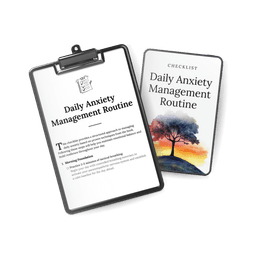
Our free Daily Anxiety Management Routine checklist turns these steps into a daily plan you can tick off.
When to get help
Talk to a doctor or mental health professional if morning anxiety:
- lasts most of the day, not just the first hours;
- makes you avoid work, school or people;
- comes with panic attacks, waking in panic, or a heartbeat that feels irregular;
- goes with worry you find hard to control on most days. The NIMH notes that a generalized anxiety disorder diagnosis requires that a person find it difficult to control worry on most days for at least 6 months, often with trouble falling or staying asleep.
Anxiety disorders are treatable, with talk therapy, medication, or both. If you are high-achieving and anxious beneath the surface, our guide to high-functioning anxiety may sound familiar, and our book The Calm Beyond Anxiety offers a longer, structured approach.
If you are in crisis or thinking about harming yourself, call or text 988 in the US to reach the 988 Suicide and Crisis Lifeline, any time, day or night.
Frequently asked questions
Why do I wake up anxious for no reason?
There usually is a reason, just not an obvious one. Short sleep, stress you have not fully noticed, caffeine or alcohol the day before, and the normal morning rise in alertness can all add up. Keeping a short log for a week or two often makes the pattern visible.
Why is my anxiety worse in the morning and better by the afternoon?
Mornings combine the cortisol rise, the first look at the day's demands, and sometimes the after-effects of poor sleep. Once you are up, busy and fed, your mind has less room to forecast, and the arousal settles.
Is morning anxiety caused by cortisol?
Not on its own. Cortisol rises every morning in everyone. Research links a larger rise with stress and anticipation of the day, so it is better to see cortisol as part of the loop than as the single cause.
Why do I wake up at 3 or 4 a.m. with anxiety?
Early waking often goes with stress, anxiety or low mood, and can follow an evening of drinking. If it happens most nights for several weeks, talk to a doctor, because insomnia is treatable and treating it can help anxiety too.
Can skipping breakfast make morning anxiety worse?
For some people, yes, especially combined with coffee on an empty stomach. Shakiness and a fast heartbeat can also be signs of low blood sugar, so if you have diabetes, talk to your care team.
How long does morning anxiety last?
For many people it eases within an hour or two of getting up. If it lasts most of the day, or for months, it may be part of an anxiety disorder that deserves proper treatment.
Should I take supplements for morning anxiety?
We could not find strong evidence that supplements fix morning anxiety, and some interact with medications. Talk to a doctor or pharmacist before trying any.
How we put this guide together
This guide was written with AI assistance and edited by the AllMyGuides team. None of us is a doctor or therapist, so we relied on published research and on sources such as Cleveland Clinic, the NIMH, the NIDDK and the FDA, and we opened every linked source to check that it says what we report. Where the evidence is limited, such as for the cause of morning anxiety or the cortisol rise, we say so. We also read what people discuss online about waking up anxious to choose the questions. This article is general information, not medical advice. Last reviewed November 2026.