Nervous system regulation is your body's ability to switch on the stress response when you need it and settle back down when the moment has passed. When people say they want to "regulate their nervous system," they usually mean the things they can do to help their body calm down after stress: slower breathing, movement, sleep, relaxing tense muscles. A "dysregulated nervous system" is not a medical diagnosis. It is everyday language for feeling stuck on high alert, or switched off, for longer than the situation calls for.
This guide explains what is actually happening in your body, the signs people describe, what calms you down in minutes and what helps over weeks. It also checks the popular claims (vagus nerve hacks, cold plunges, polyvagal theory) against the research, because some of them hold up and some do not.
Key takeaways
- Your stress response is supposed to switch on. Regulation means it also switches off afterwards, not that you stay calm all the time.
- Slow breathing with a long exhale is the best-supported quick tool. Randomized trials of breathwork show a small to medium drop in stress, with some caution about study quality.
- Over weeks, regular exercise and a mindfulness practice have stronger evidence than any single trick, and losing sleep clearly makes mood and anxiety worse.
- Humming, gargling, ear stimulation gadgets and cold plunges are promoted as vagus nerve or nervous system "resets," but the evidence is weak, short-lived or missing.
- If you feel on edge most days, or have a racing heart, dizziness or fainting, talk to a doctor. Some of these signs have medical causes that breathing exercises will not fix.
What "regulated" and "dysregulated" actually mean
Your autonomic nervous system runs the things you don't control on purpose, like heart rate, breathing and digestion. According to Cleveland Clinic, its sympathetic branch gets your body ready in times of stress or danger. Its parasympathetic branch does the opposite and supports "rest and digest." Harvard Health describes the fight-or-flight response as a survival mechanism, driven by stress hormones such as adrenaline and cortisol.
None of this is a problem in itself. In a June 2026 UC San Diego article on the trend, psychologist Janna Dickenson points out that we need our stress responses to meet the demands of our environment. The problem starts when the alarm keeps ringing after the danger is gone, day after day.
That is what people mean by "dysregulated." It is a descriptive word, not a diagnosis. The medical term for real disorders of the autonomic nervous system is dysautonomia, and Cleveland Clinic lists POTS and orthostatic hypotension among the conditions linked to it. Those need a doctor, not a breathing app.
Signs of a dysregulated nervous system
People describe two broad patterns. Many recognize both, at different times.
| Stuck "on" | Stuck "off" |
| Always on edge, even when nothing is wrong | Numb, flat or disconnected |
| Tight jaw, shoulders or neck | Exhausted but unable to rest |
| Racing thoughts, trouble falling asleep | Foggy, hard to start anything |
| Startling easily, snapping at small things | Withdrawing from people |
Chronic stress shows up in the body too. The American Psychological Association describes how long-term stress can keep muscles tense, which is linked to tension headaches and back pain, and how it affects breathing, the heart and digestion. These signs overlap with anxiety, depression, burnout, thyroid problems and heart conditions, so use the list to notice patterns, not to diagnose yourself. If the "off" column describes most of your weeks, our guide on how to recover from burnout may fit better.
How to calm your nervous system fast
These are tools for the moment, when your heart is pounding or your thoughts are racing. As Dickenson puts it in the UCSD piece, they are coping tools: they help you get through the moment, they don't change your life on their own.
1. Breathe out longer than you breathe in
Slow breathing is the best-studied quick tool. A systematic review of 15 studies found that breathing slower than 10 breaths a minute was linked to higher heart rate variability and to people feeling more relaxed and less anxious. A 2022 meta-analysis of 223 studies found that voluntary slow breathing increases the part of heart rate variability linked to the vagus nerve, during practice and right after.
One popular version is the cyclic sigh: two inhales through the nose (one long, one short top-up), then a long, slow exhale through the mouth. In a 2023 study, 108 people, mostly students, did one of three breathing exercises or mindfulness meditation for five minutes a day for a month. The 30 who did cyclic sighing gained more in positive mood than the meditation group. Both groups felt less anxious, and the difference between them on anxiety was not significant. Try it for two to five minutes.
2. If breathing makes you more anxious, use your muscles instead
Some people find that focusing on the breath speeds their heart up. That is not unusual. In a 2021 trial with 60 students, deep breathing caused a brief rise in body arousal that quickly went back to where it started. Progressive muscle relaxation and guided imagery produced a steady drop. Progressive muscle relaxation is simple: tense one muscle group for five seconds, then let it go, moving from feet to face. Dropping your shoulders and unclenching your jaw is the 10-second version.
3. Cold water on your face
Splashing cold water on your face, or holding a cold pack to it, triggers the diving reflex, which slows the heart. A 2023 meta-analysis found a moderate to large increase in vagal heart rate variability during the cold exposure. But the effect did not last afterwards, and the evidence was of low quality. Cooling only the face also had smaller effects than full-body immersion. Think of it as a circuit breaker for a spike, not a reset.
4. Move for ten minutes
A brisk walk, stairs or a few minutes of shaking out your arms uses up the energy your stress response just prepared. It is also the bridge to the longer-term habits below.
How to regulate your nervous system over weeks
Quick tools help in the moment. What changes how often the alarm goes off is the baseline: how much you move, how you sleep and how often you practice settling down on purpose.
- Practice breathing when you are calm, not only in a crisis. A 2023 meta-analysis of randomized trials found breathwork reduced stress with a small to medium effect, though most studies had a moderate risk of bias. Five minutes a day is enough to start. Want to see the effect? Try heart rate variability biofeedback: you breathe along with a device that shows your heart rhythm. A meta-analysis found its largest effects on anxiety, depression and anger. Each of those rested on only a few studies.
- Move most days. An umbrella review of 97 systematic reviews found physical activity had medium effects on depression, anxiety and distress compared with usual care, with bigger benefits from higher intensity.
- Protect your sleep. A 2024 meta-analysis of 154 studies found that every form of sleep loss reduced positive mood, and anxiety symptoms went up. A tired nervous system is a jumpy one.
- Learn a mindfulness practice. In a meta-analysis of 29 studies in healthy adults, mindfulness-based stress reduction was moderately effective at reducing stress, anxiety and distress, with a large effect on stress.
- Cut the triggers you control. Late-night scrolling, constant notifications and caffeine late in the day keep the alarm primed. Our guides on how to lower cortisol and how to break phone addiction go deeper on both.
Our book The Calm Beyond Anxiety builds these habits into a daily practice, and 12 Stress Habits That Secretly Wreck Your Health helps you spot the small daily patterns that keep stress high.
Vagus nerve exercises: what is real
The vagus nerve carries the "calm down" signal from the brain to the heart. Researchers usually estimate its activity through heart rate variability, the small changes in time between heartbeats. Here is how the popular vagus nerve exercises compare:
- Slow breathing: supported. It reliably raises vagal heart rate variability, as described above.
- Cold water on the face: real, but temporary. The effect showed up during exposure, not afterwards.
- Humming and gargling: we could not find good trials showing that they lower stress or anxiety. Humming does slow your exhale, which may be why some people find it calming.
- Ear stimulation devices: a Bayesian meta-analysis of 16 sham-controlled studies found strong evidence that one session of ear stimulation does not change vagal heart rate variability. A fake device did just as well. That measures a heart marker in healthy people, not how calm you feel, but it is the main thing these devices are meant to change.
Polyvagal theory and the window of tolerance
Much of the language around nervous system regulation (being "in ventral vagal," a "freeze state") comes from polyvagal theory, developed by Stephen Porges. It is popular with therapists because it gives people a simple story for their reactions. Its scientific foundations are disputed. In 2023, psychophysiologist Paul Grossman argued that each of its five basic premises is untenable or highly implausible. In 2026, a group of 39 researchers concluded that the theory is not defensible on current neurophysiological and evolutionary evidence. Porges defended the theory in a 2025 review that addresses earlier critiques. A fair reading: the states are useful metaphors for how you feel, not established physiology.
The "window of tolerance" is a similar idea: the zone of arousal in which you can handle what is happening. It was described by psychiatrist Dan Siegel in his 1999 book The Developing Mind and is widely used in trauma therapy. In our reading of the research, it is a clinical teaching model rather than something that has been measured and tested. It can still be a helpful way to notice when you are drifting out of your zone.
Popular claims that don't hold up
| Claim | What the evidence says |
| "A cold plunge resets your nervous system." | A 2025 meta-analysis of 11 trials found lower stress only at 12 hours after immersion and no change in mood. |
| "Cyclic sighing beats meditation for anxiety." | It improved mood more. On anxiety, the two did not differ significantly. |
| "Humming tones your vagus nerve." | We could not find good trials on stress or anxiety outcomes. |
| "A vagus nerve device will calm you down." | Single sessions did not change vagal heart rate variability, the main marker these devices target, compared with sham devices. |
| "Dysregulated nervous system is a diagnosis." | It is everyday language. Dysautonomia is the medical category. |
A simple daily plan
- Morning (5 minutes): slow breathing with a long exhale before you check your phone. A morning routine that holds makes this automatic.
- During the day: one movement break, and one body check (jaw, shoulders, breath) each time you change tasks.
- When stress spikes: cyclic sighs for two minutes, or muscle relaxation if breathing makes it worse, or cold water on your face.
- Evening: screens down an hour before bed, a regular bedtime. If your mind keeps looping at night, see our guide on how to stop overthinking.
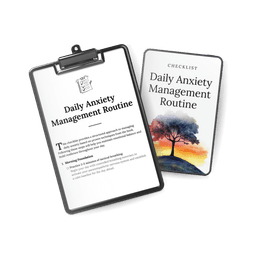
On a bad day, keep one thing: two minutes of long-exhale breathing, or a ten-minute walk. To start this week, add one piece every two days: morning breathing, then the walk, then the evening wind-down. Our free Daily Anxiety Management Routine checklist puts the daily steps on one page. If stress has been building for months, Break Free from the Cortisol Cycle covers the longer-term side.
When to get help
Self-regulation tools are for everyday stress. See a doctor if you have a racing heart at rest, dizziness or fainting when you stand up, chest pain, or symptoms that came on suddenly. See a mental health professional if you feel on edge or numb most days for weeks, if anxiety stops you from working or sleeping, or if you have a history of trauma. Talking therapies such as cognitive behavioral therapy are well-established treatments for anxiety.
If you are in crisis or thinking about harming yourself, in the US you can call or text 988 or chat with the 988 Suicide & Crisis Lifeline, available 24 hours a day. Outside the US, contact your local emergency number.
Nervous system regulation: frequently asked questions
What does a dysregulated nervous system feel like?
People describe feeling on edge, tense and easily startled, or the opposite: numb, foggy and exhausted. These feelings overlap with anxiety, depression, burnout and some medical conditions, so if they last, get them checked.
How do I calm my nervous system fast?
Breathe out longer than you breathe in for two to five minutes. If breath focus makes you more anxious, tense and release your muscles instead, splash cold water on your face, or walk briskly for ten minutes.
How long does it take to regulate your nervous system?
A quick tool can take the edge off in minutes. Changing your baseline takes weeks of regular practice. Many of the trials cited here, such as the cyclic sighing study, ran for about a month.
Why do breathing exercises make my anxiety worse?
Paying close attention to your breath can make you notice your heartbeat, and deep breaths can briefly raise arousal before relaxation follows. Keep breaths gentle rather than deep, or switch to muscle relaxation or movement.
Do vagus nerve stimulator devices work?
For everyday stress, the evidence is not there. A meta-analysis of sham-controlled studies found single sessions did not change vagal heart rate variability. Medical vagus nerve stimulation for epilepsy or depression is a different treatment, done by doctors.
Is polyvagal theory scientifically valid?
Its core physiological claims are disputed by many researchers, including a 2026 evaluation by 39 experts. Many therapists still use its language as a helpful way to talk about feelings.
Is nervous system regulation just a TikTok trend?
The word is trendy, and a lot of products ride on it. The underlying idea, that you can help your stress response settle with breathing, movement and sleep, is well supported. Be skeptical of anything that promises a quick "reset."
How we put this guide together
This guide was written with AI assistance and edited by the AllMyGuides team. None of us is a doctor or therapist. We built it from medical sources (Cleveland Clinic, Harvard Health, the APA) and peer-reviewed meta-analyses and trials, opened each linked source to check that it says what we report, and noted where evidence is weak or disputed. We also read recent discussions about the trend to understand what people are asking. Reviewed in November 2026. This article is general information, not medical advice. If you are worried about your symptoms, talk to a doctor or a licensed mental health professional.