
Overthinking is thinking about the same problem again and again without getting closer to an answer or an action. Psychologists split it into two main forms: rumination, which loops over the past ("why did I say that?"), and worry, which loops over the future ("what if it goes wrong?"). To stop overthinking, you do not try to stop thoughts. You notice the loop, turn it into one concrete next step or a planned pause, and give worry a set time and place.
This guide explains why overthinking happens, what research says works, what tends to backfire, and a simple system you can use at night, after a conversation, or when you are stuck on a decision.
Key takeaways
- Overthinking is repetitive thinking that does not lead anywhere. It is different from planning or problem solving, which end in a decision or an action.
- Trying to push thoughts away often makes them come back more. Planned distraction and concrete next steps work better.
- A fixed daily "worry window" reduced worry, anxiety and insomnia in a small randomized trial.
- At night, writing a short to-do list for tomorrow helped people fall asleep faster in a sleep lab study.
- If overthinking affects your sleep, work or mood most days, therapies that target repetitive thinking have good evidence. Talk to a professional.
What is overthinking?
Overthinking is not a diagnosis. It is an everyday word for what psychologists call repetitive negative thinking. Two forms matter most:
- Rumination. The APA Dictionary of Psychology describes it as "excessive, repetitive thoughts or themes that interfere with other forms of mental activity." It usually looks backward: replaying a conversation, a mistake, a decision you already made.
- Worry. The same dictionary defines worry as mental distress "due to concern about an impending or anticipated event, threat, or danger." It looks forward: the meeting, the test results, the money.
Not all repetitive thinking is bad. A 2008 review in Psychological Bulletin found that repetitive thought "can have constructive or unconstructive consequences," and that one thing that decides which is whether the thinking is abstract or concrete. "Why does this always happen to me?" is abstract and tends to keep you stuck. "What is the first thing I can do tomorrow at 9?" is concrete and tends to move you forward.
Overthinking or problem solving? A quick test
Ask yourself two questions:
- Is there something I can do about this in the next 24 hours?
- Have I learned anything new in the last 10 minutes of thinking?
If the answer to both is no, you are probably overthinking, not solving. That is your cue to switch to one of the tools below.
Why overthinking matters
Overthinking is more than annoying. A review in Perspectives on Psychological Science notes that rumination is associated not only with depression but also with "anxiety, binge eating, binge drinking, and self-harm." In a 30-day diary study of 79 people published in the Journal of Abnormal Psychology, the more people ruminated during a low mood, the longer that low mood lasted. That study shows a link, not proof of cause, but it matches what many people notice: the loop makes the feeling last.
Overthinking also shows up in bed. The NHS lists difficulty sleeping among the symptoms of generalised anxiety disorder, a condition built around worry that is hard to control.
What does not help: trying to stop the thoughts
"Just stop thinking about it" is the most common advice and the least useful. In the classic "white bear" experiments published in the Journal of Personality and Social Psychology in 1987, people who were told not to think of a white bear later thought about it more than people who had been asked to think about it from the start. The authors concluded that trying to suppress a thought may even produce "the very obsession or preoccupation that it is directed against." A 2020 meta-analysis of 31 studies using the same method confirmed that this rebound effect appears.
The same 1987 study had a useful second finding: people who were given a specific thought to use as a distracter were less likely to be preoccupied later. So the goal is not an empty mind. It is having somewhere else to put your attention.
Other habits that tend to feed the loop:
- Asking for reassurance again and again. It calms you for a moment, then the doubt returns.
- Reading more and more advice without trying any of it.
- Criticizing yourself for overthinking, which gives your mind one more thing to loop on.
How to stop overthinking: a five-step system
Lists of "12 tips" are hard to use when your mind is racing. This system has five steps. Each one works on its own, and together they cover the moment, the night and the long run.
Step 1: Name the loop
When you notice the same thought for the third time, say or write: "I'm ruminating" or "I'm worrying." Then add what it is about in a few words: "the meeting", "what she meant". Naming it moves you from being inside the thought to looking at it.
Step 2: Make it concrete
Turn the abstract question into a specific one. Instead of "Why am I so bad at this?", ask "What exactly happened, and what is one thing I could do differently next time?" In a randomized trial in Psychological Medicine, 121 adults with major depression in primary care were split into three groups. One group practiced exercises designed to switch them "from an unhelpful abstract thinking habit to a helpful concrete thinking habit." Added to usual care, this training reduced rumination and depressive symptoms. It was not better than relaxation training for depressive symptoms, but it was better for rumination.
If you find a next step, write it down with a time. If there is no next step, move to Step 3.
Step 3: Park it with a planned distraction
Choose your distracter in advance, so you do not have to think of one in the moment. Good options take some focus: a short walk outside, a puzzle, cooking, calling a friend about something else, a song you sing along to. A review of the research notes that "dozens of experimental studies show positive distractions relieve depressed mood," although studies that track people's everyday habits show weaker results. Distraction is a way to step out of the loop, not a way to avoid a problem forever.
Step 4: Give worry a time and a place
This is often called worry postponement or stimulus control. Thomas Borkovec and colleagues tested it as a treatment for worry in an early study from 1983. Here is how it works:
- Pick a daily worry window: the same 15 to 30 minutes, in the same place, not in bed and not right before sleep.
- During the day, when a worry comes up, write a few words on a note and tell yourself: "Later, in my window."
- In the window, go through the list. For each worry, write one concrete action or "nothing to do for now".
- When the time is up, stop, even if the list is not finished.
In a small randomized trial in Behavior Modification, 53 adults who worried a lot were assigned either to a 30-minute daily worry period for two weeks or to a comparison group told simply not to avoid their worries. The worry period group had larger reductions in worry, anxiety, negative mood and insomnia, though not in depression. The authors call the results preliminary, and we found no larger review of this technique, so treat it as promising rather than proven.
Step 5: Close the day on paper
Many people overthink most in bed, when there is nothing else to do. A five-minute writing habit before sleep can help. In a sleep lab study in the Journal of Experimental Psychology: General, 57 healthy young adults wrote either a to-do list for the next days or a list of tasks they had already finished. Those who wrote the to-do list "fell asleep significantly faster." It was a small study of people aged 18 to 30, but the habit takes five minutes and costs nothing.
Write tomorrow's tasks, add the next step for any worry that is still open, close the notebook, and leave it outside the bed.
Overthinking in three common situations
How to stop overthinking at night
- Do your worry window earlier in the evening, never in bed.
- Write the to-do list from Step 5 before you lie down.
- Turn the clock away. Checking the time feeds a second worry about not sleeping.
- If you are still awake and spiraling after a while, get up, do something quiet in dim light, and go back when you feel sleepy.
A steady daily rhythm makes this easier to repeat. Our guide to building a morning routine that actually holds pairs well with a calm evening.
How to stop replaying conversations
- Ask the Step 2 question: is there something concrete to fix? If yes, it is usually one short message, sent the next day, not at midnight.
- If no, name the loop ("replaying the meeting") and use your planned distraction.
- If you replay messages and feel a sharp sting of rejection, our guide to rejection sensitive dysphoria may help.
How to stop overthinking in a relationship
- Notice when you are reading tone into short messages. Write down what the message actually says, then two neutral explanations.
- Ask one clear question instead of guessing: "Is everything OK, or just a busy day?"
- Avoid asking for the same reassurance many times. Agree with your partner on how you will check in when something feels off.
How to stop overthinking decisions
- Set a deadline for the decision and put it in your calendar.
- Cut the options to two or three. More information rarely helps after a certain point.
- Ask: "Which choice could I live with if it goes wrong?" Most decisions can be adjusted later.
If a big task feels so heavy that thinking replaces doing, our guide on how to stop procrastinating shows how to break it into a first small step.
A plan for hard days
Some days the loop is louder than any system. On those days, do the minimum:
- Write one line: "Today I'm worrying about..."
- Do one thing that uses your body: a walk, a shower, stretching.
- Postpone every decision that can wait until tomorrow.
Overthinking is often worse when you are stressed or tired. Our guide on how to lower cortisol covers the basics of stress and recovery.
Start this week
- Day 1: Pick your worry window and your planned distracter. Write them down.
- Day 2: Start using the "Later, in my window" note during the day.
- Day 3: Add the five-minute to-do list before bed.
- Day 4 to 6: Each time you notice a loop, name it and ask the Step 2 question.
- Day 7: Look back. Which step helped most? Keep that one, even if you drop the rest.
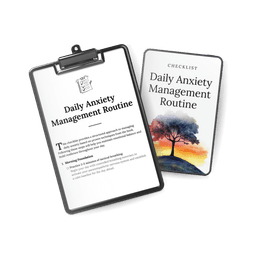
Our free Daily Anxiety Management Routine checklist gives you short daily steps to calm your mind, and it fits well around a worry window. For a deeper look at anxious thinking, our Think Clearly with the ABCD Method guide walks you through spotting and challenging unhelpful thought patterns. The Calm Beyond Anxiety covers calming tools, boundaries and routines, and 12 Stress Habits That Secretly Wreck Your Health helps you spot the daily habits that keep stress high.
When to get professional help
Talk to a doctor or mental health professional if overthinking is hard to control, affects your sleep, work or relationships most days, or comes with low mood. The NIMH suggests talking to a health care provider, such as a primary care doctor, psychiatrist, psychologist or clinical social worker, if you think you have symptoms of generalized anxiety disorder.
Therapy can help with repetitive thinking:
- A 2018 meta-analysis of 36 randomized trials found that treatments for depression reduced repetitive negative thinking, with a medium-sized effect overall. Rumination-focused cognitive behavioral therapy showed the largest effect.
- For anxiety, a 2020 meta-analysis of 46 trials found that therapies designed to target repetitive thinking and other therapies had similar effects on it. In other words, several kinds of therapy can help.
- Mindfulness-based cognitive therapy produced a moderate reduction in rumination compared with usual care in a 2017 meta-analysis of people with depression. It did not differ from other active treatments in the three studies that compared them.
Frequently asked questions
Why do I overthink everything?
There is rarely one cause. Stress, tiredness, anxiety, low mood and big uncertain decisions all make looping thoughts more likely. Some people also believe that worrying keeps them prepared, which makes it harder to let go.
Is overthinking a mental illness?
No. Overthinking is not a diagnosis. But rumination and worry are linked to depression and anxiety disorders, so if it is constant and distressing, it is worth talking to a professional.
What is the difference between overthinking and anxiety?
Overthinking is a thinking pattern. Anxiety is a wider state of fear or unease that can include physical symptoms such as a racing heart or tension. Worry that is hard to control is the main symptom of generalized anxiety disorder.
Why is overthinking worse at night?
In bed there are no tasks or conversations to hold your attention, so unfinished thoughts come back. A worry window earlier in the evening and a short to-do list before sleep give those thoughts a place to go.
Does journaling help with overthinking?
It depends on how you write. Open-ended venting can turn into rumination on paper. Structured writing, such as a to-do list or one concrete next step per worry, is more likely to help.
Can overthinking be a sign of ADHD or OCD?
Racing thoughts are common in ADHD, and repetitive, intrusive thoughts are part of OCD. Only a professional can tell what is behind your overthinking. If the thoughts feel impossible to resist or come with urges to check or repeat things, mention that when you seek help.
How long does it take to stop overthinking?
There is no fixed timeline. In the worry window trial, people practiced for two weeks. Expect the loops to get shorter and less frequent over a few weeks of practice, not to vanish.
How we put this guide together
This guide was written with AI assistance and edited by the AllMyGuides team. None of us is a doctor or therapist. We used public health sources (NHS, NIMH, the APA Dictionary of Psychology, the 988 Lifeline) and peer-reviewed research. We opened every linked source to check that it says what we say it says. Where the evidence is small or limited to specific groups, we have said so. Last checked in November 2026.
This article is for general information and is not medical advice. If overthinking is affecting your sleep, work or relationships, please speak with a qualified healthcare professional. If you are in crisis or thinking about harming yourself, call or text 988 in the US to reach the 988 Suicide & Crisis Lifeline, available 24/7, or contact your local emergency number.