Procrastination is putting off something you intend to do, even though you expect the delay to make things worse. It is rarely about laziness. Most of the time the task feels unpleasant, too big or too unclear, and delaying it gives quick relief. So the short answer to "how do I stop procrastinating?" is: make the first step small and specific enough that starting feels easy, decide when you'll do it, and forgive yourself when you slip. When everything feels too big, that means breaking things down and choosing what not to do first.
Key takeaways
- It's a mood problem more than a time problem. Researchers describe procrastination as largely about short-term mood repair: avoiding the task makes you feel better now.
- Unpleasant tasks get delayed most. A large meta-analysis found task aversiveness was one of the strongest and most consistent predictors of procrastination.
- Shrink the first step to minutes. "Write the report" invites delay. "Open the file and write three bullet points" doesn't.
- Decide when, where and what. Specific "if-then" plans help people follow through, and writing a plan for an unfinished goal can quiet the mental noise around it.
- Forgive the last slip. In a study of students, those who forgave themselves for procrastinating before one exam were less likely to procrastinate before the next.
Why you procrastinate (and why it isn't laziness)
Psychologists Fuschia Sirois and Timothy Pychyl argue that procrastination has a great deal to do with short-term mood repair and emotion regulation. The task brings up something unpleasant (boredom, confusion, fear of doing it badly), and switching to something else makes the feeling go away. For a while.
A large meta-analysis by Piers Steel found that strong and consistent predictors included task aversiveness (how unpleasant the task feels), task delay (how far away the reward or deadline is), low self-efficacy (doubting you can do it), impulsiveness and low conscientiousness. A 2007 University of Calgary release about the study put the share of chronic procrastinators in the general population at about 15 to 20%. Much of the research was done with university students, so treat the numbers as directions rather than exact measurements for every adult.
The relief doesn't last. In a classic study of students across a semester, procrastinators reported lower stress and less illness early in the term, but higher stress and more illness late in the term, and they received lower grades on all assignments. A later study of 3,525 Swedish university students found that procrastination was associated with higher symptoms of depression, anxiety and stress nine months later, as well as poorer sleep and loneliness. That is an association, not proof that procrastination causes them, but it shows why the pattern is worth breaking.
Each driver points to a different fix:
| What's going on | How it feels | What helps |
| The task is unpleasant | "I really don't want to do this" | Shrink the first step, pair it with something pleasant, time-box it |
| The task is too big or unclear | "I don't know where to start" | Break it down until the next action takes a few minutes |
| The deadline is far away | "There's still time" | Set intermediate checkpoints, ideally with someone else |
| You doubt you can do it well | "It won't be good enough" | Aim for a rough first version, get feedback early |
| There's too much at once | "Everything is urgent" | Write it all down, triage, choose three |
Step 1: Notice the feeling and name it
The moment you reach for your phone instead of the task is the moment to pause for ten seconds and ask: what does this task make me feel? Bored, lost, anxious, tired? Naming it doesn't make it disappear, but it turns "I'm lazy" into a specific problem with a specific fix (see the table above).
If you want to spot your own pattern, keep a short procrastination log for a few days: what you avoided, what you did instead, and how the task felt. You may find you avoid the same kind of task every time, such as phone calls, writing, or anything with numbers.
Step 2: Break the big thing down
When a project feels overwhelming, the problem is usually that the next step isn't visible. "Plan the wedding", "write the thesis" or "sort out my finances" aren't tasks; they're piles of tasks. Break them down in three layers:
- The goal, in one sentence. What does "done" look like? For example: "Thesis chapter 2 drafted and sent to my supervisor."
- Three to six milestones. The big chunks: "sources collected", "outline", "first rough draft", "revised draft".
- The next action. Only for the first milestone, write the very next physical action, small enough to finish in about five minutes: "open the folder and list the 10 papers I already have".
You don't need to plan every step from the start. You only need the next one to be obvious. When it's done, write the next one.
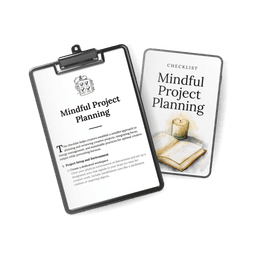
Our free Mindful Project Planning checklist walks you through planning a project in a calm, step-by-step way. For bigger projects, Break Down Overwhelming Projects teaches the full method: a clear goal, milestones, focus areas and five-minute micro-tasks.
Step 3: When there's too much to do
Sometimes the problem isn't one big task but twenty small ones. Everything feels urgent, so nothing gets done.
- Write everything down. Every task, every "I should", in one list. Getting it out of your head can make it feel less noisy.
- Mark what is truly important. What has real consequences, for you or others, if it doesn't happen this week?
- Watch the urgency trap. In a series of experiments, researchers found a "mere urgency effect": people tend to pursue urgency over importance, choosing tasks that feel urgent even when another task pays off more. Quick emails and small requests feel urgent; the important project rarely does.
- Choose three for today. One important task and two smaller ones. Everything else waits, gets delegated or gets dropped.
If the list keeps growing because your days disappear, Reclaim 15 Hours of Your Time Each Week shows how to track where your time goes and cut low-value tasks. If the problem is bigger than this week's list, Prioritize Your Life helps you set priorities that match what matters to you.
Step 4: Decide when and where
"I'll do it this week" is a wish. "On Tuesday at 9:00, at my desk, I'll write the first three bullet points" is a plan. Psychologists call this an implementation intention, often phrased as "if (situation), then I will (action)".
In one experiment with 152 students, those who formed a when-and-where plan for showing up to a session had nearly 8 times higher odds of keeping the appointment. It's a single study with a simple task, and the plan helped everyone rather than procrastinators in particular, but it's an easy habit to try.
Planning also helps your head. In lab experiments by Masicampo and Baumeister, unfinished goals caused intrusive thoughts during an unrelated reading task, and letting participants make specific plans for those goals eliminated the interference. If an unfinished task keeps nagging you, write down exactly when you'll do it. You'll think about it less in the meantime.
When you plan, add buffer time. Research on the planning fallacy found that people's predictions of their completion times were too optimistic for a variety of academic and everyday tasks. In one of those studies, the bias disappeared when people were asked to connect the prediction with past experience. Before you estimate, ask: how long did something like this actually take me last time?
Far-away deadlines are another trap. If the deadline is in two months, set your own checkpoints (for example: outline by the 10th, draft by the 25th), and tell someone about them. A checkpoint someone else knows about is harder to ignore.
Step 5: Start small and time-box it
Starting is the hardest part. Make it smaller than feels necessary:
- The five-minute start. Promise yourself only five minutes. If you want to stop after five minutes, you can. Often you won't.
- A time box. Set a timer for 25 minutes, work only on that task, then take a short break. A fixed end can make the task feel less threatening.
- A rough first version. Aim for 70% good, not perfect. A bad first draft is easy to improve; an empty page isn't.
- Company. Working next to someone (in person or on a video call), sometimes called body doubling, helps many people start. The evidence is mostly anecdotal, but it costs nothing to try.
When you also struggle to stay on the task once you've started, our guide on how to stay focused helps you find and remove what's pulling your attention away.
Step 6: Forgive yourself and restart
It sounds soft, but it's practical. In a study at Carleton University, first-year students who forgave themselves for procrastinating before their first midterms procrastinated less before the next ones, and also felt less negative in between. It is one study with students, but the logic fits the mood-repair idea: if thinking about the task makes you feel guilty, you'll avoid it even more.
So when you lose a day (you will), skip the self-criticism. Note what got in the way, write the next small step, and pick a time for it. Restarting quickly matters more than never slipping.
When it might be more than procrastination
If procrastination is severe, lasts for years and affects your studies, work or relationships, structured help works. A meta-analysis of 24 intervention studies suggested that cognitive behavioral therapy reduced procrastination more strongly than other types of intervention, and a trial with 92 students with severe procrastination found large improvements with both internet-based and group CBT, though there was no untreated comparison group.
Procrastination is also linked to ADHD, depression and anxiety. If you recognize yourself in that, talking to a doctor or psychologist is a better next step than another productivity trick. If you already know you have ADHD, our guide on how to be productive with ADHD covers systems built for that.
Your first week
| Day | What to do |
| Day 1 | Write everything you've been putting off on one list. Mark the one that matters most. |
| Day 2 | Break that task into a goal, milestones and one five-minute next action. |
| Day 3 | Write an if-then plan for the next action: when, where, what. Do the five-minute start. |
| Day 4 | Do one 25-minute time box on the same task. Note how it felt. |
| Day 5 | Triage the rest of the list: three tasks for today, the rest waits or goes. |
| Day 6 | If you slipped, forgive it, write the next step and schedule it. |
| Day 7 | Review: which step helped most? Keep it for next week. |
If you'd like a complete book on the subject, Conquer Procrastination covers goal setting, time management, focus and the habits that keep procrastination from coming back.
Frequently asked questions
Why do I procrastinate even when I want to do the task?
Because wanting the result is different from wanting the work. If the work feels unpleasant, unclear or risky, avoiding it brings quick relief. Making the first step smaller and clearer reduces that unpleasant feeling.
Is procrastination a sign of laziness?
Usually not. Lazy means not wanting to do anything; procrastinators often stay busy with other things and feel bad about the delay. Research links procrastination mainly to how unpleasant the task feels, doubt about your ability, distant deadlines and impulsiveness.
How do I stop procrastinating when I'm overwhelmed?
Write everything down, pick the one task that matters most, and break it down until the next step takes about five minutes. Then decide when you'll do it. Ignore the rest of the list until that step is done.
Do deadlines help?
Distant deadlines make delay easy. Breaking a long deadline into closer checkpoints, especially ones someone else knows about, gives you more chances to start.
What is the 2-minute or 5-minute rule?
It's the idea of making the first step so short that it's hard to refuse: just open the file, just write one sentence, just work for five minutes. The idea is that starting is often the hardest part, not that five minutes is enough.
Can procrastination be a sign of ADHD or depression?
It can be part of them, but procrastination alone isn't a diagnosis. If it's severe, long-lasting and comes with other symptoms, talk to a doctor or psychologist.
How we put this guide together
This guide was written with AI assistance and edited by the AllMyGuides team. None of us is a doctor or psychologist. We started from the questions people ask about procrastination and feeling overwhelmed. Then we checked each claim against peer-reviewed studies and meta-analyses, opening every source linked above and confirming that it says what we report (for some studies only the abstract or a summary was publicly available). Much of the research was done with university students, so we describe effects with that limit in mind. Last checked: November 2026. This is not medical advice: if procrastination comes with persistent low mood, anxiety or other problems, please talk to a doctor or a qualified professional.