Staying focused means keeping your attention on one chosen task long enough to make real progress, and bringing it back quickly when it drifts. Most advice jumps straight to tips: turn off notifications, try Pomodoro, drink water. The problem is that you don't know which of those fixes your problem. So the short answer to "how do I stay focused?" is: first find the two or three things that are actually stealing your attention, then remove them in that order. This guide shows you how to do both.
Key takeaways
- Diagnose before you fix. A few days of logging what pulls you away shows which focus killers matter for you. Generic tips often target the wrong one.
- Many distractions come from inside. In a field study of office workers, self-interruptions were almost as frequent as interruptions from other people and devices.
- Distraction is often mood repair. When a task feels unpleasant, the phone offers quick relief. Making the task smaller often works better than more willpower.
- Batch, don't ban. In a field experiment, people who received phone notifications in three batches a day felt more attentive and productive.
- Your attention span is not broken. The famous "goldfish" statistic has no scientific source. A wandering mind is normal, and focus can be rebuilt with better conditions.
Is your attention span really shrinking?
You have probably read that humans now have a shorter attention span than a goldfish: eight seconds. That figure went around the world in 2015, but a BBC investigation found that it did not actually come from Microsoft's research, the report that made it famous, and could not be traced to any study. The Wall Street Journal reached the same conclusion: claims that attention spans have dwindled to a few seconds are not corroborated by science. Researchers point out that attention depends on the task, not on a fixed number of seconds.
What is real is that minds wander, a lot. In a large Harvard study that pinged about 2,250 adults on their phones at random moments, people's minds were wandering in 46.9% of the sampled moments, and they were less happy when their minds wandered. The participants were volunteers using an app, not a representative sample, but the message is useful: drifting attention is the normal state of a human mind, not a personal failure. The goal is not to stop it, but to notice it sooner and make it less likely.
The three kinds of focus killers
Almost everything that breaks your focus falls into one of three groups. Knowing which group dominates for you tells you where to start.
| Type | Examples | Typical sign |
| External | Notifications, messages, email, colleagues, family, noise, an open-plan office | Something outside you starts the switch |
| Internal | Sudden thoughts, worries, "I'll just check…", boredom, avoiding an unpleasant task | You switch without anything happening around you |
| Body | Poor sleep, hunger, long stretches without a break, low energy at certain hours | Focus is hard all day, or at the same time every day |
The internal group is bigger than most people think. In a study by Dabbish, Mark and González, researchers observed 36 people at three tech companies for three workdays each. Self-interruptions accounted for 18% of all task switches and external interruptions for 22%: about one self-interruption an hour against 1.3 from outside. People in open-plan seating interrupted themselves more, and so did people who had just been interrupted more by others. It is a small, older field study, but it matches what many people notice once they start paying attention: you often pick up the phone before it buzzes.
Why do we do it? Psychologists Fuschia Sirois and Timothy Pychyl argue that procrastination has a great deal to do with short-term mood repair: when a task feels boring, confusing or threatening, switching to something easier makes us feel better right now. A lot of "I can't focus" is really "this task feels bad and the phone feels good". That changes the fix: you need to make the task feel less bad, not just hide the phone.
The 3-day attention audit
This is the diagnosis. It takes a few minutes a day for three normal working or study days.
- Keep a log next to you. A sheet of paper with four columns: time, what pulled you away, type (external, internal or body), and roughly how long until you were back.
- Write a line every time you notice you've drifted. Don't judge it, just record it. For example: "10:40, checked news after a hard paragraph, internal, 12 min" or "14:15, chat message from team, external, 5 min".
- Add a quick energy score (1 to 5) three times a day: mid-morning, after lunch, late afternoon.
- Check your phone's own data. Screen Time (iPhone) or Digital Wellbeing (Android) shows pickups and notifications per day. It's a useful reality check next to your log.
On the evening of day three, count the lines by type and look for the patterns:
- Which type has the most lines, and which costs the most minutes?
- Is there a time of day when the log fills up?
- Which single source appears most often (one app, one person, one kind of task)?
Pick the top one or two killers and work on those only. Fixing ten things at once rarely lasts. Writing results down helps: a meta-analysis of 138 studies found that monitoring progress toward a goal helped people reach it (d = 0.40), and more so when the progress was physically recorded. Almost all of those studies were about health goals like exercise and diet, but the principle carries over.
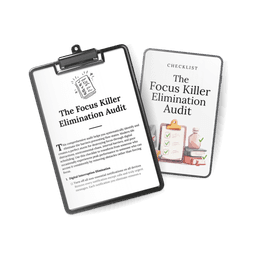
Our free Focus Killer Elimination Audit is a checklist that walks you through spotting the most common focus killers. If you'd like the full three-day method with tracking pages and reflection prompts, The 3-Day Attention Audit guides you through it step by step.
How to fix external focus killers
Batch your notifications. In a randomized field experiment with 237 people, those whose phone notifications were delivered in three batches a day felt more attentive, more productive and in a better mood than those who got them as usual. Most phones can do something similar: Scheduled Summary on iPhone, or Focus and Do Not Disturb schedules on Android. Keep real-time alerts only for calls and the few people who truly need to reach you.
Understand why silence matters. In a lab experiment, notifications disrupted performance on an attention task even when participants did not touch their phones. And when 221 adults spent one week with phone alerts on and one week with them off, they reported higher levels of inattention and hyperactivity during the alerts-on week. These are single studies with self-reported or lab measures, so treat them as early evidence rather than proof. They point the same way: fewer pings, steadier attention.
Check email at set times. When 124 adults limited email to about three checks a day for a week, they experienced lower daily stress than in a week of unlimited checking. Productivity didn't change, and the authors call the result exploratory, but less stress for no loss is a good trade. Try three or four fixed slots: for example, 9:00, 12:30 and 16:30.
Make the phone hard to reach. Many people who cut their phone use find that friction works better than willpower. Put it in another room or a drawer during focused work, log out of the apps you open on reflex, or switch the screen to grayscale. You don't need to resist what isn't there.
Deal with people and noise. Agree on visible signals (headphones on, a status in your chat app, a closed door) and offer a time when you'll be available. For reading and learning, quiet matters: a meta-analysis of 65 studies found that background noise, speech and music all have a small but reliably negative effect on reading. Intelligible speech and music with lyrics were the most disruptive.
Don't run five things at once. A well-known Stanford study found that heavy media multitaskers were more easily distracted by irrelevant information. Later research is mixed: a review in the same journal notes that many studies find no difference. We can't say multitasking "damages" attention, but one window, one task, is a simple rule that removes a lot of temptations.
How to fix internal focus killers
Park the thought, don't follow it. Keep a "later" list next to you. When a thought pops up ("reply to Ana", "check flights"), write three words and go back. The thought is safe on paper, so your mind doesn't need to keep repeating it.
Shrink the task when you notice avoidance. If your log shows you drift right after hitting a hard part, the task is too big or too vague. Turn "write the report" into "write the first three bullet points of the summary". Starting is the uncomfortable moment; a smaller first step makes it bearable.
Name what the task is missing. Many people notice they can focus on games or videos for hours but not on study or work. That isn't proof of a broken attention span; those activities give constant novelty and feedback. You can borrow a little of that: set a short timer, tick off visible steps, check your answers as you go.
Notice, then return. Mind wandering is normal. The skill is noticing sooner and coming back without a fight. Each return is practice.
The short reads 7 Attention Traps That Quietly Kill Progress and 13 Invisible Focus Killers Blocking Your Flow States describe the most common hidden habits in this group, with examples you'll probably recognize. 21 Attention Traps Holding You Back from Deep Work covers the wider list, with fixes that don't need new apps.
How to fix body focus killers
Sleep comes first. A meta-analysis of 147 tests found that after short-term total sleep loss (a night or more without sleep), simple attention was among the most affected abilities, with lapses showing a large effect. Those studies looked at up to 48 hours without sleep, not one short night, but if your log shows focus collapsing everywhere, look at sleep before any productivity trick.
Use your energy map. Your energy scores from the audit show when you focus best. Put the hardest task in that window and move email, admin and calls to the low hours.
Take real breaks. A short walk, water, a window. Not your inbox, which is just another kind of work.
If tiredness, low mood or trouble concentrating last for weeks, that's a reason to talk to a doctor, not to try harder.
Staying focused at work vs while studying
At work, many killers are external: chat, meetings, email. Block one or two focus slots in your calendar, set your chat status, and check messages at fixed times. If you work from home, the line between work and home tasks is the main leak; a fixed start ritual and a clear workspace help.
While studying, many killers are internal: the material is hard, the phone is easy. Study in short blocks with a concrete goal ("10 flashcards", "one practice problem set"), phone in another room, and quiet for reading. When you want longer focused sessions, our guide on how to enter a flow state shows how to set up a deep work block step by step.
Your first week
| Day | What to do |
| Days 1 to 3 | Run the attention audit. Change nothing yet, just log. |
| Day 4 | Count by type. Pick your top one or two focus killers. |
| Day 5 | Apply one fix for your top killer (for example: notification batching, or phone in another room). |
| Day 6 | Add one fix for the second killer (for example: a later list, or email at fixed times). |
| Day 7 | Log one more day and compare it with day one. Keep what helped, drop what didn't. |
When it might be more than distraction
Everyone gets distracted. But sometimes trouble focusing has been with you since childhood, shows up everywhere (work, home, conversations) and causes real problems. Then it may be worth talking to a doctor or psychologist about ADHD or other causes such as anxiety, depression or sleep problems. This guide can't diagnose anything. If you already know you have ADHD, our guide on how to be productive with ADHD covers systems built for that.
Frequently asked questions
Why do I get distracted so easily?
Usually a mix of three things: an environment full of interruptions, a task that feels unpleasant (so your mind looks for relief), and low energy from poor sleep or long stretches without breaks. A few days of logging shows which one matters most for you.
How can I stay focused for longer?
Remove your main focus killer first, then work in blocks with a clear goal and an end time. Start with blocks you can actually protect, such as 25 to 30 minutes, and extend them once they feel easy.
Is it true our attention span is shorter than a goldfish's?
No. The statistic has no traceable scientific source, and researchers describe attention as task-dependent rather than a fixed number of seconds.
Should I turn off all notifications?
You don't have to. In one field experiment, getting notifications in three batches a day worked well. Keep real-time alerts for calls and a few key people, and batch the rest.
Does music help me focus?
It depends on the task. For reading and learning, research finds that background music and speech have a small negative effect, especially with lyrics. For routine tasks, many people find music helps them start.
How do I stay focused while studying at home?
Phone in another room, one concrete goal per block, a quiet spot for reading, and a fixed time to check messages. If you drift after hard parts, make the next step smaller.
How we put this guide together
This guide was written with AI assistance and edited by the AllMyGuides team. None of us is a doctor or psychologist. We started from the questions people ask about focus and distraction. Then we checked each claim against peer-reviewed studies and major news investigations, opening every source linked above and confirming that it says what we report (for some studies only the abstract was publicly available, and the paywalled Wall Street Journal article was read through a reproduction). Most of the studies are single experiments or observational studies with a few hundred people or fewer, so we describe effects as modest where they are. Last checked: November 2026. This is not medical advice: if focus problems are persistent and affect your work or wellbeing, please talk to a doctor or a qualified professional.