Flow state is the feeling of being fully absorbed in what you are doing: time moves differently, you stop reaching for your phone, and the work almost pulls you along. Deep work is the session you set up so that kind of focus has a chance to happen: one demanding task, no distractions, a fixed block of time. So the honest answer to "how do I enter a flow state?" is this: you can't switch flow on like a light. You can run a deep work session that makes it much more likely, and that still produces good work on the days flow never shows up.
This guide gives you that session as a routine you can repeat. You'll see what to do before, during and after the block, how long to make it, what usually breaks it and how to start this week.
Key takeaways
- Aim for the session, not the feeling. You control how a deep work block is set up. Flow is a possible result, not the score you grade yourself on.
- Pick a task that stretches you a little. Research on flow keeps returning to three conditions: a challenge that matches your skills, a clear goal and clear feedback.
- Interruptions cost more than time. In a lab study, people who were interrupted kept up their pace by working faster, and paid for it with more stress and frustration.
- Start shorter than you think. 25 to 50 minutes is a good first block. The famous 90-minute cycle comes from sleep research and has not been shown to apply to office work.
- Close every session on purpose. A short note on where you stopped makes the next start easier and helps your head let go of the task.
Deep work vs flow: what you can actually control
The two words get used as if they meant the same thing, and that causes a lot of frustration. Cal Newport, who popularized the term, defines deep work as "the act of focusing without distraction on a cognitively demanding task". That is something you decide to do. You choose the task, the time and the conditions.
Flow is different. A 2022 scoping review of 252 flow studies describes it as a gratifying state of deep involvement and absorption that people report when they face a challenging activity and feel able to cope with it. It is an experience that shows up, not a button you press.
This is why chasing flow directly tends to backfire. If you judge every session by whether you "got in the zone", most sessions will feel like failures, even the productive ones. Judge the session instead: did you protect the time, stay on one task and make progress? If yes, it was a good session. Flow may turn up in some of them; it is a bonus, not the bar.
What makes flow more likely, according to research
The flow literature has a fairly stable answer to "what conditions come before flow?". The same Frontiers review, summarizing earlier work including that of Jeanne Nakamura and Mihaly Csikszentmihalyi, names the balance between task demands and skills as a central precondition, together with clear goals and clear feedback. In practice that gives you three questions to ask before any session:
- Is it the right size? Too easy and your mind wanders. Too hard and you freeze or escape to email. Aim for something you can do, but only with full attention. For example, "learn statistics" is too big for one block, while "work through the five practice problems on standard deviation" is about right.
- Do I know what "done" looks like for this block? "Work on the report" is vague. "Draft the three paragraphs of the results section" is a goal you can see.
- Will I know if it's going well? Feedback can be simple: a test that passes, a word count, a problem set where you check answers, a page that reads clearly when you go back over it.
Here is how the most common flow advice holds up when you look at the evidence:
| Advice | What the evidence says | How to use it |
| Match challenge to skill | Central in flow research for decades | Resize the task until it is hard but doable |
| Set a clear goal and get feedback | Consistently named alongside challenge-skill balance | Write the goal of the block in one line |
| Avoid interruptions | Interruptions raise stress and frustration in lab studies; unfinished tasks leave "attention residue" | Batch messages before and after the block |
| Keep your phone out of sight | The original "brain drain" result failed a direct replication; a meta-analysis found a small effect on working memory | Do it, because it's free, but don't expect miracles |
| Work in 90-minute cycles | Based on a sleep cycle; daytime rhythms exist, but no confirmed link to the 90-minute sleep cycle and no controlled trial for work blocks | Treat 90 minutes as an upper limit, not a rule |
| Focus music | Mixed: overall null effect, with background music disturbing reading | Use it for routine tasks, try silence for reading and writing |
The deep work session, step by step
This is the routine. It has three parts, and the part most people skip (the last one) is the one that makes the next session easier.
Before: 10 minutes to set it up
- Choose one task. Only one. If two things feel equally urgent, pick the one that needs more thinking; the other can fill the shallow time later.
- Write the goal of the block. One line on paper or a sticky note: "By the end of this block I will have…". This is your clear goal.
- Decide when it ends. Set a timer. Knowing the end is fixed makes it easier to ignore the urge to check things "just for a second".
- Remove the obvious triggers. Close the email tab and chat apps, turn on Do Not Disturb, put your phone in another room or a drawer. Tell people around you, if you can, that you'll reply after the block.
- Plan the "if" moment. Psychologists call this an implementation intention: a plan in the form "if X happens, I will do Y". A meta-analysis by Gollwitzer and Sheeran found these plans had a medium-to-large effect on reaching goals (d = .65), across many kinds of goals. For a session, it can be: "If I feel the urge to check my phone, I'll write the thought on my park-it list and go back to the sentence I was on."
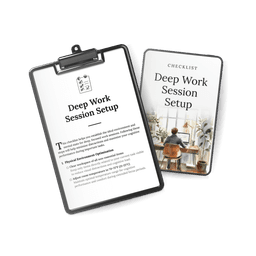
Our free Deep Work Session Setup checklist puts these steps on one page, so you can tick them off before every block instead of rebuilding the routine from memory.
During: get through the restless start
The start is the hardest part. Many people describe the first stretch of a session as restless: the mind keeps offering other things to do. That is normal, and it's not a sign the session is failing.
- Begin with something small and concrete. Reread the last paragraph you wrote, rename the file, solve the easiest problem first. Starting is easier when the first step is obvious.
- Keep a park-it list. A piece of paper next to you. Every "I should reply to…" or "don't forget to…" goes on the list, and you return to the task. For example: "book dentist", "reply to Sam about Friday", "check the train time". Nothing is lost, and nothing gets done now.
- Don't switch tasks mid-block. In two experiments, management researcher Sophie Leroy found that people need to stop thinking about one task to perform well on the next; when they move on from unfinished work, part of their attention stays behind. She called it attention residue; it was strongest when people left the first task unfinished and had no time pressure to wrap it up.
- If you get interrupted, note where you were. Write half a line ("next: fix the second chart") before you deal with the interruption. Coming back is much faster when you know the next step.
After: close the session on purpose
When the timer goes off, take two minutes to close properly:
- Write where you stopped and what the very next step is.
- Look at the park-it list and move anything real to your to-do list.
- Mark the session on a calendar or tracker. A visible chain of sessions is a quiet motivator.
In our view this small ritual also makes it easier to let go of the task when you move on, because the next step is already written down.
How long should a deep work session be?
Long enough to get past the restless start, short enough that you can protect it every time. For most people starting out, that means 25 to 50 minutes. You can stretch toward 90 minutes once a shorter block feels easy.
You will often read that the brain works in 90-minute cycles. The idea comes from Nathaniel Kleitman's basic rest-activity cycle, a rhythm clearly seen in sleep that he proposed also runs during the day. A review of performance rhythms during sleep deprivation found that daytime ultradian rhythms do exist, but that no confirmation has been reached for a common rest-activity cycle linking them to the sleep cycle. We could not find a controlled study showing that knowledge workers do better in 90-minute blocks. So use 90 minutes as a sensible upper limit for one block, not as a biological law. Our guide The 90-Minute Focus Cycle shows how to plan a day around blocks of that length if it suits your work.
What about breaks? The evidence here is modest but consistent:
- A 2022 meta-analysis of micro-breaks (breaks of up to 10 minutes) found small but real gains in energy and less fatigue, but no significant effect on overall performance. Performance improved significantly only on less demanding tasks, and longer breaks helped more.
- A study of 87 university students compared fixed breaks (Pomodoro style) with breaks taken whenever students felt like it. Fixed breaks gave better mood and similar progress; students who chose their own breaks studied longer but reported more fatigue and lower concentration.
The practical reading: plan your breaks instead of taking them when you crash, and after a really demanding block, make the break longer than five minutes. A walk, water, a window. Not your inbox.
What breaks flow (and what to do about it)
Interruptions. In a study by Gloria Mark and colleagues, people who were interrupted while working on an email task didn't produce worse work. They compensated by working faster, and it came at a price: more stress, more frustration, more time pressure. The participants were mostly university students in a lab, so treat it as a direction, not a precise measure. You may also have read that it takes "23 minutes" to refocus after an interruption. The number most likely traces back to an earlier field study that observed 24 information workers at one IT company. Interrupted work resumed the same day was picked up again after about 25 minutes on average (about 23 for interruptions coming from outside), with other tasks done in between and huge variation. That is the time before people came back to a project, not the time it takes to refocus.
Your own impulses. Many interruptions are self-made: the quick look at messages, the tab you open "for a second". Removing the trigger (closed apps, phone in another room) is simply easier than resisting it every few minutes.
Your phone, even silent. A well-known 2017 study reported that the mere presence of a smartphone reduces available cognitive capacity. The finding is weaker than it sounded: a pre-registered replication found no difference, and a later meta-analysis found a small negative effect on working memory, smaller than first claimed. Putting the phone away is still worth it, simply because you can't check what isn't there.
The wrong task. If a block keeps collapsing, the task is often too big or too vague. Cut it until the first step is obvious and the goal fits in one block.
If you'd like to go further on cues and rituals, our short guide 7 Neuroscience-Backed Triggers That Unlock Flow States collects practical starting cues. Engineer Your Flow State Trigger System walks you through building your own pre-session ritual and testing it over 30 days.
The minimum version and bad days
Some days the full routine won't happen: you slept badly, the day is full of meetings, or your head is somewhere else. On those days, use the minimum version:
- One task, one line of goal.
- Phone in another room.
- A 20-minute timer.
- Two lines at the end on where you stopped.
That's it. The goal on a bad day is not flow; it is keeping the habit alive so tomorrow starts from a session and not from zero. If focus is hard for you most days, not just some, our guide on how to be productive with ADHD covers systems built for that, including how to restart after a lost day.
Working from home adds its own problems (no clear start to the day, household interruptions, chat that never stops). The Remote Worker's Flow Blueprint covers those specifically.
Your first week
| Day | What to do |
| Day 1 | Pick your daily slot (the time with fewest interruptions). Do one 25-minute block with the full setup. |
| Day 2 | Same slot, 25 minutes. Start the park-it list. |
| Day 3 | 30 to 40 minutes. Write your "if… then…" plan for the most common distraction. |
| Day 4 | Same length. Practice the closing note: where you stopped, next step. |
| Day 5 | Try a 45 to 50 minute block on your hardest task of the week. |
| Day 6 | Minimum version only, even if you feel fine. Practice the fallback. |
| Day 7 | Review: which slot worked, what broke your focus, what to change next week. |
If you want a longer structure after this week, the 21-Day Deep Work Implementation Protocol takes the same idea over three weeks, with tracking templates and fixes for common problems. The Ultimate Focus Block Setup Protocol goes deeper on the before, during and after of a single block. If you like working with AI, The Personal Flow Operating System is a set of prompts to design your routine and review it over time.
Frequently asked questions
Can you enter a flow state on command?
Not reliably. You can't decide to feel absorbed, but you can repeat the conditions that come before flow: a task matched to your skill, a clear goal, feedback and no interruptions. A routine you repeat makes those conditions quick to set up, which is probably what people mean by "on command".
How long does it take to get into flow?
There is no fixed time, and we found no reliable research number. Many people report that the start of a session feels restless before focus settles. That's one reason very short blocks can feel shallow, and why a small, concrete first step helps.
What is the difference between deep work and flow?
Deep work is a way of working you choose: focusing without distraction on a demanding task. Flow is a state you may experience during it: deep absorption, often with a changed sense of time. You can do excellent deep work without ever feeling flow.
Is the 90-minute rule real?
The 90-minute rhythm is well documented in sleep. During the day, ultradian rhythms have been observed, but a shared 90-minute cycle with sleep has not been confirmed, and we found no controlled study showing that 90-minute work blocks beat other lengths. Use it as an upper limit if it feels right, not as a rule.
How many hours of deep work a day are realistic?
There's no reliable research number. For most people with a regular job, one or two protected blocks a day is a solid, sustainable goal. Consistency matters more than a long day you can't repeat.
Does music help you get into flow?
It depends on the task. A meta-analysis on background music found no overall effect, but music disturbed reading and had small negative effects on memory. If music helps you start, keep it for routine work and try silence for reading and writing.
How we put this guide together
This guide was written with AI assistance and edited by the AllMyGuides team. None of us is a psychologist or researcher. We started from what people ask about flow and deep work, then checked each claim against peer-reviewed studies and reviews, opening every source linked above and confirming that it says what we report (for a few studies only the abstract was publicly available). Where the evidence is weak or mixed (90-minute cycles, phones on the desk, music), we say so. Most of the studies cited were done in labs or with students, so treat the numbers as directions rather than promises. Last checked: November 2026. If focus problems are persistent and affect your work or wellbeing, talking to a doctor or a qualified professional is a better next step than any routine.