Rejection sensitive dysphoria (RSD) is intense emotional pain triggered by real or perceived rejection, criticism or failure. Cleveland Clinic describes it as a person feeling "intense emotional pain related to rejection" and links it most often to ADHD. It is not an official diagnosis, but the experience is real: a text left on read or a short reply from your manager can hit like a blow, even when part of you knows it probably means nothing.
This guide explains what RSD is, what research says about the ADHD link, how it differs from social anxiety, BPD and depression, and a simple plan for the moment it hits and the weeks after.
Key takeaways
- RSD means a sudden, very strong emotional reaction to rejection or criticism, real or imagined. It is a descriptive term, not a diagnosis in its own right.
- Research shows that difficulty regulating emotions is common in adults with ADHD, and studies link ADHD symptoms to higher rejection sensitivity.
- We found no controlled trial of any treatment for RSD itself. The tools below come from research on emotion regulation in general and from what people with RSD report.
- The most useful plan has three layers: what to do in the first minutes, what to do after the wave passes, and what to change over weeks.
- If the pain is constant, affects your work or relationships, or comes with thoughts of self-harm, talk to a professional. In the US you can call or text 988.
What is rejection sensitive dysphoria?
Psychiatrist William Dodson, who has written widely about the term, describes RSD in ADDitude as "extreme emotional sensitivity and pain triggered by the perception that a person has been rejected or criticized by important people in their life." He notes that "dysphoria" is Greek for "difficult to bear." The point of the name is the intensity: not the normal sting everyone feels, but a reaction that seems far bigger than the event.
Cleveland Clinic notes that RSD "isn't an officially recognized symptom or diagnosis." That matters for two reasons. First, there is no official test, so online quizzes can only describe patterns, not diagnose you. Second, researchers are still debating whether RSD is a separate thing or one visible part of the emotional side of ADHD.
The idea behind it is older. In 1996, psychologists Downey and Feldman described rejection sensitivity as a tendency to "anxiously expect, readily perceive, and overreact to" social rejection. RSD is a name for the most painful end of that pattern.
RSD symptoms: what it looks and feels like
People describe RSD episodes in very similar ways. Common signs include:
- A sudden drop. One message, look or comment, and your mood falls in seconds.
- A body reaction first. A jolt in the stomach, heat in the face, a tight chest, before you have even thought about it.
- Replaying and mind reading. Going over the conversation again and again, looking for what you did wrong.
- Withdrawal. Pulling away from people, not answering messages, skipping the next meeting.
- Masking and people pleasing. Working hard to never give anyone a reason to criticize you.
- Anger. For some people the pain comes out as a sharp reaction toward the person who "rejected" them.
- Avoiding risk. Not applying, not asking, not posting, because the possible "no" feels unbearable.
A small 2026 qualitative study in PLOS One asked university students with ADHD about rejection sensitivity. Three themes came up: withdrawal, masking and bodily sensations. The authors also wrote that rejection sensitivity "significantly impacts mental wellbeing." With only five participants it is a starting point, not a final answer, but it matches what many adults report.
Typical triggers
- A text left on read, or a reply that feels shorter than usual.
- "Can we talk at 11?" from a manager, with no context.
- Feedback on your work, even when it is mostly positive.
- A partner who sounds tired, or who asks for some space.
- Job applications that get no reply.
Rejection sensitive dysphoria and ADHD: what research says
Most RSD research looks at ADHD, and the strongest evidence is about emotion regulation in general:
- A 2014 review in the American Journal of Psychiatry concluded that "emotion dysregulation is prevalent in ADHD throughout the lifespan and is a major contributor to impairment."
- A 2020 meta-analysis in BMC Psychiatry found that adults with ADHD showed much higher levels of emotional dysregulation than adults without ADHD, and the authors concluded that their findings support it as a core feature of ADHD.
- In a study of children and teenagers published in European Child & Adolescent Psychiatry, those with ADHD symptoms reported higher anxious and angry rejection sensitivity than controls.
- A 2019 study of young adolescents in the Journal of Abnormal Child Psychology linked more ADHD symptoms to a stronger brain response to peer rejection, which in turn went with higher self-reported rejection sensitivity.
Two honest limits. Much of this research is on children and teens, not adults. And Dodson writes that almost 100% of people with ADHD experience rejection sensitivity, while other sites say up to 70%. We could not find a study behind either number, so we do not rely on them.
RSD is also not limited to ADHD. Rejection sensitivity as Downey and Feldman described it can affect anyone, and Cleveland Clinic notes that experts have also linked RSD to other personality and mood disorders, though more research is needed.
RSD vs social anxiety, BPD and depression
These conditions can overlap, and they can exist together. Only a professional can tell them apart for you, but the main differences are useful to know:
| Condition | Main feature | When the distress shows up |
| Rejection sensitive dysphoria | Sudden, intense pain after perceived rejection or criticism | Usually after a specific event; it can last hours or longer |
| Social anxiety | A long-term, overwhelming fear of social situations and of being judged | Before, during and after social situations |
| Borderline personality disorder | Intense emotions, unstable relationships, strong efforts to avoid being left alone | A wider, ongoing pattern, not only after one event |
| Depression | Low mood or loss of interest that affects how you feel, think and handle daily life | Most of the day, nearly every day, for at least 2 weeks |
If your low mood stays after the trigger is gone, or you notice it most days, mention that to a professional. It may be more than RSD.
How to cope with rejection sensitive dysphoria: a three-layer plan
RSD episodes are fast. You will not out-think the first wave. A plan you set up in advance works better than willpower in the moment. Here is a simple one with three layers.
Layer 1: the first ten minutes
- Notice the body. The jolt usually comes before the thought. Treat it as your early warning: "There it is."
- Name it. Say or write "This is RSD." In a lab study published in Psychological Science, putting feelings into words reduced the response of the amygdala, a brain area involved in emotional reactions. It was a lab experiment, not a treatment trial, but naming the feeling is free and many people with RSD say it creates some distance.
- Do not send anything yet. No reply, no apology, no angry message. Put the phone down or close the chat.
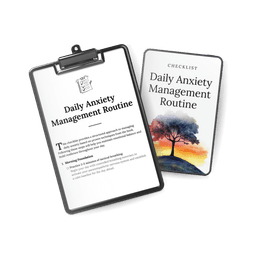
- Calm the body. Slow breathing, a glass of water, a short walk. Our free Daily Anxiety Management Routine checklist has short calming steps you can keep ready for moments like this.
Layer 2: after the wave passes
- Write three other explanations. "She is in a meeting." "He reads everything and replies later." "My manager wants to talk about the new project." This is a form of cognitive reappraisal, looking at a situation in a different way. A large meta-analysis in Psychological Bulletin found that reappraisal and taking another person's perspective had small to moderate effects on emotions. That research pooled lab experiments, not studies of people with ADHD.
- Ask a clear question. "What would you like to discuss at 11?" or "Is everything OK with us?" A plain question often ends hours of guessing.
- Then decide. If you still need to reply, write it now, and reread it before sending.
Layer 3: over the next weeks
- Keep a short trigger log. Date, what happened, how strong it felt from 1 to 10, what it turned out to be. After a few weeks you will see your patterns, and you will have proof that many triggers were not rejection at all.
- Tell a few people. A partner, a close friend or a manager you trust. You do not need to use the term. "Vague messages make me anxious, could you add a line of context?" is enough.
- Ask for clear feedback. Specific, direct feedback is easier to handle than hints and sarcasm.
- Look after the basics. Many people notice RSD is worse when they are tired, hungry or already stressed. Our guide on being productive with ADHD covers simple routines for sleep, energy and planning.
- Get support. See the section on professional help below.
A typical day with the plan
It is 9:40. Your manager writes "Can we talk at 11?" and nothing else. Your stomach drops. You notice it, think "this is RSD", and close the chat. You fill a glass of water. At 9:50 you open your notes and write three possible reasons for the meeting. Two are neutral. You reply: "Sure. Anything I should prepare?" The answer is about next quarter's schedule. In your log you write: "Manager message, 8/10, turned out neutral."
The episode did not disappear. It got shorter, and you did not send a message you would regret.
A plan for bad days
Some days the plan will feel impossible. On those days, keep only the minimum:
- Do not send important messages while the feeling is at its peak.
- Write one line in the log, nothing more.
- Do one thing that calms your body.
- Remind yourself that the wave usually passes, even when it does not feel that way.
If you find yourself withdrawing for days, avoiding all messages, or ghosting people you care about, that is a sign to reach out for support rather than push through alone. If you also feel stuck on tasks, our guide to ADHD paralysis may help.
RSD in relationships and at work
For the person with RSD
Partners and colleagues cannot read your mind. Explaining what helps, such as context in messages or a quick "we're fine" after a disagreement, makes it easier for them to support you. It also helps to say what does not help: being told you are "too sensitive" usually makes things worse.
For partners, friends and managers
- Talk about specific behaviors, not the whole person: "the dishes were left out" instead of "you never help".
- Add one line of context to messages that could sound alarming.
- Do not avoid all feedback out of fear. Holding things back tends to build resentment. Clear, kind and specific is the goal.
- Look after yourself too. Supporting someone with intense emotions can be tiring.
Rejection sensitive dysphoria treatment: what professionals can offer
Because RSD is not a formal diagnosis, there is no treatment approved for RSD itself. A search of the Europe PMC research database in November 2026 returned only nine papers using the term, and none was a controlled trial of an RSD treatment. Here is what we found:
- Therapy. Cleveland Clinic says psychotherapy "can help people with RSD" learn to manage the feelings, though it does not stop episodes from happening, and Dodson is more skeptical about therapy. In a randomized trial in JAMA, adults with ADHD who were already on medication and received cognitive behavioral therapy had larger improvements in ADHD symptoms than those who received relaxation training with educational support. That trial measured ADHD symptoms, not RSD.
- Skills groups. Programs based on dialectical behavior therapy (DBT) teach emotion regulation skills and have been tested in adults with ADHD. Again, the outcomes measured were ADHD symptoms, not RSD.
- Medication. Cleveland Clinic says medication is the main way doctors treat RSD, prescribed off label because no medicine is approved specifically for it. Only a prescriber who knows your history can tell you whether that is right for you.
A good first step is a doctor or mental health professional who knows ADHD. Bring your trigger log. It gives them concrete examples to work with.
How to start this week
- Day 1: Write your three-layer plan on one card or phone note.
- Day 2: Start the trigger log, even if nothing happens.
- Day 3: Pick one calming action for Layer 1 and practice it once when you are calm.
- Day 4: Tell one trusted person what helps you.
- Day 5 to 7: Use the plan when a trigger comes. At the end of the week, read your log.
If you want more structure, our Productivity with ADHD Workbook has exercises to map your patterns, and the ADHD prompts pack includes prompts you can use to reframe a hard message. The Productivity with ADHD Bundle brings our ADHD guides together, and The Calm Beyond Anxiety covers calming tools and boundaries for everyday stress.
Frequently asked questions
Is rejection sensitive dysphoria a real diagnosis?
No. RSD is not an officially recognized diagnosis. It is a term clinicians and patients use to describe a real and common experience, especially in ADHD.
What does RSD mean?
RSD stands for rejection sensitive dysphoria: very strong emotional pain after real or perceived rejection or criticism.
Can you have RSD without ADHD?
Sources disagree. Most writing on RSD is about ADHD, but rejection sensitivity in general can affect anyone, and Cleveland Clinic notes that experts have linked RSD to other personality and mood disorders too.
Is there a test for rejection sensitive dysphoria?
There is no official test. Online quizzes can help you notice patterns, but they cannot diagnose you. A professional can assess ADHD and related conditions.
How long does an RSD episode last?
It varies. Some people say the wave eases within hours. Students in the 2026 PLOS One study described effects lasting from hours to weeks, sometimes coming back years later. If the low mood lasts most days, talk to a professional.
Why does a text left on read hurt so much?
Without context, the brain fills the gap, and with RSD it tends to fill it with rejection. Naming the reaction and writing other explanations helps you see the gap for what it is.
Should I tell my manager I have RSD?
That is your choice. You do not have to share a label. Asking for clear agendas and specific feedback is a reasonable request that helps most people.
How is RSD different from BPD?
RSD is usually a reaction to a specific event. Borderline personality disorder is a wider, ongoing pattern that includes intense emotions, unstable relationships and strong fear of being left alone. A professional can help tell them apart.
How we put this guide together
This guide was written with AI assistance and edited by the AllMyGuides team. None of us is a doctor or therapist. We used public health sources (Cleveland Clinic, NHS, NIMH, the 988 Lifeline), clinician-written articles and peer-reviewed research. We opened every linked source to check that it says what we say it says. Where the evidence is weak or missing, we have said so. Last checked in November 2026.
This article is for general information and is not medical advice. If rejection sensitivity is affecting your work, health or relationships, please speak with a qualified healthcare professional. If you are in crisis or thinking about harming yourself, call or text 988 in the US to reach the 988 Suicide & Crisis Lifeline, available 24/7, or contact your local emergency number.