
Grounding techniques are simple ways to pull your attention out of anxious thoughts and back into the present moment, usually through your senses or your body: what you can see, touch, hear, smell and taste right now. They are used for anxiety, panic attacks, racing thoughts and dissociation. The best known is the 5-4-3-2-1 method, but there are dozens more, and the right one depends on how activated you are.
This guide explains what grounding is and where it comes from, what the evidence says, how to do 5-4-3-2-1, which technique to use for panic, spiraling thoughts, dissociation, work and bedtime, and 25 techniques you can try. It also covers when grounding isn't enough.
Key takeaways
- Grounding brings your attention to the here and now through your senses, body or simple mental tasks. It is a coping skill, not a treatment for an anxiety disorder.
- For panic or feeling unreal, start with strong physical input like cold water, pressure or movement. Save counting and naming exercises for when you are a bit calmer.
- Few studies test grounding on its own, but related techniques, like slow breathing, relaxation training and mindfulness, have encouraging evidence for anxiety.
- Practice your two or three favorite techniques when you are calm, so they work when you need them.
- If panic attacks keep coming back or you often feel detached from yourself, talk to a professional. Effective treatments exist.
What is grounding?
Cleveland Clinic describes grounding techniques as "a set of simple strategies that help calm your anxiety by focusing on the here and now," and lists anxiety, PTSD and dissociation among the problems they can help with. When your mind is racing through worst-case scenarios or replaying something painful, grounding gives it a concrete job in the present.
The idea comes from trauma treatment. Psychologist Lisa Najavits made grounding a core skill in Seeking Safety, a treatment program for people with PTSD and substance use problems, where it appears as "detaching from emotional pain." Cleveland Clinic groups grounding techniques into three categories, which this guide uses too:
- Physical grounding: using your senses and body, like touching something cold or pressing your feet into the floor.
- Mental grounding: giving your mind a neutral task, like counting backward or naming things in a category.
- Soothing grounding: being kind to yourself, like repeating a calming phrase or picturing a safe place.
Grounding is broader than "earthing," the practice of touching the ground barefoot in the belief that the earth's electrical energy rebalances the body. A Cleveland Clinic psychologist calls grounding "an umbrella term for a wide range of mindfulness techniques" that includes earthing, whose evidence is still too preliminary to draw conclusions from.
Do grounding techniques work?
Honestly: we could not find a controlled trial that tests 5-4-3-2-1 or sensory grounding on its own. Grounding rests on clinical experience and on treatment programs that include it. Seeking Safety as a whole has a good track record: a 2013 review of treatments for PTSD with substance use found it was "the only treatment outperforming a control on both PTSD and SUD."
Techniques that work in a similar way have stronger evidence:
- Slow breathing. A systematic review of 15 studies in healthy adults linked slow breathing with more relaxation and comfort and less anxiety, alongside higher heart rate variability, a marker linked to calm.
- Relaxation training. A meta-analysis of 27 studies found a moderate-to-large effect of relaxation training, such as progressive muscle relaxation, on anxiety.
- Mindfulness. A meta-analysis of 39 studies found mindfulness-based therapy improved anxiety, with larger effects in people with anxiety and mood disorders. Grounding is closely related: both train attention on the present moment.
- Cold on the face. In a small experiment with people with panic disorder, putting the face in cold water for 30 seconds lowered heart rate and panic symptoms.
The 5-4-3-2-1 grounding technique
Cleveland Clinic describes 5-4-3-2-1 as a mindfulness exercise that engages each of your five senses. Slowly, and out loud or in your head, name:
- 5 things you can see. Look for small details: the grain of the desk, a crack in the ceiling.
- 4 things you can feel. Your feet in your shoes, the chair under you, the air on your skin.
- 3 things you can hear. Traffic, a fan, your own breathing.
- 2 things you can smell. If nothing is around, think of two smells you like.
- 1 thing you can taste. A sip of water, gum, or just the taste in your mouth.
Take your time with each one. The point is not to finish the list but to notice. If you lose count or can't find five of something, that is fine; keep going with whatever you notice.
Which grounding technique to use, and when
| Situation | Start with | Why |
| Panic attack | Cold water on the face or hands, pressing hard against a wall, a sour candy | Strong, fast physical input can cut through when you are too activated to think |
| Spiraling or racing thoughts | Counting backward by 7s, naming items in a category, describing the room | A mental task competes with the worry for attention |
| Feeling unreal or detached | Strong smells, holding ice, saying your name, the place and the date | Intense sensations and facts anchor you to the here and now |
| At work or in public | Feet flat on the floor, pressing fingertips together, silent 5-4-3-2-1 | Nobody can see it |
| At night | 5-4-3-2-1 for the bedroom, a slow body scan, relaxing muscle by muscle | Calming, low-stimulation options that don't wake you up further |
25 grounding techniques for anxiety
Physical grounding
- Run cold water over your hands or splash it on your face.
- Hold an ice cube, moving it between your hands (don't hold it on one spot long enough to hurt). If you have a heart condition, Raynaud's or sensitivity to cold, check with a doctor before using cold water or ice.
- Press your feet firmly into the floor and notice the pressure in your heels.
- Push your palms hard against a wall for 10 seconds, then release.
- Grip the arms of your chair and notice the texture.
- Carry a grounding object, like a smooth stone or textured keychain, and focus on how it feels.
- Bite into a lemon slice or a sour candy.
- Smell something strong: coffee beans, peppermint oil, a candle.
- Stretch slowly, noticing each muscle.
- Walk and count your steps, feeling each foot touch the ground.
Mental grounding
- Count backward from 100 by 7s.
- Name as many animals, cities or foods as you can, or one for each letter of the alphabet.
- Describe the room in detail, as if to someone who can't see it.
- Read something nearby backward, letter by letter.
- Recite something you know by heart: a song, a poem, a sports team's lineup.
- Say the facts out loud: your name, where you are, the date and the time.
- Pick a color and find every object of that color around you.
- Do a simple puzzle or a mental math problem.
Soothing grounding
- Repeat a coping phrase: "This feeling is temporary. I am safe right now."
- Picture a place where you feel safe, in as much sensory detail as you can.
- Think of someone who cares about you and what they would say right now.
- Wrap yourself in a blanket or put a hand on your chest.
- Breathe out slowly, longer than you breathe in.
- Listen to one song you love, paying attention to a single instrument.
- Pet an animal and notice its fur, warmth and breathing.
Grounding during a panic attack
A panic attack is, in NIMH's words, "a sudden wave of fear or discomfort or a sense of losing control even when there is no clear danger." Symptoms can include a racing heart, trembling or tingling, shortness of breath, chest discomfort and a fear of dying. The good news is that the peak doesn't last: according to the MSD Manual, symptoms usually peak within 10 minutes.
During that peak, counting things can feel impossible. Use the body first: cold water, pushing against a wall, sour taste, stamping your feet. Add a coping phrase like "This will pass." Once the wave starts to drop, switch to slower grounding like 5-4-3-2-1 or longer exhales.
Some people with panic say that focusing on their breath makes them more aware of how fast they are breathing, and that this makes things worse. If that is you, ground through your senses first and come to the breath later, or skip it. Our guide on nervous system regulation covers fast calming techniques, including what to do when breathing exercises make it worse.
How to make grounding work for you
- Practice when you are calm. A skill you've rehearsed is much easier to reach for under stress than one you are trying for the first time.
- Find your two or three. Try several over a couple of weeks. Keep the ones that work, drop the rest.
- Prepare your tools. Keep a grounding object in your pocket, sour candy in your bag and your coping phrase in your phone notes.
- Match intensity to intensity. The more activated you are, the stronger and more physical the input needs to be.
- Use grounding to get through, not to get away. Grounding helps you ride out a wave of anxiety. If it turns into a way to avoid every uncomfortable situation, it can keep anxiety going. A review of safety behaviors in anxiety disorders notes that therapy models see these avoidance habits as a factor that maintains anxiety, although the experimental evidence is mixed.
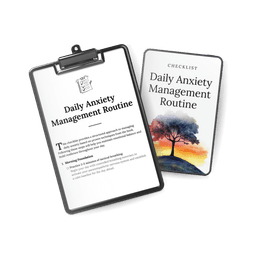
Our free Daily Anxiety Management Routine checklist helps you build grounding into a daily routine. For a fuller plan, our book The Calm Beyond Anxiety covers anxiety step by step, and Think Clearly with ABCD Method teaches a structured way to question anxious thoughts once you are calmer. If your anxiety shows up as constant overthinking, see our guide on how to stop overthinking, and if you hide it well behind being busy and competent, our article on high-functioning anxiety may sound familiar.
When grounding isn't enough
Grounding helps in the moment. It doesn't treat the cause. Talk to a doctor or mental health professional if:
- You have panic attacks often, or avoid places because you fear one.
- You have chest pain or a first-ever attack; a doctor should rule out a physical cause.
- You often feel detached from yourself or like the world isn't real.
- Anxiety is affecting your work, sleep or relationships.
Feeling detached can be part of trauma-related conditions. The VA National Center for PTSD describes depersonalization as "feeling as if oneself is not real" and derealization as "feeling as if the world is not real," and notes that people with PTSD who have these symptoms responded better to treatments that also included cognitive restructuring and skills training in emotional and interpersonal regulation. For panic, NIMH describes cognitive behavioral therapy (CBT) as a research-supported treatment that is commonly used. If you are in crisis or thinking about harming yourself, call or text 988 in the US, or chat at 988lifeline.org. In an emergency, call 911.
Frequently asked questions
What is the fastest grounding technique?
Many people find strong physical input works fastest: cold water on the face or hands, holding ice, or biting a lemon or sour candy. These are hard for your brain to ignore.
Why doesn't 5-4-3-2-1 work for me?
It can be too much thinking when you are very activated. Start with a physical technique to bring the intensity down, then try 5-4-3-2-1. Also practice it when you are calm, so it feels familiar.
Can grounding help with dissociation?
Many people find it helps. Strong sensations, like ice or a strong smell, and saying facts out loud, like your name, where you are and the date, are commonly suggested. Frequent dissociation is worth discussing with a professional.
How can I ground myself at work without anyone noticing?
Press your feet into the floor, press your fingertips together, hold a smooth object in your pocket, or do 5-4-3-2-1 silently. A slow, long exhale is invisible too.
Do sour candies help with anxiety?
They can work as a quick distraction, because an intense taste grabs your attention. There are no studies on them specifically, so treat them as one option among many.
Is grounding the same as earthing?
Not quite. Grounding is a broad set of attention techniques for anxiety. Earthing is the idea that physical contact with the ground has health effects, and its evidence is preliminary.
Are grounding techniques enough, or do I need therapy?
For occasional anxiety, grounding may be all you need. If anxiety or panic is frequent or getting in the way of your life, therapy treats the cause, and grounding becomes one of the tools you use along the way.
How we put this guide together
This guide was written with AI assistance and edited by the AllMyGuides team. None of us is a doctor or therapist. We built it from Cleveland Clinic articles, NIMH, the MSD Manual and the VA National Center for PTSD. We also used the Seeking Safety treatment manual and research on slow breathing, relaxation training, mindfulness, cold-water immersion and safety behaviors. We opened each linked source to check that it says what we report, and we said clearly where grounding has no direct trials. We also read what people with anxiety and panic say about which techniques help them. Reviewed in November 2026. This article is general information, not medical advice.