High-functioning anxiety is an informal term for persistent anxiety in people who still perform well, often very well, at work and in daily life. From the outside they look organized, reliable and successful. On the inside they deal with constant worry, overthinking, fear of letting people down and trouble switching off. It is not a diagnosis, but the anxiety underneath it is real, and it can be treated.
This guide explains what high-functioning anxiety is and the signs others don't see. It looks at why the anxiety seems to "work" and what it really costs. Then it covers how it relates to generalized anxiety disorder, and what helps, from everyday habits to therapies with strong evidence.
Key takeaways
- High-functioning anxiety is not a formal diagnosis. It describes anxiety hidden behind good performance, often with perfectionism and people-pleasing.
- The idea that anxiety makes you perform better is weaker than it sounds. Anxious people often keep their results up by spending extra effort. That effort has a hidden cost.
- Many people with this pattern may meet the criteria for an anxiety disorder without knowing it. Only a professional can tell.
- Therapies like cognitive behavioral therapy and mindfulness-based stress reduction have good evidence for anxiety, and so does regular exercise.
- Functioning well is not a reason to skip help. Anxiety is treatable, and you don't have to wait for it to break you.
What is high-functioning anxiety?
Cleveland Clinic describes it as anxiety that "can't be diagnosed" as such, in people who respond to anxiety by pushing harder rather than avoiding. Instead of staying home, they overprepare. Instead of missing deadlines, they finish early and still worry it isn't good enough.
The diagnosis it most often overlaps with is generalized anxiety disorder (GAD), which means hard-to-control worry on most days for at least six months, plus at least three symptoms such as restlessness, fatigue, poor concentration, irritability, muscle tension or sleep problems. The National Institute of Mental Health estimates that 2.7% of US adults have GAD in a given year and 5.7% at some point in their lives. Anxiety disorders as a group are much more common: an estimated 19.1% of US adults had one in the past year. Those figures come from survey data from the early 2000s that NIMH still uses as its reference.
Some people find the label validating: it names an experience they couldn't explain. Others find it minimizing, as if "high-functioning" meant "not really a problem." Both reactions make sense. The useful point is that how well you perform says little about how much you are struggling.
Signs of high-functioning anxiety
| What others see | What it can feel like inside |
| Always prepared, early, organized | Overpreparing because of fear of being caught out |
| High standards, great results | Nothing ever feels good enough; success brings relief, not joy |
| Helpful, says yes to everything | Can't say no for fear of disappointing people |
| Busy, productive, always doing something | Can't relax; downtime feels wasted or guilty |
| Calm in meetings | Replaying every word afterward, looking for mistakes |
| Detail-oriented | Checking and rechecking, seeking reassurance |
| Hard worker who stays late | Procrastinating out of fear, then working in a panic |
Physical signs are common too. The NIMH symptom list for GAD includes trouble falling or staying asleep, fatigue, headaches, muscle aches or tension, stomachaches, restlessness and difficulty concentrating.
Does anxiety make you perform better?
Many people with high-functioning anxiety secretly believe their anxiety is the engine of their success. This belief is often linked to the "Yerkes-Dodson law," the idea that a moderate level of anxiety boosts performance. The evidence is shakier than the popularity suggests. The original 1908 study was about how mice learned under electric shocks of different strengths, not human anxiety. A 1994 review argued that reading it as a law about anxiety and performance was a later reinterpretation. Applied to work stress, one review concluded it "has no basis in empirical fact."
What research does show is a cost. A meta-analysis of 177 samples with over 22,000 people found that higher self-reported anxiety was reliably linked to poorer working memory performance. According to attentional control theory, anxiety disrupts the brain's goal-directed attention, but people can often keep their results up by compensating with extra effort. That is high-functioning anxiety in one sentence: the output looks fine because you are paying for it with energy you don't see on the scoreboard.
Perfectionism, which often travels with this pattern, carries its own risk. A meta-analysis of 284 studies found that both perfectionistic strivings and perfectionistic concerns are associated with various forms of psychopathology, including anxiety.
The hidden costs
- Exhaustion and burnout. Running on extra effort for years drains you. Our guide on how to recover from burnout covers what happens when the tank empties.
- Poor sleep. A racing mind at night means less recovery, which makes the next day's anxiety worse.
- Overthinking. Replaying conversations and imagining worst cases eats hours. Our guide on how to stop overthinking has a five-step system for it.
- Relationships. Saying yes to everyone leaves little for the people closest to you, and they may not know how you feel.
- Delayed help. Because you are "fine," nobody suggests support, and you don't ask.
That last point is common worldwide. In WHO World Mental Health Surveys of over 51,000 people in 21 countries, only 41.3% of people with an anxiety disorder felt they needed care. Only 9.8% received treatment that was possibly adequate.
Is it high-functioning anxiety or an anxiety disorder?
These are not opposites. Someone described as having high-functioning anxiety may meet the criteria for GAD or another anxiety disorder; they simply hide it well. Ask yourself:
- Do I worry more days than not, and find it hard to stop?
- Has it been going on for six months or more?
- Do I have physical symptoms like poor sleep, tension, fatigue or stomach problems?
- Does it cost me rest, relationships or enjoyment, even if my work is fine?
If you answer yes to most of these, talk to a doctor or a mental health professional. This is not a self-diagnosis checklist; it is a reason to get a proper assessment. Cleveland Clinic lists medical conditions such as thyroid problems among the factors that may contribute, so a doctor may want to rule them out.
What helps high-functioning anxiety
Therapies with good evidence
Cognitive behavioral therapy (CBT) is the most studied option. A meta-analysis of 41 placebo-controlled trials found moderate effects of CBT across anxiety and related disorders, with large effects for GAD. CBT works on the thoughts behind the pattern ("If it isn't perfect, I've failed") and on behaviors like overchecking and reassurance seeking. It also works online: a meta-analysis of 64 trials found internet-delivered CBT effective for anxiety and depression.
Mindfulness-based stress reduction (MBSR) is another option. In a randomized trial of 276 adults with anxiety disorders, an 8-week MBSR course was noninferior to the antidepressant escitalopram, a common medication for anxiety. An earlier meta-analysis of 39 studies also found mindfulness-based therapy improved anxiety.
Medication, such as certain antidepressants, can also help. That is a decision to make with a doctor.
Daily habits that support treatment
- Move regularly. An umbrella review of over 1,000 trials found that physical activity had medium-sized effects on anxiety symptoms in adults.
- Give worry a time slot. In a small, two-week randomized study of 53 chronic worriers, a daily 30-minute "worry period" at a fixed time and place reduced worry, anxiety and insomnia more than the comparison condition. When a worry pops up outside the slot, write it down and save it.
- Run "good enough" experiments. A common CBT technique for perfectionism: deliberately send an email without a third reread, or hand in a draft at 90%, and note what actually happens. Often, the feared outcome doesn't happen.
- Cut back on reassurance seeking. Asking "Was that okay?" brings short relief and can keep the doubt coming back. Try waiting an hour before asking, then see if you still need to.
- Say no once a week. Start with low-stakes requests. Each one tests whether the disaster you fear actually happens.
- Protect real downtime. Schedule rest the way you schedule work, with no productive purpose attached.
- Calm the body, not just the mind. Slow breathing and physical release help when anxiety is in your shoulders and stomach. Our guide on nervous system regulation explains fast techniques that hold up.
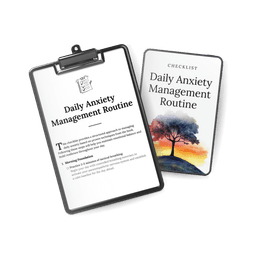
Our free Daily Anxiety Management Routine checklist turns these habits into a simple daily plan. For a deeper program, our book The Calm Beyond Anxiety walks through managing anxiety step by step. Think Clearly with ABCD Method teaches a structured way to question anxious thoughts, in the spirit of CBT. If stress is showing up in your body and habits, 12 Stress Habits That Secretly Wreck Your Health helps you spot them.
Your first week
- Day 1: write down three situations this week where anxiety pushed you to overdo something.
- Day 2: set a 30-minute worry slot at the same time each day.
- Day 3: run one "good enough" experiment and note the result.
- Day 4: say no to one small request.
- Day 5: take a 20-minute walk or workout.
- Day 6: schedule two hours of rest with no goal.
- Day 7: review the week. If worry still dominates most days, book an appointment with a professional.
When to get help
See a doctor or mental health professional if worry is hard to control on most days or you have been sleeping badly for weeks. The same goes for panic attacks, relying on alcohol or other substances to switch off, or feeling the effort of holding it together start to fail. You don't need to be falling apart to deserve help. If you are in crisis or thinking about harming yourself, call or text 988 in the US, or chat at 988lifeline.org, to reach the 988 Suicide & Crisis Lifeline. In an emergency, call 911.
Frequently asked questions
Is high-functioning anxiety a real diagnosis?
No. It is an informal term, not a diagnosis clinicians use. But the anxiety behind it is real and may meet the criteria for an anxiety disorder such as GAD.
What's the difference between high-functioning anxiety and GAD?
GAD is a formal diagnosis based on persistent, hard-to-control worry plus physical symptoms for at least six months. "High-functioning anxiety" describes how anxiety looks from outside: hidden behind good performance. A person can have both.
Can you have anxiety if you're successful?
Yes. Success and anxiety often go together, especially when anxiety shows up as perfectionism and overworking. Performance says little about how much someone is struggling.
Why can't I relax even when everything is going well?
When anxiety drives your effort, calm can feel like danger, as if relaxing will let something slip. Scheduling rest, practicing mindfulness and working with a therapist can help retrain that response.
Can high-functioning anxiety lead to burnout?
It can. Keeping results up through constant extra effort is tiring, and over time the energy runs out. Watch for exhaustion that rest doesn't fix.
Do I need medication for high-functioning anxiety?
Not necessarily. CBT has strong evidence, and mindfulness-based programs have good evidence. Some people benefit from medication too. Discuss the options with a doctor.
Is there a test for high-functioning anxiety?
There is no specific test, since it isn't a diagnosis. A doctor or psychologist can assess you for anxiety disorders using standard questionnaires and an interview.
How we put this guide together
This guide was written with AI assistance and edited by the AllMyGuides team. None of us is a doctor or therapist. We built it from NIMH data and guidance, a Cleveland Clinic article and WHO survey research on treatment gaps. We also used meta-analyses on anxiety, perfectionism, CBT, mindfulness and exercise, a trial of MBSR and a study of scheduled worry time. We opened each linked source to check that it says what we report, and we noted where evidence is older, small or popular rather than proven. We also read how people describe living with high-functioning anxiety. Reviewed in November 2026. This article is general information, not medical advice. If anxiety is affecting your life, please talk to a qualified professional.