Prioritizing tasks is deciding which of your tasks get your limited time first, based on what each one is worth and when it is really due. The short version: put everything on one list, cut what does not need doing, sort the rest by importance and real deadlines, pick one to three tasks for today, and give each a time slot. Then review the list once a day and once a week.
Most people do not fail at prioritizing because they picked the wrong method. They fail because the loudest task wins. Below is a six-step system that works with any method, a comparison of the popular methods, and an honest note on how little of this has been tested.
Key takeaways
- Urgency pulls harder than importance. In experiments, people picked urgent tasks over important ones even when the important task paid more.
- One list, cut first, sort second. A short list is easier to rank than a long one.
- The Eisenhower matrix and its cousins are useful rules of thumb, but we could not find a controlled study showing that any of them improves results.
- Choosing a task is half the job. Deciding when you will do it raises the odds you actually do it.
- When two people both say their task comes first, the fix is usually a conversation, not a better ranking.
Why prioritizing feels so hard
Three things work against you.
Urgent feels more important than it is
In five experiments, Zhu and colleagues found what they call the mere urgency effect: people showed "a tendency to pursue urgency over importance" even when the important option had the bigger payoff (Journal of Consumer Research, 2018). These were experiments, so how strong the effect is at work is unclear. The direction is not: a task with a countdown on it grabs attention whether it matters or not.
There is too much to do
In a 2024 NIOSH summary of 2018 US General Social Survey data, almost 70% of workers agreed that they had to work very fast, and 43% said the demands of their job interfered with family life (NIOSH, 2024). When the pile is bigger than the day, every choice means leaving something undone, and that is uncomfortable. Many people avoid the discomfort by working on whatever is in front of them.
We misjudge how long things take
The planning fallacy is the habit of underestimating how long our own tasks will take, partly because we focus on the plan and ignore how long similar tasks took before (Buehler, Griffin and Ross, 1994). A list that looks doable at 9 a.m. is often two days of work.
How to prioritize tasks in 6 steps
This is the system. Each step takes a few minutes, and the whole thing takes about 20 minutes the first time and 5 to 10 minutes on a normal day.
Step 1: Put everything on one list
Write down every task you are carrying: work, home, messages you owe, things you promised. One list, not three apps and a sticky note. You cannot rank tasks you cannot see. There is a side benefit too. In lab studies, unfinished goals led to intrusive thoughts and worse performance on unrelated tasks, and making a specific plan for those goals removed these effects (Masicampo and Baumeister, 2011).
Step 2: Cut before you sort
Go down the list and ask four questions about each item:
- Does this need doing at all? If nothing bad happens when it never gets done, delete it.
- Does it need to be me? If someone else can do it well enough, hand it off.
- Does it need to be now? If it matters but not this month, move it to a separate "someday" list.
- Is it really one task? For example, "website redesign" is a project. Write down only its next physical step, such as "list the five pages that get the most visits."
Many lists get noticeably shorter here. If a big project keeps sitting at the bottom because you cannot see where to start, our guide Break Down Overwhelming Projects walks through splitting it into steps you can finish in one sitting.
Step 3: Sort by importance and real deadlines
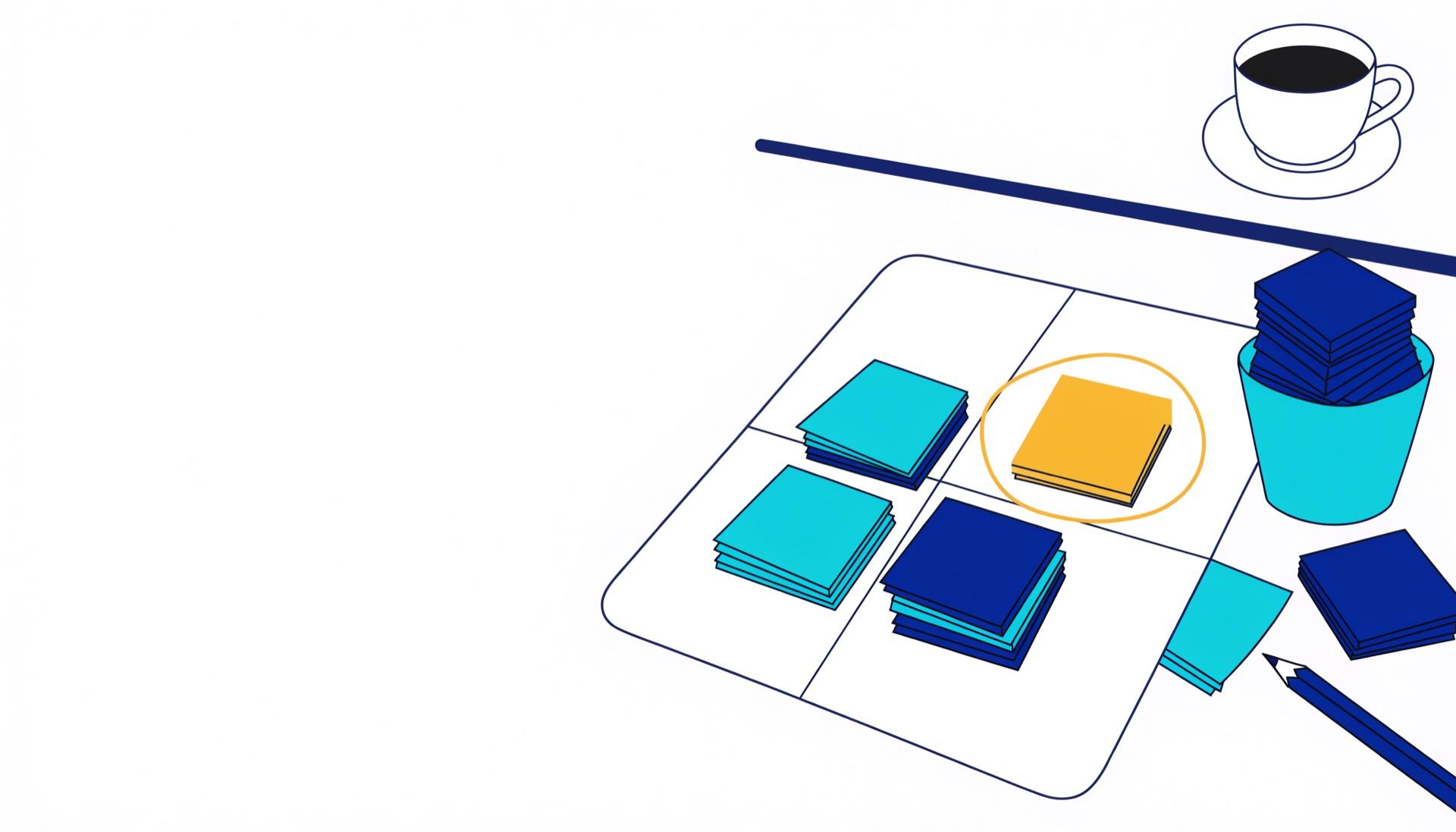
Now use the best-known tool, the Eisenhower matrix. Draw four boxes:
| Urgent | Not urgent | |
| Important | Do first. Real deadlines and real problems. | Schedule. The work that moves your goals: planning, learning, health, the big project. |
| Not important | Limit or hand off. Interruptions, many meetings, other people's rush. | Drop. Busywork and filler. |
The name comes from a 1954 speech in which President Eisenhower quoted "a former college president": "I have two kinds of problems, the urgent and the important. The urgent are not important, and the important are never urgent" (American Presidency Project). The four-box grid came later; it is widely credited to Stephen Covey's book The 7 Habits of Highly Effective People (1989). We searched for experiments that test the matrix and found none, so treat it as a thinking aid, not a proven method.
The common problem: everything lands in "urgent and important." Two questions fix most of it. First, "What actually happens if this waits a week?" If the honest answer is "someone is mildly annoyed," it is not urgent. Second, "Who made this urgent?" A message marked urgent is urgent for the sender. It becomes urgent for you only if it serves your goals or your manager agrees it comes first.
Step 4: Rank the top of the list
You now have maybe five to ten important tasks. To order them, ask three questions:
- Which one is tied to a goal I actually care about this month? Decades of goal-setting research, summarized by Locke and Latham, point to specific, challenging goals working better than vague "do your best" goals (American Psychologist, 2002). A clear goal also makes ranking easier, because you have something to rank against.
- Which one unblocks other people or other tasks? A task that three people are waiting on is worth more than its size suggests.
- Which one gets worse or more expensive if it waits? Taxes, a small bug, a tense conversation.
For example, if "update the client deck" is due next week but two colleagues need your numbers from it tomorrow, it moves above a task that is due sooner but blocks no one. If two tasks still tie, pick one and start. The time spent deciding between two equally good options is usually worth more than the difference between them.
Step 5: Pick one to three for today and give them a time
From the top of your ranked list, choose one main task and at most two smaller ones for today. Then decide when each will happen: "At 9:00, before email, I open the budget draft." Plans in this "if this, then that" form are called implementation intentions, and a meta-analysis of 94 tests found they had a medium-to-large effect on reaching goals (Gollwitzer and Sheeran, 2006). Our guide to staying focused covers how to protect that time once it starts.
Step 6: Review daily and weekly
Priorities change. At the end of each day, spend five minutes writing tomorrow's one to three tasks. In a small sleep-lab study, people who wrote a to-do list for the coming days before bed fell asleep faster than people who wrote about tasks they had already finished, and the more specific the list, the faster they fell asleep (Scullin et al., 2018). Once a week, look at the whole list, move items between "now" and "someday," and ask what last week's "urgent" tasks really were.
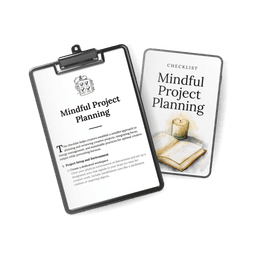
Our free Mindful Project Planning checklist puts the weekly review and the planning questions on one page.
Prioritization methods compared
Every method below is a different way of doing Steps 3 to 5. None has been tested in a controlled trial that we could find, so pick the one that fits how you work.
| Method | How it works | Good for | Watch out for |
| Eisenhower matrix | Sort tasks into urgent/important boxes | Seeing how much of your day is other people's rush | Everything ends up in the top-left box |
| ABCDE | Label each task A (must) to E (eliminate), then number within each letter | Short to medium lists | Letters inflate until everything is an A |
| MoSCoW | Must, Should, Could, Won't have | Projects with a fixed deadline and a team | Everything becomes a Must; no order inside each group |
| 1-3-5 | Each day: 1 big task, 3 medium, 5 small | People who overfill their days | Nine tasks is still a lot; shrink the ratio if you never finish |
| Ivy Lee | Each evening, write six tasks in order; work top to bottom | Simple, paper-based days | Only works if you do the evening step |
| Eat the frog | Do your hardest important task first | Tasks you keep avoiding | Can stall people who need a warm-up (see below) |
| 80/20 rule | Look for the few tasks that produce most of the value | Cutting a long list | A rule of thumb, not a law; the split varies |
A good habit with any of them: start every item at the lowest priority and make it argue its way up. It keeps the top category small.
Eat the frog or start with an easy task?
"Eat the frog" means doing your hardest, most important task first thing. There is no direct test of the idea, but one study comes close. Researchers looked at six years of emergency department data and found that under heavy workload, doctors tended to pick easier patients, and after adjusting for the complexity of the work, that habit was linked to worse throughput (KC, Staats, Kouchaki and Gino, 2020). In other words, always choosing the easy thing has a cost over time.
That does not mean the hard task must come first every morning. Some people, including many with ADHD, say a small easy win gets them moving. A sensible middle ground: one quick task of five minutes or less to warm up, then the frog, before email and meetings. If you never get to the frog, our guide on how to stop procrastinating deals with that part.
How to prioritize when everything is urgent
When the whole list screams at once, slow the sorting down rather than speeding up:
- Write every "urgent" item down with its real deadline next to it. Not "ASAP," a date and time.
- Next to each, write what happens if it is late by one day. Many items have no real consequence.
- Do the one with the earliest real deadline and the worst consequence.
- Tell the owners of the others when they will get it. A clear "Thursday at noon" calms most requests.
If every week feels like this, the problem is not your method. It is the amount of work. Our guide on how to manage stress at work has a script for raising workload with your manager.
Prioritizing work when you have more than one boss
When two managers both say their work comes first, ranking it yourself puts you in the middle. The common advice from workplace columnists: make the people who set the work decide its order. Write to both, or ask them together:
"I have the client report for Maria and the budget review for Sam, both due Friday. I can do one well by Friday and the other by Tuesday. Which should come first?"
Put it in writing so the decision is on record. If they cannot agree, go to whoever manages both of them. While you wait, work by real deadline, then by value to the business.
How to say no to a new task
A new request is a priority question in disguise. Instead of yes or no, answer with a trade-off:
"I can take this on. If I do, the onboarding guide moves to next week. Is that the right trade?"
Other options are a partial yes ("I can do the first draft, not the slides") or a later yes ("I can start on the 15th"). If saying no at all feels impossible, that is a pattern worth looking at on its own. Our guide on how to stop being a people pleaser covers it.
How to prioritize with ADHD
With ADHD, tasks often feel equally important, and the act of choosing can freeze you. What tends to help:
- Brain dump first, choose second. Do Steps 1 and 2 on paper before you try to rank anything.
- Pick one, not three. One main task for the day is enough. Add more only after it is done.
- Make deadlines visible. Put due dates on a calendar you see, not in your head. Our article on time blindness explains why "later" feels far away.
- Borrow an outside view. Ask a manager, coworker or friend which item they would do first. It is faster than deciding alone.
For the wider system, see how to be productive with ADHD.
Prioritization myths to drop
| Myth | What the evidence says |
| "Willpower runs out, so make big decisions early or you will choose badly." | The "ego depletion" idea behind decision fatigue failed two large preregistered replications: one with 23 labs and 2,141 people found an effect close to zero (Hagger et al., 2016), and one with 36 labs and 3,531 people found a nonsignificant result (Vohs et al., 2021). The famous "hungry judges" study is also disputed: a simulation suggested much of the pattern could be a statistical artifact of how cases were scheduled around breaks, rather than fatigue (Glöckner, 2016). |
| "80% of results come from 20% of tasks." | Pareto's ratio came from his observations on how land and wealth were distributed in Italy. Skewed patterns are common, but the exact split varies and we found no evidence specific to personal tasks. |
| "Unfinished tasks stick in memory (the Zeigarnik effect)." | A 2025 meta-analysis found no memory advantage for unfinished tasks, though people do tend to go back to interrupted tasks (Ghibellini and Meier, 2025). |
| "Working on several priorities at once is efficient." | Switching between tasks costs time, and the cost grows as the rules for each task get more complex (Rubinstein, Meyer and Evans, 2001). |
| "Good time management guarantees better results." | A meta-analysis of 158 studies found time management moderately related to performance and more strongly to wellbeing, but most studies were cross-sectional, so cause and effect are unclear (Aeon, Faber and Panaccio, 2021). |
When your to-do list keeps growing
A list that only grows becomes a guilt pile, and people stop looking at it. Three fixes:
- Keep two lists. "Now" holds only what you could do this week. Everything else goes on "someday."
- Cap the daily list. Many people cap it at three to five items.
- Declare list bankruptcy. Once or twice a year, archive the whole list and rebuild it from scratch. Whatever you cannot remember probably did not matter.
If the list grows because new tasks keep finding their way to you, the issue is usually upstream: how many requests you accept.
Your first week
- Day 1: Do Steps 1 and 2. One list, cut what you can.
- Day 2: Sort with the matrix. Ask "what happens if this waits a week?" for every urgent item.
- Day 3: Rank the important tasks against one goal for this month.
- Days 4 and 5: Each morning, one main task with a time slot. Each evening, five minutes to pick tomorrow's.
- Day 6: Notice which "urgent" requests came from other people, and have one trade-off conversation.
- Day 7: Weekly review. Move items between "now" and "someday."
If you want the longer version of this, with values, goals and a full daily routine built around them, our book Prioritize Your Life goes deeper. For more tips that fit this system, read our productivity tips.
Frequently asked questions
What is the best way to prioritize tasks?
There is no tested "best" method. What works for most people is a short routine: one list, cut what does not matter, sort by importance and real deadlines, pick one to three tasks for today with a time for each, and review daily and weekly.
How many tasks should be on a daily to-do list?
Fewer than you think. One main task plus two smaller ones is a good start. Because we tend to underestimate how long tasks take, a short list you finish beats a long list you carry over.
What is the Eisenhower matrix?
A four-box grid that sorts tasks by urgent and important: do, schedule, hand off or limit, and drop. It is named after a remark Eisenhower quoted in 1954 and was popularized by Stephen Covey. It has not been tested in controlled studies.
Should I do the hardest task first?
Often, yes, because always choosing easy tasks has a cost over time. If starting with the hardest task makes you freeze, do one five-minute task first, then the hard one.
How do I prioritize when my boss says everything is a priority?
Ask for an order, not a list. Show your tasks and their deadlines and ask, "If I can only finish two this week, which two?" Put the answer in writing.
How we put this guide together
This guide was written with AI assistance and edited by the AllMyGuides team. We started from what people ask about prioritizing in public forums and videos, then checked each research claim against the original paper or official page, using abstracts from Europe PMC and Crossref where full texts were closed. Where we could not find a study, we say so. We have not run our own tests of these methods. Sources were checked in November 2026.