Managing stress at work is a mix of two jobs: changing what you can about the work itself (workload, priorities, after-hours expectations) and helping your body and mind recover from what you cannot change. Most advice covers only the second half. The approach below starts with the causes, then gives you tools for the moment, the end of the day, and the weeks when work stays heavy.
This guide covers the main causes of job stress, a quick way to find yours, scripts for talking to your manager, how to switch off after work, what the research says works, and when stress is a sign to get help or to leave.
Key takeaways
- Work stress is common. In Gallup's latest data, half of US employees said they felt a lot of stress the previous day.
- The biggest drivers are high demands with little control and effort that is not rewarded. Self-care helps you cope, but it does not fix an impossible workload.
- The most useful conversation is about priorities: show your manager the full list and ask which tasks matter most.
- Switching off after work matters. Mentally detaching from work is linked to less exhaustion and better sleep.
- Programs based on cognitive behavioral techniques produced the largest effects in a major meta-analysis of workplace stress programs.
What work stress is, and why it happens
The US National Institute for Occupational Safety and Health (NIOSH) defines job stress as the harmful physical and emotional responses that occur when the requirements of a job do not match the capabilities, resources, or needs of the worker. In other words, stress is a mismatch, not a personal weakness.
It is also widespread. Gallup's State of the Global Workplace report found that 50% of US employees experienced stress a lot of the previous day, compared with 40% globally. In the American Psychological Association's 2025 Work in America survey, 54% of US workers said job insecurity had a significant impact on their stress levels.
Researchers have two classic explanations, both summarized in a 2020 review by Siegrist and Wege:
- Demand and control. Jobs with high demands and little control are especially stressful, because they limit your autonomy.
- Effort and reward. Stress builds when you put in high effort and get little back in pay, recognition, or security.
The World Health Organization lists similar risks, including excessive workloads or work pace, understaffing, and lack of control over job design or workload. This is why the steps below start with the work, not with breathing exercises.
Find your main stressor
For one week, write down the moments your stress jumps: what happened, who was involved, and how you reacted. Then match them to the table:
| Stressor | What it looks like | Where to start |
| Too much work | Long lists, constant catch-up, no time to think | A priorities conversation with your manager |
| Low control | Decisions made for you, constant interruptions | Ask for one thing you can own, such as when you do focused work |
| Always on | Messages at night and on weekends | Clarify response expectations, set notification rules |
| Unclear role | Conflicting requests, not sure what "good" looks like | Ask for the top three outcomes for this quarter |
| Little reward | Effort goes unnoticed, no growth | Ask for feedback and a development conversation |
| Difficult people | A hostile coworker or a micromanaging boss | Distance, clear agreements in writing, HR if needed |
| Job insecurity | Layoff rumors, restructuring | Limit news checking, update your resume, keep your network warm |
How to manage stress at work: 7 steps
1. Get the full list out of your head
Write every task, meeting and commitment in one place, with a rough time estimate for each. Stress feels bigger when it is vague. A list turns "everything" into 23 specific items, and it is the tool you need for the next step.
2. Ask your manager to prioritize
If the list does not fit the week, that is information your manager needs. Show the list and ask them to rank it. For example:
"Here's everything on my plate this week, with time estimates. It adds up to about 55 hours. Can you help me decide what comes first and what can wait?"
When a new task arrives, name the trade-off: "I can take this on. If I do, the client report moves to next week. Which matters more?" This keeps you from silently absorbing work, which is a habit our guide on how to stop being a people pleaser covers in more depth.
3. Protect one block of focused time
Part of work stress can come from never finishing anything. Put one block of 60 to 90 minutes on your calendar most days, turn off notifications, and work on your top priority. If your days are fragmented, our productivity tips explain how to plan around your energy.
4. Take short breaks
A 2022 meta-analysis of micro-breaks (breaks of up to 10 minutes) found they slightly increased vigor and reduced fatigue (small effects), although they did not clearly improve overall performance, and the authors note that very draining tasks may need longer breaks. Stand up, walk, look out a window, or get a drink of water between meetings.
5. Calm your body in the moment
When stress spikes before a meeting or after a hard email, slow your breathing with a longer out-breath than in-breath for a minute or two. If the stress shows up in your body as a racing heart or tight chest, our guide to nervous system regulation has more quick tools.
6. Set rules for after-hours messages
Being expected to watch email outside work is a stressor in itself. In three studies of working adults, mostly in the US, organizational expectations to monitor email during nonwork time were linked to employees' anxiety and worse health, and the effects spilled over onto their partners. Do not guess what your manager expects. Ask:
"When you send messages in the evening, do you need a reply that night, or is first thing in the morning fine?"
The answer may well be "morning is fine." Then turn off work notifications after a set hour, and schedule your own late messages to send during work hours so you do not create the same pressure for others.
7. Switch off at the end of the day
Psychologists Sabine Sonnentag and Charlotte Fritz describe four recovery experiences: psychological detachment from work, relaxation, mastery (challenging experiences or learning opportunities outside work), and control over your free time. For detachment, a meta-analysis of 91 samples linked it with less exhaustion, more life satisfaction, more well-being and better sleep, although those studies show associations, not cause and effect.
A simple shutdown routine helps you detach:
- Write tomorrow's top three tasks, so your mind does not have to hold them.
- Close every tab and the laptop, the same way each day.
- Do one thing that marks the end of work: a walk, a change of clothes, music on the way home.
- If thoughts about work come back in the evening, write them on the list and tell yourself you will deal with them tomorrow.
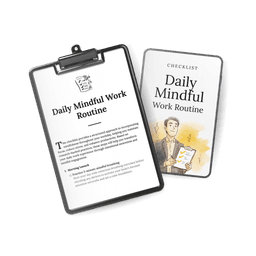
Our free Daily Mindful Work Routine checklist gives you a simple structure for the start, middle and end of the workday.
What the research says works
Workplace stress programs have been studied for decades. A meta-analysis of 36 studies found that cognitive behavioral programs, which teach you to notice and challenge stressful thoughts and to solve problems actively, consistently produced larger effects than other types of interventions. Mindfulness training also helps: a meta-analysis of 23 randomized trials found moderate reductions in stress among employees.
Regular exercise is worth keeping even in busy weeks. An umbrella review covering more than 1,000 trials found physical activity had medium effects on symptoms of depression and anxiety. Those trials were not about work stress specifically, but exercise benefits both physical health and mood.
The honest limit: these tools help you cope. They do not change a job that asks too much, gives too little control, or rewards nothing. If the cause is the work itself, the conversation in step 2 matters more than any app.
Why work stress is worth taking seriously
Short bursts of stress are normal. Years of it are a different matter. A WHO and International Labour Organization study estimated that long working hours led to 745,000 deaths from stroke and ischemic heart disease in 2016, with 55 or more hours a week linked to a higher risk than 35 to 40 hours. A large analysis of European cohorts found job strain was linked to a modestly higher risk of coronary heart disease, about 23%. Stress also works through hormones like cortisol, which our guide on how to lower cortisol explains.
If you want to spot the daily patterns that keep stress high, our 12 Stress Habits list is a quick place to start.
Stress or burnout?
Stress often feels like too much: too many tasks, too much pressure, a sense of urgency. Burnout tends to feel like too little: exhaustion, cynicism or distance from the job, and a sense that you are not effective. If you recognize the second pattern, our guide on how to recover from burnout covers what to do next, and our Personal Burnout Detector helps you track the early warning signs.
Stress about work also tends to show up at the edges of the day: Sunday-night dread, or waking up with a racing heart before a workday. If mornings are the worst part, read our guide to morning anxiety.
A plan for your next two weeks
- Days 1 to 5: Keep the stress log. Rate your stress from 0 to 10 at the end of each day and note the main cause.
- Day 6: Write your full task list with time estimates.
- Day 7 or 8: Have the priorities conversation with your manager.
- Days 8 to 14: Protect one focus block a day, take micro-breaks between meetings, and use the shutdown routine every evening.
- Day 10: Ask about after-hours expectations if messages at night are a problem.
- Day 15: Compare your ratings. Keep what helped and decide what still needs a bigger change.
If after-hours requests and saying yes to everything are the core problem, our guide Boundaries that Work at Work gives you scripts for coworkers and clients and a simple system for meetings and availability.
When to get help, and your rights
Talk to a doctor or mental health professional if stress affects your sleep most nights, if you feel hopeless or constantly on edge, or if you rely on alcohol to unwind. Many employers offer an Employee Assistance Program (EAP), which the US Office of Personnel Management describes as a voluntary, work-based program that offers free and confidential assessments, short-term counseling and referrals. Check your benefits or ask HR.
If you have a mental health condition such as depression or an anxiety disorder, the US Equal Employment Opportunity Commission explains that you may have a legal right to a reasonable accommodation, such as altered break and work schedules or a quieter workspace.
If you are in crisis or thinking about harming yourself, call or text 988 in the US to reach the 988 Suicide and Crisis Lifeline, any time, day or night.
Frequently asked questions
How do I tell my boss I have too much work without sounding like I can't handle it?
Make it about priorities, not ability. Bring the full list with time estimates and ask which tasks matter most. You are giving your manager information they need to make good decisions.
Do I have to answer work messages after hours?
It depends on your role and your agreement with your employer. Some people send messages at night simply because that is when they have time, not because they expect an instant reply. Ask what is expected instead of assuming you must reply right away.
How do I stop thinking about work when I get home?
Use a shutdown routine: write tomorrow's top tasks, close everything, and do one activity that marks the end of the workday. If work thoughts come back, write them down for tomorrow instead of solving them in your head.
Is it unprofessional to cry at work?
Crying is a common human reaction to stress, and it is not a sign of weakness. In the moment, ask for a few minutes, step away, and breathe slowly. If it happens often, take it as a sign to look at what is going on, at work or outside it.
Will meditation or a wellness app fix my work stress?
They can help you cope, and mindfulness has decent evidence. They will not fix an unmanageable workload or a toxic environment. Use them alongside changes to the work itself.
How do I cope with fear of layoffs?
Focus on what you control: limit how often you check news and rumors, keep your resume and contacts up to date, and talk to people you trust. Uncertainty is stressful for almost everyone, so you are not overreacting.
When is work stress a sign to leave the job?
Consider it when stress stays high for months despite real changes, when it harms your health or relationships, or when the job requires things you cannot accept. A therapist or career counselor can help you weigh the decision.
How we put this guide together
This guide was written with AI assistance and edited by the AllMyGuides team. None of us is a doctor, therapist or HR professional, so we relied on published research and on public sources such as NIOSH, the WHO, Gallup, the EEOC and OPM, and we opened every linked source to check that it says what we report. Where studies show associations rather than cause and effect, we say so. We also read what people discuss online about work stress to choose the questions and scripts. This article is general information, not medical or legal advice. Last reviewed November 2026.