
Time blindness is a popular name for a persistent difficulty sensing how much time has passed and estimating how long things will take. It is often linked to ADHD, but it is not a diagnosis in itself. In daily life it shows up as chronic lateness, tasks that take three times longer than planned, hours that vanish during hyperfocus, and whole afternoons lost waiting for a single appointment.
This guide explains what time blindness is, what research actually shows about time perception in ADHD, the signs, and why "just set an alarm" rarely works. Then it gives you a simple system to make time visible, plan with real numbers and protect yourself from the hyperfocus trap, plus what professional help can do.
Key takeaways
- Time blindness is not a formal diagnosis. It describes real time-perception and time-management problems that research links to ADHD.
- Studies find people with ADHD judge durations less accurately and less consistently than others. Most people underestimate how long tasks take, though, so not every late arrival is ADHD.
- The fix is outside your head: clocks you can see, timers that show time draining away, and plans built from how long things really took last time.
- Plan backwards from the moment you must leave or finish, and use a ladder of warnings instead of a single alarm.
- Cognitive behavioral therapy programs that teach time management have shown benefits for adults with ADHD in clinical trials.
What is time blindness?
Cleveland Clinic describes time blindness as being unable to recognize when time has passed or to estimate how long something will take, and notes that it "isn't a diagnosis or a specific symptom." You won't find it in the diagnostic manual. A CHADD article on time blindness at work describes it as a consistent difficulty perceiving how much time has passed or is left, recalling the order of events, and repeating a task for the same length of time as before.
The idea comes largely from psychologist Russell Barkley, who argued in 1997 that ADHD is as much a problem of managing time as of attention. In his words, ADHD "returns control of behavior to the temporal now." People often summarize this as two zones: now and not now. A deadline next week lives in "not now" and feels unreal, until it suddenly becomes "now" and urgent.
ADHD itself is common. A 2024 CDC report estimated that 15.5 million US adults (6.0%) had a current ADHD diagnosis, based on self-report. Not all of them struggle with time in the same way, and people without ADHD can have similar problems.
What the research says
Time perception in ADHD has been studied for decades, mostly in labs where people estimate, reproduce or compare short durations. A 2022 meta-analysis of 55 studies found "a broad range of timing deficits in persons with ADHD," from judging very brief intervals to estimating and producing durations of several seconds.
Most of that research is in children, but adults show it too. In a study of 104 adults with ADHD and 64 without, the ADHD group made larger errors when reproducing intervals of 12, 45 and 60 seconds. Another adult study found "greater and more variable deviation in time estimation." Results are not uniform, and some studies find little difference, so time blindness is a tendency, not something every person with ADHD has.
Two related findings help explain everyday life:
- Most people underestimate their own tasks. In classic studies of the planning fallacy, people underestimated how long their own tasks would take, but not other people's, because they focused on the plan and ignored past experience. ADHD seems to add more error and less consistency on top of this common bias.
- Later rewards feel smaller. A meta-analysis of 21 studies found people with ADHD discount delayed money rewards more steeply than controls, a medium-sized effect. That is the "not now" problem in numbers: a future payoff has less pull on today's choices.
Signs of time blindness
| What it looks like | What is going on |
| You are late even when you start getting ready "on time" | Each step (shower, keys, traffic) takes longer than you estimated, and the errors add up |
| A "quick" task eats the afternoon | The estimate came from the plan, not from how long it took last time |
| Hours disappear during something interesting | Hyperfocus: attention locks on the task and you may lose track of time completely |
| Five boring minutes feel like an hour | Time feels slow when a task gives your brain little to grab onto |
| One afternoon appointment ruins the whole day | "Waiting mode": you can't start anything in case you lose track and miss it |
| Deadlines feel fake until the night before | "Not now" versus "now": the future lacks urgency until it is close |
Is time blindness real, or an excuse?
Both reactions miss the point. The underlying time-perception differences are real and measurable, as the studies above show. But the label explains lateness only some of the time, and it doesn't make the impact on others go away. A partner or coworker who waits 20 minutes still waited 20 minutes.
The useful way to see it: time blindness explains why the problem happens, and it tells you what kind of fix will work. Willpower and good intentions don't create an internal clock. External tools do. Taking responsibility means building those tools, not pretending the difficulty isn't there.
How to manage time blindness: make time visible
The common thread in everything that helps is moving time out of your head and into the world, where you can see it. One caution on evidence: the strongest trials of time aids are in children. A small study of 47 children with disabilities, including ADHD, and a randomized trial in 38 children with ADHD found that time aids plus training improved how well they handled time. We found no trials of visual timers in adults, so treat the tools below as practical, low-risk experiments.
1. Put a clock where your eyes already are
An analog clock in your line of sight at your desk, in the bathroom and by the front door. Many people find that moving hands show time as space running out in a way digital numbers don't. Some people find a ticking clock distracting, so try a silent one.
2. Use a timer that shows time draining away
A visual timer, the kind with a colored disc that shrinks, makes "20 minutes left" something you can see from across the room. Use it for tasks under an hour and for getting ready to leave. If a reminder stops registering after a few weeks, move it or switch to a different kind.
3. Time your real tasks for one week
This is the most useful step and the one most people skip. For a week, note how long routine things actually take: showering, getting out the door, answering email, a weekly report, the commute. In the planning fallacy studies, the bias disappeared when people were told to connect their predictions to past experience. Your log is that past experience, written down. Use its numbers, not your gut, the next time you plan. Our Productivity with ADHD Workbook has exercises for building this kind of personal time map.
4. Plan backwards from the moment that matters
Start from when you must arrive or deliver, then subtract every step with its real duration, plus a buffer. "Meeting at 10:00. Drive 25 minutes, parking 5, walk in 5, buffer 10: leave at 9:15. Getting ready takes 40: start at 8:35." Write the start time down. That is the time you set your first alarm for, not the meeting time.
5. Use a ladder of alarms, each with a job
One alarm is easy to dismiss. Set a short ladder with labels: "30 minutes: finish what you're doing," "10 minutes: shoes and keys," "Leave now." A label tells you what to do, which beats a beep that only tells you something is happening.
6. Put a fence around hyperfocus
Before starting something absorbing, decide when it ends and set an alarm you have to stand up to turn off, such as a phone across the room. Having to stand up makes it harder to tap "snooze" and keep going. Working next to someone else, in person or online, also helps some people notice time passing; our guide to body doubling explains how.
7. Get out of waiting mode
If one appointment freezes your whole day, book appointments first thing in the morning or late in the day when you can. Otherwise set a "go" alarm for when you need to start getting ready, then give yourself permission to forget the appointment until it rings and do something useful in between.
A day with time blindness, managed
- Evening: look at tomorrow's calendar. For each fixed event, work out the start-getting-ready time and set the alarm ladder.
- Morning: visual timer on the routine, clock in sight, leave at the planned time even if something is unfinished.
- Work blocks: a set end time for each block, timer visible, phone alarm across the room for anything that could pull you into hyperfocus.
- Before a deadline: break it into dated mini-deadlines, so "not now" becomes a series of small "nows."
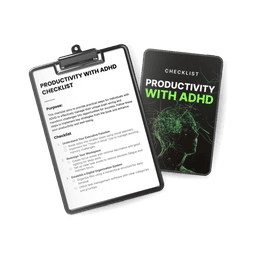
Pulling the pieces together into one routine is where a system helps. Our Productivity with ADHD Bundle combines the guide, workbook, prompts and toolstack, and our free Productivity with ADHD checklist is a quick place to start. The Productivity with ADHD Toolstack lists tools for tracking time and managing schedules if you want to compare apps. For the bigger picture, see our guide on how to be productive with ADHD.
Your first week
- Day 1: put an analog clock where you work and one by the door.
- Days 1 to 7: log how long your routine tasks really take.
- Day 2: use a visual timer for getting ready in the morning.
- Day 3: plan one appointment backwards with a written start time.
- Day 4: set up an alarm ladder for that appointment.
- Day 5: try one work block with a fixed end and an alarm across the room.
- Day 7: compare your guesses with your log and adjust your default estimates.
Time blindness at work and in relationships
At work, tell your manager what helps rather than leading with a label: clear due dates, alerts before tasks and meetings, shorter meetings with breaks, regular check-ins. CHADD's workplace article points out that neurotypical people ask for these changes too. If you have a diagnosis, you can ask HR about formal accommodations.
In relationships, lateness often lands as "you don't care." Explain the problem once, calmly, and then show the system you are using: a shared calendar with travel time built in, the alarm ladder, an agreed text if you are running late. What rebuilds trust is the fix, not the explanation.
When to get professional help
If time problems are costing you jobs, grades or relationships, talk to a doctor or a psychologist who works with adult ADHD. An evaluation can tell you whether ADHD, anxiety, depression, sleep problems or something else is driving it.
Therapy can help with the practical side. In a randomized trial of 86 adults with ADHD already on medication, cognitive behavioral therapy led to more improvement in symptoms than relaxation training with education, and gains held at 12 months. Another trial tested a group program focused on time management, organization and planning, and found larger symptom improvement than supportive therapy. A Cochrane review rates the overall evidence as low quality, suggesting these therapies may help in the short term. Medication decisions belong with your doctor.
Time blindness often travels with other ADHD difficulties. If starting tasks is the bigger problem, our guides on ADHD paralysis and executive dysfunction go deeper.
Frequently asked questions
Is time blindness only an ADHD thing?
No. It is most often discussed with ADHD, where research finds time-perception differences, but anyone can underestimate tasks, and anxiety, depression, sleep loss and other conditions can affect how you handle time.
Is there a time blindness test?
There is no official test, because it isn't a diagnosis. A simple self-check is to guess how long five routine tasks take, time them for a week and compare. If ADHD is a question, a professional evaluation is the right route.
Why do I always underestimate how long things take?
Partly because most people do: we plan from the ideal version of a task and forget the interruptions. ADHD can add more error on top. The cure is data: time your tasks and plan from those numbers.
Why do I lose a whole day to one appointment?
That is "waiting mode." Not trusting yourself to notice the time, you avoid starting anything. A start-getting-ready alarm lets you hand the remembering to your phone and get on with the day.
Do visual timers actually help?
Trials in children with ADHD found time aids plus training improved time management. We found no trials in adults, but visual timers are cheap and many adults find them useful, especially for routines and getting out the door.
Why do my alarms stop working after a while?
Many people stop noticing alarms they hear every day. Change the sound, label each alarm with the action to take, and put the phone where you must get up to turn it off.
Can medication help with time blindness?
A review of timing research in ADHD reported early evidence that methylphenidate reduces many of the timing difficulties seen in lab tasks, but whether medication is right for you is a decision to make with your doctor.
How we put this guide together
This guide was written with AI assistance and edited by the AllMyGuides team. None of us is a doctor or therapist. We built it from meta-analyses and studies on time perception in ADHD, randomized trials of therapy and time aids, a Cochrane review, CDC data and articles from Cleveland Clinic and CHADD. We opened each linked source to check that it says what we report, and we noted where evidence comes from children or lab tasks rather than adults' daily lives. We also read discussions among adults with ADHD to understand which tools they find useful. Reviewed in November 2026. This article is general information, not medical advice. If ADHD or time problems are seriously affecting your life, talk to a qualified professional.