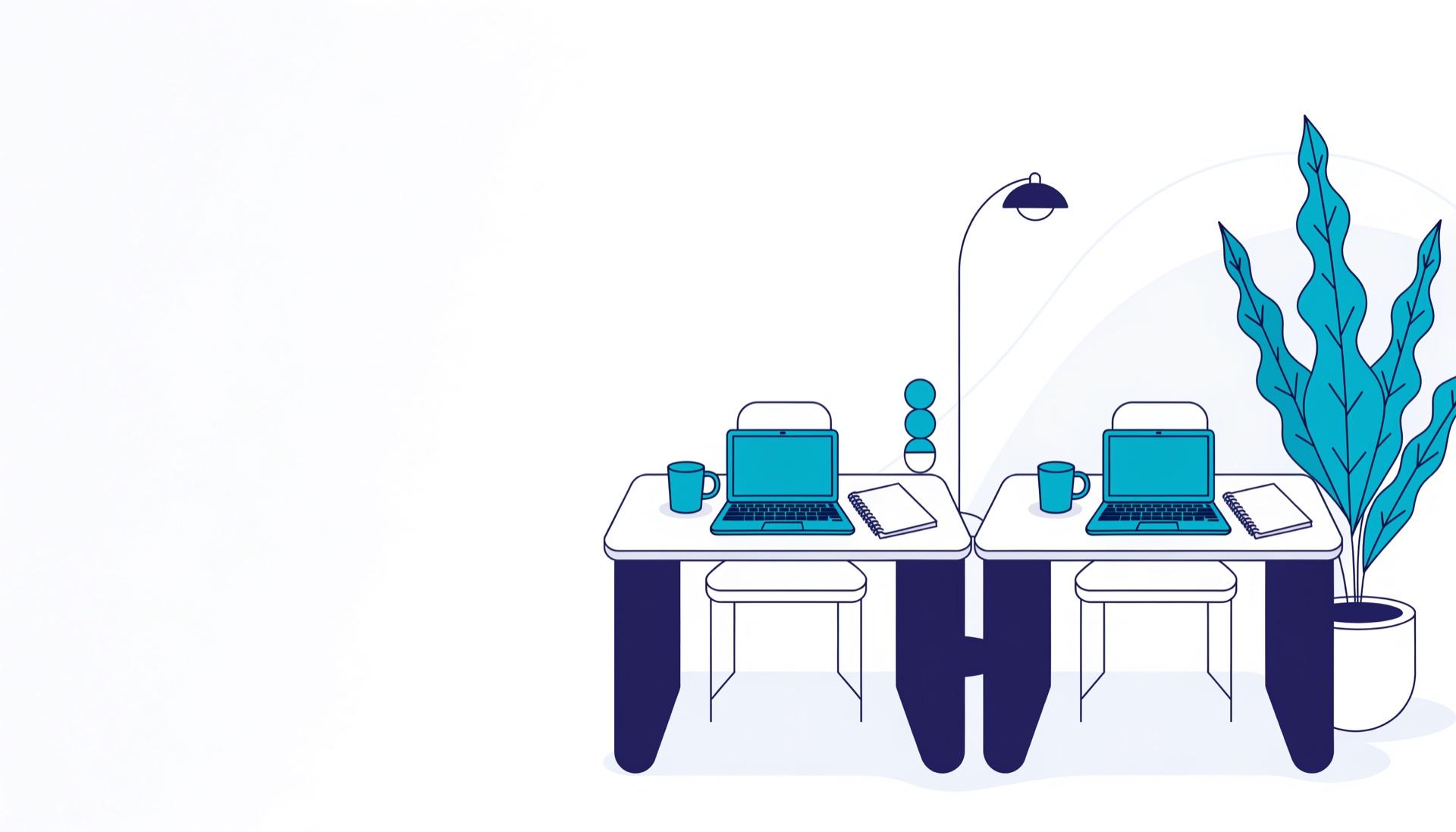
Body doubling is doing a task while another person is present, in the same room or on a video call. The other person doesn't help with your task. Often they are working on something of their own. Their presence is the whole tool: it makes it easier to start, stay with, and finish the thing you keep putting off.
It is popular among people with ADHD, and plenty of people without ADHD use it too. The short answer to "does it work?" is: many people say it does, the research is still thin, and it costs almost nothing to test. This guide covers what body doubling is, why it may help, what the studies actually show, and how to run your first session this week.
Key takeaways
- Body doubling means working while someone else is present, in person or online. They don't need to help or even do the same task.
- People use it most to start tasks they avoid, such as admin, cleaning, studying or email.
- There is no controlled trial yet, and small studies point both ways, so treat it as an experiment.
- Research on working in front of others suggests it helps most with simple, familiar tasks and less with hard, new ones.
- A good first session: one named task, a timer, no chatting, and a short check-in at the end.
What body doubling is (and what it isn't)
A 2024 survey of 220 people about body doubling, a practice used mainly by neurodivergent people, describes it as using someone else's presence to start, stay focused on, or finish a task (Eagle et al., 2024). The "double" can be a friend, a partner, a coworker or a stranger in an online room.
It helps to separate it from three things it gets confused with:
| Practice | What happens | How it differs from body doubling |
| Body doubling | You work while someone else is present | The other person is there, not helping |
| Parallel play | Young children play next to each other, each with their own activity | Same shape, but it is a stage of child development, not a work method |
| Accountability partner | You report your goals and progress to someone | Can happen by message, with nobody present while you work |
| Coworking | You share a workspace with other people | Body doubling is coworking with a purpose: getting one task done |
The APA Dictionary of Psychology defines parallel play as a child being "next to others and using similar objects but still engaged in their own activity" (APA Dictionary of Psychology). Body doubling is often described as the adult version, which is a fair comparison as long as you remember that one is a developmental stage and the other is a deliberate habit.
Why body doubling may help
Nobody has pinned down exactly why it works for the people it works for. Two older lines of research offer reasonable explanations.
Other people change how we perform
Psychologists call this social facilitation. Robert Zajonc argued that when we are with others, we feel more aroused than when we are alone, which pushes us toward our "dominant response," the thing we would most likely do anyway (Principles of Social Psychology). A meta-analysis of 241 studies found that the presence of others speeds up simple tasks and slows down complex ones (Bond and Titus, 1983). The effects were small.
No study has tested this directly on body doubling, so here is our reading, not a finding: body doubling probably works best on boring, familiar tasks you already know how to do, like laundry, invoices or reviewing notes. For hard thinking work, you may want quiet and solitude instead.
Checking in keeps you honest
A meta-analysis of 138 studies with nearly 20,000 people found that monitoring progress toward a goal helped people reach it, and that the effect was larger when progress was reported to others or written down (Harkin et al., 2016). That is close to what happens at the start and end of a body doubling session: you say what you'll do, and later you say what you did.
One caution. A separate set of experiments found that when other people took notice of someone's plans toward an identity goal, for example becoming a lawyer, people who cared strongly about that goal then acted on those plans less. Being noticed gave them a premature sense of already being that person (Gollwitzer et al., 2009). So keep your check-ins small and concrete: "I'll file three invoices," not "I'm getting my life together."
Body doubling and ADHD
In 2023, about 6% of US adults, roughly 15.5 million people, reported a current ADHD diagnosis (CDC, 2024). The National Institute of Mental Health lists procrastination, poor time management, and trouble finishing projects among the common signs in adults (NIMH). Those are exactly the problems body doubling is used for, which helps explain why it is so popular in ADHD communities.
Cleveland Clinic behavioral health specialist Michael Manos describes the effect simply: "Modeled behavior is very potent" (Cleveland Clinic). Seeing someone else working makes working feel like the normal thing to do in that moment.
Body doubling is a self-help habit, not a treatment. It can sit alongside whatever support you already have, and it works best as one piece of a wider routine. Our guide on how to be productive with ADHD shows where it fits next to planning, small first steps and a distraction-free space.
What the research says so far
Here is the honest state of the evidence, as of late 2026:
- No randomized controlled trial. We could not find one. CHADD, the US ADHD organization, notes that there hasn't been significant research on how body doubling works, and that it doesn't work for everyone (CHADD).
- Surveys describe how people use it. The 2024 survey above maps what people do and why, but it doesn't measure whether it improves their output.
- Small lab studies disagree. A 2025 conference poster describes a study in which people with and without ADHD wore a brain-computer interface headset and did a reading test, alone and then with a body double. It found no significant effect on performance, focus or calm (Schuenke and Moore, 2025). The authors note that a reading test may not capture how people really use body doubling, which is often to start or finish tasks. A 2025 virtual reality study with 12 adults with ADHD found they finished a task faster with a body double, but it is a preprint that hasn't been peer reviewed yet (Ara et al., 2025).
Put together: the idea is plausible, many people report that it helps, and the controlled evidence isn't there yet. It is free and low-risk, so the sensible move is to test it on yourself for a week and judge by results.
Ways to find a body double
- In person. A friend, partner or roommate sits with you while you both work. Agree before you start that it is work time, not chat time.
- On a video call. A friend, classmate or coworker on camera, both muted, both working. This is the easiest free option.
- In a public place. Cleveland Clinic suggests places where people work quietly, such as a library or a coffee shop.
- Online focus rooms. Platforms match you with a stranger for a timed session. CHADD mentions Focusmate, for example, which has a free tier and paid options. Search "body doubling app" and you'll find several more.
- Recorded "study with me" or "work with me" videos. Someone works on camera for an hour or more. There is no check-in, so there is less accountability, but also no pressure. A good starting point if a live camera makes you anxious.
How to run a body doubling session
A session that works for most people takes five steps:
- Pick one task. Name it in one sentence: "I'm answering the three emails from Monday." Vague tasks like "work on stuff" give you nothing to report.
- Write down the first physical step. Open the document. Put the laundry basket on the bed. A small first step is easier to start with someone watching than a big one. Our guide on how to stop procrastinating has more ways to shrink a task.
- Set a timer. Cleveland Clinic suggests sessions of about 20 to 90 minutes. Start short: 25 or 30 minutes is plenty for a first try.
- Work, don't talk. If something comes up, write it on paper and keep going. Phones face down.
- Check in at the end. Say what you got done in one sentence. Small and concrete is the point.
If the first session went well, try a second one right after a five-minute break, while you are already in motion.
Which tasks suit body doubling
Based on the research on working in front of others, the best fits are tasks that are boring rather than hard:
- Admin and paperwork: bills, forms, expense reports, inbox clean-up.
- Household chores: laundry, dishes, decluttering one drawer.
- Studying routine material: flashcards, rewriting notes, practice questions.
- The first 15 minutes of anything you've been avoiding.
For deep, complex work like writing a hard proposal or learning something new, you may do better alone. Try both and compare. If you want to protect long stretches of hard focus, see how to enter a flow state and how to stay focused.
When body doubling stops working
It is common for a new trick to feel great for two weeks and then fade. A few fixes:
- You feel watched or anxious. Turn the camera off and keep only the audio, switch to a recorded video, or try a library instead of a call.
- Your double turns into a chat partner. CHADD warns that a friend may end up socializing instead of working. Agree on a rule: talking only during the break.
- The novelty wore off. Change one thing: a new partner, a new place, or a new time of day.
- It never helped. That is a valid result. Body doubling doesn't work for everyone, and some people focus better alone. Drop it and use the time for a different tool.
Try it this week
- Day 1: Write down three tasks you've been avoiding.
- Day 2: Ask one person for a 30-minute video session, or book one on a focus platform.
- Day 3: Run the session with the five steps above. Note how long it took you to start.
- Day 4: Do the second task alone, same length of time. Note how long it took you to start.
- Day 5 to 7: Repeat with a different format (in person, video, recorded). Then compare your notes and keep what worked.
If you'd like a checklist to go with it, our free Productivity with ADHD Checklist covers the daily basics for time, habits and focus. For a full system with exercises, the Productivity with ADHD Bundle brings the guide, workbook and ebook together, and the Toolstack lists apps for time, habits and focus.
FAQ
Is body doubling only for ADHD?
No. It is most talked about in ADHD and other neurodivergent communities, but anyone who struggles to start boring tasks can try it.
Why does body doubling work?
Nobody knows for sure. Two likely reasons: the presence of others tends to speed up simple tasks, and saying what you'll do and then reporting back makes you more likely to follow through. Neither has been tested specifically on body doubling.
What is the difference between body doubling and parallel play?
Parallel play is a stage of early childhood in which children play next to each other, each with their own activity. Body doubling borrows the same shape for adults: two people side by side, each on their own task, on purpose.
Can a YouTube video be a body double?
For many people, yes, at least partly. A "study with me" video gives you the sense of someone working alongside you, without the pressure of a live camera. It gives you no one to check in with, so you lose some of the accountability.
Are there free body doubling options?
Yes. A video call with a friend is free, as are libraries and recorded work-along videos. Some online focus platforms are free to join, with paid options on top.
How long should a body doubling session be?
Cleveland Clinic suggests about 20 to 90 minutes. Start with 25 to 30 minutes and adjust once you know how your focus holds up.
How we put this guide together
This guide was written with AI assistance and edited by the AllMyGuides team. None of us is a doctor or therapist. We used public health sources (CDC, NIMH, Cleveland Clinic, CHADD), peer-reviewed research and the APA Dictionary of Psychology, and we opened every linked source to check that it says what we say it says. Where the evidence is weak or missing, we have said so. Last checked in November 2026.
This article is for general information and is not medical advice. If ADHD symptoms are affecting your work, health or relationships, please speak with a qualified healthcare professional.