Eat the frog is a productivity method that means doing your most important and most dreaded task first, before anything else in your day. The "frog" is the task you are most likely to put off and most likely to regret putting off. The idea is that once it is done, the rest of the day is easier, and the task that matters most cannot get pushed aside by email and small jobs.
It works well for many people, but not for everyone and not every day. Below: where the phrase comes from, how to pick your frog, a five-step way to do it, what the research says, and how to adapt it if you are a night owl or have ADHD.
Key takeaways
- Your frog is one task: important, and the one you most want to avoid. Not the longest task, not the most urgent one.
- The quote is usually credited to Mark Twain, but its earliest known version is an 18th century French saying about swallowing a toad.
- No study has tested "eat the frog" directly. Related research supports parts of it: people drift toward easy tasks under pressure, and that habit has costs.
- "First thing in the morning" is the weakest part. Pick your best hours for the frog, which may not be 8 a.m.
- Most frogs are too big. Shrink yours to a first step you can start in two minutes.
What does "eat the frog" mean?
The phrase comes from a saying: if you have to eat a live frog, do it first thing in the morning, and nothing worse will happen to you the rest of the day. The method was popularized by Brian Tracy's book Eat That Frog!, first published in 2001, which built 21 time management ideas around it.
In practice, eating the frog means three things:
- Decide which single task matters most today.
- Start it before you open email, chat or social media.
- Stay on it until it is done, or until you reach a planned stopping point.
Did Mark Twain say it?
Probably not. Quote Investigator traced the idea to the French writer Nicolas Chamfort, who in the late 1700s credited a "M. de Lassay" with advising people to swallow a toad every morning. The first link to Twain they found was a 1988 newspaper column that hedged: it thought Twain said it, "and if he didn't he should have." Their conclusion: "The spurious linkage to Twain apparently occurred in recent decades" (Quote Investigator).
How to pick your frog
Picking the wrong frog is an easy way for the method to fail. A good frog passes three tests:
| Test | Question to ask | Not a frog |
| It matters | Will finishing this move a goal, a project or a promise forward? | Clearing your inbox |
| You are avoiding it | Is this the task I keep moving to tomorrow? | A task you enjoy and would do anyway |
| It is yours alone | Can I make real progress without waiting for anyone? | A task blocked by someone's reply |
If several tasks pass all three tests, pick the one with the biggest cost if it slips another week. If you are not sure which tasks matter most, sort your list first with our guide on how to prioritize tasks, then pick the frog from the top.
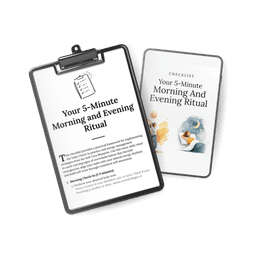
Picking tomorrow's frog the evening before means the morning starts with a decision already made. Our free 5-Minute Morning and Evening Ritual builds that choice into a short end-of-day routine.
How to eat the frog in 5 steps
Step 1: Name the frog the night before
Write one sentence on paper or a sticky note: "Tomorrow my frog is ___." One task only. If you write three, you have a to-do list, not a frog.
Step 2: Shrink it to a first step
"Write the annual report" is not something you can start. "Open the report file and write the three section headings" is. One of the strongest predictors of procrastination is how unpleasant a task feels, according to a meta-analysis of 691 correlations (Steel, 2007). A first step that takes two minutes feels much less unpleasant than the whole job. One recent experiment with 238 people working on a task they had been putting off found that breaking it into subtasks helped them get started (Garg and Schooler, 2026). It is a single study, but it fits common advice.
If the frog would take more than about half a day, it is a project. Make today's frog its next chunk. Our guide Conquer Procrastination has more ways to split tasks you dread.
Step 3: Decide exactly when you start
Turn the frog into an if-then plan: "When I sit down at my desk at 9:00, I open the report file." Plans in this form, called implementation intentions, had a medium-to-large effect on reaching goals across 94 tests in a meta-analysis (Gollwitzer and Sheeran, 2006). Put the time on your calendar so meetings cannot take it.
Step 4: Do it before the inbox
Email and chat are full of small, urgent-looking tasks that are easy to finish and feel productive. In one lab study, people who were interrupted while working finished faster but reported more stress, frustration and time pressure after only 20 minutes (Mark, Gudith and Klocke, 2008). Keep notifications off until the frog block is over. In a separate study, people who were asked to check email only three times a day for a week felt less stressed than in a week of unlimited checking (Kushlev and Dunn, 2015).
Step 5: Set a stopping point and protect the rest of the day
Give the frog a block, for example 60 to 90 minutes, and decide in advance what "done for today" looks like. Some people lose steam after the frog. Plan the next block right away so the rest of the morning has a shape too. Our Ultimate Focus Block Setup Protocol covers how to plan those blocks.
Does eating the frog work? What the research says
No study has compared "hardest task first" with other orders of work for ordinary people. But several lines of research speak to parts of the method.
We drift toward easy tasks, and it costs us
Researchers studied six years of data from a hospital emergency department and found that under heavier workload, doctors tended to choose easier patients. After adjusting for how complex the work was, that habit was linked to worse throughput and less learning. A lab experiment suggested the pull comes from both fatigue and "the sense of progress individuals get from task completion" (KC, Staats, Kouchaki and Gino, 2020). That is the problem eating the frog tries to solve: easy wins feel good today but can crowd out the work that matters.
Procrastination is about mood, not laziness
Researchers describe procrastination as having "a great deal to do with short-term mood repair and emotion regulation" (Sirois and Pychyl, 2013). We put off tasks because of how they make us feel. Doing the dreaded task early limits the hours you spend dreading it. Our guide on how to stop procrastinating goes deeper into this.
"Willpower is highest in the morning" is not well supported
A common reason given for eating the frog first is that willpower gets used up during the day. That idea, called ego depletion, did not hold up in two large preregistered replications: 23 labs with 2,141 people found an effect whose confidence interval included zero (Hagger et al., 2016), and 36 labs with 3,531 people found a nonsignificant result (Vohs et al., 2021). The method can still help. The willpower explanation for it is just weak.
Morning is not everyone's best time
Mental performance changes across the day, and how much depends on your body clock, or chronotype (Schmidt et al., 2007). In one study of 56 adults, late chronotypes ("night owls") did worse than early types on every measure tested in the morning (Facer-Childs, Boiling and Balanos, 2018). A review of attention research found that attention tends to be lowest at night and in the early morning, better around noon, and higher still in the afternoon and evening (Valdez, 2019). So the useful rule is "frog first in your best hours," not "frog at 7 a.m."
When eating the frog backfires
| Situation | What goes wrong | What to try |
| You are a night owl | You fight your slowest hours on your hardest task | Eat the frog first in your work session, even if that is 11 a.m. Do routine tasks early. |
| The frog is huge | You stare at it and do nothing | Shrink it to a two-minute first step (Step 2) |
| Your morning is full of meetings | There is no time before the first call | Block the first free 60 to 90 minutes, wherever it falls |
| The frog depends on other people | You start, then wait | Pick a frog you can move forward alone, and send the requests the day before |
| Anxiety spikes on waking | The dread makes the morning worse | A short warm-up task, then the frog. See below. |
| Every task feels like a frog | You cannot choose | Your list needs sorting, not a frog. Prioritize first. |
Eat the frog vs eat the ice cream first
Some people, many of them with ADHD, prefer the opposite: start with a small, pleasant or easy task to get moving, then turn to the hard one. Some writers call this "eat the ice cream first." There is a reasonable case for a short warm-up. In diary research with 238 office workers, Teresa Amabile and Steven Kramer found that making progress was "by far the most prominent" event on people's best days at work (Harvard Business School). A quick win can give that feeling.
The risk is the one from the emergency department study: one easy task becomes five, and the frog moves to tomorrow. One middle path:
- One warm-up task of five minutes or less, chosen the night before.
- Then the frog, with a timer.
- Then everything else.
Eat the frog with ADHD
Executive function problems, common in ADHD, can affect "an individual's ability to begin, work on and complete tasks," and CHADD lists "organizing, prioritizing and activating for tasks" among the executive functions involved (CHADD). That means the hard part is often starting at all, not knowing which task matters. Adaptations that fit:
- Make the frog tiny. "Open the document" counts as eating it. Anything after that is a bonus.
- Use a warm-up on purpose. One short, chosen task, then the frog, with a visible timer.
- Do it with someone. Working next to another person, in person or on a video call, is called body doubling, and some people find it helps them start.
- Drop the guilt rule. If the frog did not happen by noon, pick a smaller one for the afternoon instead of writing off the day.
If you freeze in front of the task no matter how small it is, our article on ADHD paralysis explains what is going on and what helps.
Eat the frog vs other methods
- Eisenhower matrix: sorts your whole list by urgent and important. Use it to find candidates, then pick one as your frog.
- Time blocking: plans the whole day in blocks. The frog is your first block.
- 1-3-5 rule: one big, three medium, five small tasks a day. Your frog is the "one."
- Pomodoro: 25-minute work sprints. Useful for starting a frog you dread: commit to one sprint only.
Eating the frog is not a full system. It is a rule for the first block of your day, and it combines well with a simple morning routine that ends at your desk.
A sample frog day
- Evening before (5 minutes): write tomorrow's frog and its first step. Send any requests the frog depends on.
- Start of work: water, coffee, phone in another room. One warm-up task if you need it.
- First 60 to 90 minutes: the frog. Notifications off.
- After the frog: email and messages, then your next planned block.
- End of day: note where you stopped on the frog, and pick tomorrow's.
For a deeper look at choosing what deserves your best hours, our book Prioritize Your Life covers goals, values and a daily routine built around them. For keeping your attention once the frog is underway, see how to stay focused.
Frequently asked questions
What is the frog in "eat the frog"?
Your most important task of the day that you are also most tempted to put off. It should be one task you can make progress on without waiting for anyone.
Where does "eat the frog" come from?
The method comes from Brian Tracy's 2001 book Eat That Frog!. The saying behind it is often credited to Mark Twain, but the earliest known version is an 18th century French aphorism about swallowing a toad every morning.
Does eating the frog actually work?
It has not been tested directly. Research on why we procrastinate and why we drift toward easy tasks supports its logic, while the claim that willpower is strongest in the morning is not well supported.
What if I have more than one frog?
Pick one. Ask which one costs the most if it slips another week, eat that one, and save the others for tomorrow.
Do I have to do it first thing in the morning?
No. Do it first in your best working hours. For night owls, that may be late morning or after lunch.
What if my frog takes all day?
Then it is a project. Make today's frog the next 60 to 90 minutes of it, with a clear stopping point.
How we put this guide together
This guide was written with AI assistance and edited by the AllMyGuides team. We started from the questions people ask about the method in forums and videos, then checked each research claim against the original paper, an official page or the publisher's abstract, using Europe PMC and Crossref where full texts were closed. Where no study exists, we say so. We have not run our own tests of the method. Sources were checked in November 2026.