A brain dump is writing down everything on your mind in one go, without sorting or judging it, so you can decide what to do with it afterwards. Tasks, worries, ideas and half-remembered errands all go on the same page. It takes a pen and about 10 minutes. You may have seen it promised as a way to clear your head. The research is more specific than that: putting open tasks on paper is one half, and choosing a next step for what you wrote is the half with more research behind it.
Key takeaways
- A brain dump has two parts: get everything out, then sort it. Skip the second part and you can end up with a page that stresses you out.
- We could not find a controlled trial of brain dumping for stress, sleep or productivity. Related studies are useful, but they tested neighboring things.
- In one experiment, writing about unfinished tasks led to more intrusive thoughts than writing about finished ones. Adding a plan for how, when and where removed that effect.
- At bedtime, people who spent five minutes listing upcoming tasks fell asleep faster than people who listed finished ones, in one small sleep lab study.
- Use one place you trust, keep the sort short and let yourself drop things. We did not see a study that says which notebook or app is best.
What is a brain dump?
The phrase has another meaning too. In computing slang, the FOLDOC dictionary lists it as telling someone everything one knows about a particular topic. In productivity advice it means emptying your own head onto paper. It is close to what the Getting Things Done method calls a mind sweep, where the point is to capture what has your attention before you analyze any of it.
You may also see the term used for a study technique (writing all you remember about a topic) or for leaked exam questions. This guide is about getting a crowded mind onto paper.
| Brain dump | To-do list | Journaling | |
| What goes in | Everything: tasks, worries, ideas | Only things to do | Thoughts and feelings, often one topic |
| Order | None at first | By priority or date | Free-flowing text |
| Goal | See it all, then sort | Get things done | Understand or process |
| What comes next | Sort, decide, drop | Do and tick off | Nothing required |
Does brain dumping work? What the research says
Short answer: parts of it are well supported, and the big promise is not. We could not find a controlled trial of brain dumping itself for stress, sleep or productivity. The closest were two small classroom studies, a single-athlete case, and two small studies without a control group where it was one step in a therapy program. Here is what related research shows.
Naming open tasks may not be enough. A plan can help.
In a 2011 set of experiments, students who wrote about two unfinished tasks had more intrusive thoughts while reading than students who wrote about two finished ones, and answered fewer questions about the text correctly. Those who also wrote how, when and where they would handle each task did not have that problem. The plan did not reduce anxiety, though, and the samples were students and online workers doing short tasks.
If-then plans in general have a good record. A meta-analysis of 94 tests found a medium-to-large effect on reaching goals, and a 2024 review of 642 tests found effects from small to medium-large, depending on what was measured.
Writing it down helps you remember, not necessarily stop thinking
Psychologists call this kind of thing cognitive offloading: using a physical action to lower the mental demand of a task. Reminders do help people carry out what they meant to do. But in a 2024 set of experiments, students who were promised an on-screen reminder did not think about the task any less. So "it's on paper, now my brain can let go" may be true for you, but that study found no sign of it. It also did not test writing things down yourself.
The Zeigarnik effect is weaker than its fame
The popular claim is that your brain holds on to unfinished tasks better than finished ones. A 2025 review and meta-analysis found no such memory advantage overall. What held up is a different finding: people tend to go back to a task that was interrupted.
Emotional writing is a different exercise
Expressive writing, where you explore feelings about something hard, has been tested a lot. Across 146 randomized studies of this kind of disclosure, the average effect was positive but very small. It also often brings a short-term rise in distress. A brain dump is a list, so those results do not transfer directly.
How to do a brain dump in 6 steps
Plan on about 20 minutes the first time: 10 to write, 10 to sort. The times are our suggestion, not from a study.
1. Pick one place
One notebook, one note or one sheet. In a set of experiments with computer files, saving one file helped people remember the next, but not when they thought the saving was unreliable. Files are not worries, yet the practical lesson is sensible: use a place you know you will see again.
2. Set a timer and write without sorting
Ten minutes. One item per line, in any order. "Call dentist," "am I behind at work," "gift for Sam" and "learn to bake" can sit next to each other. No spelling, no categories, no editing. If you worry about doing it wrong, start with the worst line you can think of. Nobody will read it.
3. Use prompts when you slow down
Go through the list of prompts below until two or three in a row bring up nothing. Then stop. You do not need to find every last thing.
4. Mark each line with a letter
Read once from the top and give each line one letter:
- D for do: there is an action you can take.
- W for worry: it bothers you, and it may or may not have an action.
- L for later: an idea or a someday thing.
- X for drop: it no longer matters, or you are not going to do it.
Use X freely. One forum poster's rule: if you have carried something over three or four times, either make it a priority or accept that it will not get done.
5. Give every D a next step
This is the part the research favors. For example, "taxes" becomes "Saturday after breakfast, at the kitchen table, find last year's return." Name the how, when and where. For big items, write only the first small action. Our Break Down Overwhelming Projects guide shows how to split a project into steps of five minutes or less.
Do the same for a W if there is something you can do. If there is not, write "no action now" and, if it helps, a time to come back to it. Our guide on how to stop overthinking covers worries that keep looping.
6. Choose three, and park the rest
Move one to three D items to today or tomorrow. Everything else goes on a separate list that you check once a week. If choosing is the hard part, see how to prioritize tasks. If everything looks equally important because your goals are fuzzy, Prioritize Your Life includes a five-question filter for what deserves a yes.
Brain dump template
Copy this into a notebook, a notes app or a spreadsheet. Fill in the first column fast, and the other three only after the timer ends.
| On my mind (write fast) | D, W, L or X | Next step (how) | When and where |
| Dentist | D | Call to book a cleaning | Tomorrow at lunch, from the car |
| Presentation is a mess | D | Write the three main points | Monday 9:00, desk, before email |
| Is my manager annoyed with me? | W | Ask for feedback in our one-on-one | Thursday meeting |
| What if the flight is delayed? | W | No action now | Check again Friday evening |
| Learn to bake bread | L | Put it on the weekly list | Sunday review |
| Reorganize the garage | X | Not this year |
The entries are made-up examples. Yours will be messier, and that is fine.
Brain dump prompts and categories
Use these to jog your memory, not as headings to fill in:
- Home: repairs, bills, food, laundry, things to return.
- Work or school: deadlines, people waiting on you, people you are waiting on, meetings to prepare.
- People: birthdays, messages to answer, a conversation you are avoiding.
- Health: appointments, prescriptions, sleep, how you feel.
- Money: payments, subscriptions, something you keep not checking.
- Worries: what would you say is wrong if a friend asked?
- Ideas: things you want to make, read, learn or try.
Brain dump before bed
The bedtime version has the most direct study. In a 2018 sleep lab experiment, 57 healthy adults aged 18 to 30 spent five minutes writing. Those who listed what they had to do over the next few days fell asleep about nine minutes faster than those who listed what they had already finished. Within the to-do group, longer lists went with falling asleep sooner. Three limits: it was one night, nobody in the study skipped writing, and the sleepers were healthy. We could not find a replication.
For worries at night, writing a possible solution seems to matter too. In a small study of 33 students with insomnia, that left their minds calmer before sleep than recording worries and filling in worry questionnaires did. A larger study of 232 teenagers found a similar exercise did not change worry before sleep. Evidence is mixed, so treat it as a cheap experiment.
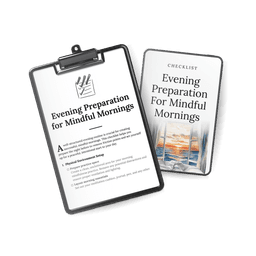
To try it: five minutes, pen and paper, tomorrow and the next few days only, then close the notebook. Our free Evening Preparation for Mindful Mornings checklist picks up from there, with a look at tomorrow's schedule and one to three intentions. The Evening Preparation Protocol goes further, with a 15-minute planning block that includes obstacles and how to handle them. The evening half of our morning routine guide shows where it fits.
Brain dump for ADHD
CHADD, the ADHD organization, uses the term itself. Its page on to-do lists suggests moving items from your "brain dump" to a separate action list, writing specific actions instead of vague ideas, and marking the three most important.
A trial with 88 adults tested a 12-week group program that teaches planners, scheduling and breaking tasks down. By blind interview, 42% responded, against 12% in a support group. That was a whole program led by psychologists with ADHD experience, so it does not show that a list alone helps. We could not find a trial of brain dumps for ADHD.
Ways to lower the effort: speak it into your phone instead of writing, stop at five minutes, and do the sorting with someone else in the room. More in our guide on being productive with ADHD.
When a brain dump makes things worse
- The list feels crushing. Seeing it all at once is a lot. Cover the page, pick one line, do or schedule it. Then cross out at least one X.
- You keep hunting for thoughts. One poster on a Getting Things Done forum described a brain on the lookout all day for something to capture. Use a set time and leave it there.
- You write the same worry every night. That is a sign to plan a step or talk to someone, not to write it again. One study of recently separated adults found that people who tend to ruminate, or were searching for meaning at the time, did worse after writing about their feelings than after neutral writing. A study of 69 students found the opposite for people who brood, and neither tested lists, so go by how you feel afterwards.
- Every dump ends in too many choices. Cut the options before you decide. Our guide to decision fatigue has ways to do that.
A brain dump is an organizing tool, not a treatment. The NHS page on worries suggests writing them down during a short "worry time" of 10 to 15 minutes. If worry, low mood or poor sleep get in the way of daily life or do not ease, talk to a doctor. In the US, the NIMH fact sheet on stress lists ways to find help, including calling or texting 988 in a crisis.
Your first week
| Day | What to do |
| Day 1 | Full brain dump: 10 minutes to write, 10 to sort. |
| Day 2 | Do one of your three D items. Add nothing new. |
| Day 3 | Five-minute bedtime list of the next few days. |
| Day 4 | Pick one worry and write one possible step. |
| Day 5 | Cross out three things you are not going to do. |
| Day 6 | Rest from lists. |
| Day 7 | Check the weekly list, do a shorter dump, choose your next three. |
Planning once a week has some support on its own. In a study of 208 employees, weeks with a short planning exercise came with fewer unfinished tasks and less rumination. There was no separate control group, and rumination was already falling before the planning began. If work is where the pile comes from, see how to manage stress at work.
FAQ
How often should you do a brain dump?
We could not find a study that sets a number. Once a week is a reasonable start, plus whenever your head feels too full. Keep the daily version to five minutes.
Is paper or an app better for a brain dump?
We could not find a study comparing them for this. The research people cite is about lecture notes, and a 2019 replication found no consistent difference there between writing by hand and typing, while a 2024 meta-analysis found a small edge for handwriting. Choose what you will have with you and look at again.
What do you do after a brain dump?
Mark each line do, worry, later or drop. Give every "do" a next step with a time and place, pick up to three, and move the rest to a list you check weekly.
Is a brain dump the same as journaling?
Not quite. Journaling explores thoughts and feelings in sentences. A brain dump is a fast list of everything, made to be sorted. You can do one and then journal about a single line from it.
Do you have to reread it?
If it has tasks in it, yes, once, to choose next steps. If you wrote it only to vent, you can throw it away.
How we put this guide together
This guide was written with AI assistance and edited by the AllMyGuides team. None of us is a doctor or psychologist. We based it on published research, the NHS, NIMH, CHADD, the FOLDOC dictionary and the Getting Things Done website. We checked each linked source, in full text where we could (sometimes a free copy on another site) and otherwise through its abstract, and we say where a study tested something other than a brain dump. To understand what people struggle with, we also read public threads on Mumsnet, the GTD Forums and Hacker News; we could not open Reddit. The template entries are illustrative, not personal stories. Last checked in November 2026. This article is for general information and is not medical advice.