Decision fatigue is the idea that after many decisions in a row, you start making worse ones. You put choices off, grab the easiest option or decide on impulse. A conceptual analysis in the Journal of Health Psychology defines it as "the impaired ability to make decisions and control behavior as a consequence of repeated acts of decision-making." The tired, can't-choose-dinner feeling is real for a lot of people. The science behind the famous stories is much shakier than most articles admit. The good news is that the fixes do not depend on who wins that debate: the aim is to make fewer decisions, not to try harder.
Key takeaways
- Decision fatigue is a drift toward easy, default or avoided choices after a long run of decisions. It is a concept, not a medical diagnosis.
- Some field studies of doctors, analysts and voters find this drift. The most famous one, about judges, has credible alternative explanations. A 2025 study of over 230,000 nurse calls found no evidence of it.
- The "willpower tank" theory behind it failed two large replications, and the popular figure of 35,000 decisions a day has no traceable source.
- Defaults, routines, deciding in advance and if-then rules cut the number of choices you face in the moment. Defaults and if-then plans also have research behind them, though the studies we cite did not test decision fatigue.
- If you feel drained for weeks no matter how you organize your day, look at burnout, mood and sleep, not just your decisions.
What decision fatigue is
The term covers a pattern more than a single symptom. In the same analysis, the authors describe it through behaviors such as avoiding decisions, acting impulsively and choosing the default. A 2025 review of healthcare studies proposed a narrower definition: "the tendency towards making less effortful decisions as the cumulative mental burden of effortful decision-making increases."
Clinicians are careful about what it is not. A psychotherapist quoted by Cleveland Clinic calls it "a phenomenon (as opposed to a diagnosable medical condition)." You will not find it in any diagnostic manual, and there is no test for it.
It overlaps with two other ideas. Mental fatigue is general tiredness from demanding mental work. Mental load is the invisible job of running a household. A sociology study of 35 couples calls it cognitive labor: "anticipating needs, identifying options for filling them, making decisions, and monitoring progress." Decision fatigue is the part of both that shows up when you have to choose.
Signs of decision fatigue
A psychiatrist interviewed by the American Medical Association names four main symptoms: "procrastination, impulsivity, avoidance and indecision." In everyday life they tend to look like this:
| Sign | What it can look like |
| Putting things off | The email that needs a yes or no sits in your inbox for days. |
| Taking the default | You order the same takeout or keep the plan you already have, even when it does not fit. |
| Impulse choices | An evening purchase or snack you would have skipped in the morning. |
| Handing it off | "I don't care, you pick" about things you actually care about. |
| Small choices feel huge | Standing in front of the fridge with no idea what to cook, after a day of easy calls at work. |
| Second-guessing | Regret or rumination right after you decide. |
Cleveland Clinic adds exhaustion, trouble concentrating, irritability and feeling overwhelmed. Many of these signs also fit stress, poor sleep and low mood, which is one reason the concept is hard to study.
Is decision fatigue real? What the research says
Short answer: the feeling is common and some real-world data fit it. But the evidence is weaker and more mixed than its fame suggests. Here is how the main pieces stack up.
The hungry judges study, and why it is disputed
The study that made decision fatigue famous looked at 1,112 parole rulings by eight Israeli judges. Danziger and colleagues reported that favorable rulings fell from about 65% to nearly zero within each session and jumped back after a meal break.
Other researchers pushed back hard. A letter in the same journal pointed out that "case ordering is not random": prisoners without a lawyer often went last, and they were less likely to be freed anyway. A simulation study showed the pattern could be a statistical artifact: favorable rulings take longer, so a judge who avoids starting a long case right before a break would produce a similar drop. It concluded the effect is likely overstated. A 2022 legal review called the effect "doubtful." None of this proves the effect is zero. But it is no longer a clean example.
Field studies: some find it, one large one does not
- Doctors. Across 21,867 visits, antibiotic prescribing for respiratory infections rose as clinic sessions went on. That fits a drift toward the easy option. But the study used time as a stand-in for fatigue and did not measure it.
- Surgeons. In one Swedish clinic, patients seen late in a shift were "33 percentage points less likely to be scheduled for an operation" than those seen first. It was eight surgeons in one clinic, and wanting to avoid overtime could also explain it.
- Analysts and voters. Stock analysts' forecast accuracy declines over the course of a day, and voters facing long ballots abstain more and lean on shortcuts for items further down the list.
- Nurses. Then came a stronger test. Researchers from the same Swedish group studied 231,076 calls handled by 174 nurses at a national phone triage line. They set out their methods in advance and wrote: "We thus found no evidence for decision fatigue."
Two 2025 reviews of healthcare studies sum up the picture. The one quoted above found clear evidence of an effect in about 45% of the quantitative tests and called the concept "inconsistently defined and inadequately operationalised." The other found no randomized or experimental studies at all among 43 papers.
The willpower tank theory did not replicate
Decision fatigue grew out of "ego depletion," the idea that self-control runs on a fuel that can run out. Early experiments supported it. In a 1998 study, people who ate radishes instead of tempting chocolates gave up sooner on unsolvable puzzles. A 2008 paper reported that "making choices led to reduced self-control."
When the effect was tested at scale, it mostly vanished. A replication across 23 labs and 2,141 people found an effect close to zero. A second test across 36 labs and 3,531 people, led by researchers who had published ego depletion studies themselves, was also nonsignificant. The idea that sugar refuels willpower had the same fate: an analysis of the glucose studies concluded the evidence "is weak" and that no conclusions should be drawn.
Another way to think about mental fatigue is as a signal rather than an empty tank. One well-known review proposed that people stop trying when the effort seems to cost more than it is worth. That fits the feeling of decision fatigue without a fuel gauge in your head.
What we can say
Feeling worn out after a day full of choices is real, and decisions sometimes drift toward the easy option late in a session. Whether one general effect applies to everyone, everywhere, is not proven. You do not need to settle that to act. The tools below do not depend on it.
Myths worth dropping
"We make 35,000 decisions a day." This number is repeated everywhere, and we could not find any study behind it. The closest real research estimated around 200 daily food decisions, and a 2025 paper in Appetite argues even that figure comes from how the question was asked.
"More options always overwhelm us." A meta-analysis of 50 experiments found an average choice overload effect of "virtually zero," with large differences between studies. A later one found that overload does happen under some conditions: complex choices, a hard task, not knowing what you want, or needing to settle on a choice quickly. Those conditions are worth knowing, because you can change some of them.
"Successful people wear the same clothes because of science." Barack Obama told writer Michael Lewis in a 2012 Vanity Fair profile that he wore only gray or blue suits to "pare down decisions." That shows what he believed helped him, not proof that it works. It can still be a sensible personal rule.
How to reduce decision fatigue: a 7-step system
The goal is not more willpower. It is fewer live decisions, so the ones that matter get your attention. Each step builds on the one before.
1. List the decisions you repeat
For one ordinary day, jot down every choice you make more than once a week. Think meals, clothes, workouts, which task to start and what to reply. Mark each one as low, medium or high stakes. The list may be longer than you expect, and much of it may be low stakes.
2. Turn repeat decisions into defaults
A default is a choice you make once and then follow unless there is a reason not to. Defaults set by others are powerful: a meta-analysis of 58 studies found a considerable effect on what people end up choosing. Those studies were about defaults set by companies and governments; setting your own is an extension of the same idea. Examples: a weekly meal rotation, two work outfits, a fixed gym slot, one go-to gift.
3. Decide the night before
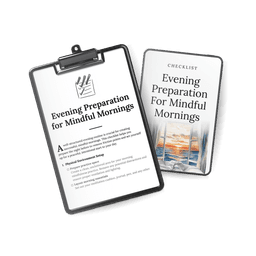
Move small decisions out of the busy part of the day. Lay out clothes, pick tomorrow's first task, decide breakfast and check your calendar in the evening, when there is no time pressure. Our free Evening Preparation for Mindful Mornings checklist gives you a short list to run through. If you want a full routine, The Evening Preparation Protocol includes a section on reducing next-day decisions, along with sleep and screen habits. Our guide to building a morning routine that holds shows how the two halves fit together.
4. Write if-then rules
An if-then plan decides in advance what you will do when a situation comes up: "If it is 6 pm and I have not planned dinner, then it is pasta night." A meta-analysis of 94 tests found these plans had a medium-to-large effect on reaching goals. Good candidates are the moments where you usually stall or give in.
5. Match the effort to the stakes
Low-stakes choices get a "good enough" rule: pick the first option that meets your basic needs and move on. Medium ones get a time limit. High-stakes ones get proper time, notes and, if useful, another person's view. Hard tasks and complex options are among the conditions linked with overload, so save the careful search for decisions that deserve it. For work tasks, our guide on how to prioritize tasks covers this in more detail.
6. Shrink the menu
When you do need to choose, cut the options to two or three before you start comparing. Shortlist restaurants, apartments or job offers on one or two must-haves, then compare only the finalists.
7. Give big decisions a fresh slot
The psychiatrist quoted by the AMA suggests making important decisions in the morning and spacing them out. The research on timing is mixed, as you saw above, so treat this as a practical habit rather than a law. As a common-sense rule, avoid making a big decision while rushed or upset, and sleep on it when you can.
If you want to go further, Build Unbreakable Daily Routines in 30 Days shows how to set up your space so the right action takes the least effort. Prioritize Your Life helps you decide what matters most, so fewer choices compete for attention.
Decision fatigue at home and at work
| Situation | Default or rule to try |
| What to cook tonight | A two or three week meal rotation, or a fixed theme per weekday (soup Monday, pasta Wednesday) |
| Kids' choices all day | Offer two options instead of an open question; decide school clothes the night before |
| Household mental load | Split whole areas between partners (one owns meals, the other appointments), not single tasks |
| Email and messages | Check at set times; use short templates for common replies |
| Which task to start | Pick tomorrow's first task before you finish today |
| Meetings that need a decision | Put the decision first on the agenda, not last |
Parents in online forums often describe feeling worn down less by cooking than by deciding what to cook every day. A rotation removes the deciding without changing the cooking. At work, decision fatigue often travels with general overload; our guide on managing stress at work starts with the cause.
Decision fatigue and ADHD
Many people with ADHD say decisions drain them faster, and it makes sense that choices feel heavier when planning and prioritizing are already hard. We could not find any controlled study that tests decision fatigue in ADHD specifically, so we cannot tell you how much is ADHD and how much is everyday overload. What we do know is that these struggles often overlap with executive dysfunction. Sometimes starting freezes up entirely, which we cover in our guide to ADHD paralysis. Defaults and if-then rules are useful here because they take the choice out of the moment.
When it might be something else
Decision fatigue should ease with rest, a lighter day or fewer choices. If it does not, other causes are more likely. Cleveland Clinic notes that persistent symptoms can reflect anxiety, depression or burnout. The NHS advises seeing a doctor if "you've been feeling tired for a few weeks and you're not sure why," if it affects your daily life, or if it comes with symptoms such as weight loss or mood changes. If you feel exhausted and detached from work, our guide on how to recover from burnout may fit better than any decision trick.
Your first week
| Day | What to do |
| Day 1 | List the decisions you repeat and mark their stakes. |
| Day 2 | Pick three low-stakes repeats and turn them into defaults. |
| Day 3 | Start a five-minute evening prep: clothes, first task, breakfast. |
| Day 4 | Write two if-then rules for the moments you usually stall. |
| Day 5 | Use a "good enough" rule on every low-stakes choice for the day. |
| Day 6 | Schedule one pending big decision in a fresh slot. |
| Day 7 | Review: which defaults stuck, which felt forced? Keep the first, drop the second. |
FAQ
Is decision fatigue real?
The experience is real for many people, and some field studies find decisions drifting toward easier options later in a session. But the famous judges study is disputed, the willpower tank theory failed large replications, and a large 2025 field study found no evidence of it. Think of it as a useful description, not a proven law.
Is decision fatigue the same as burnout?
No. Decision fatigue is short-term and should ease with rest or fewer choices. Burnout is a longer-lasting state of exhaustion and detachment linked to ongoing stress, usually at work. Persistent "decision fatigue" can be a sign of burnout, anxiety or depression.
Why do some people wear the same outfit every day?
Some, like Barack Obama, say it removes small decisions so they can focus on bigger ones. There is no study showing it improves decisions, but a fixed outfit is a simple default if getting dressed takes more thought than you want to give it.
How many decisions do we make a day?
Nobody knows. The figure of 35,000 has no traceable scientific source, and even the estimate of about 200 daily food decisions has been questioned.
How we put this guide together
This guide was written with AI assistance and edited by the AllMyGuides team. None of us is a doctor or psychologist. We based it on peer-reviewed studies found through PubMed Central, Europe PMC and Crossref, and on pages from the AMA, Cleveland Clinic and the NHS. We checked the studies in full text where we could and otherwise through their abstracts or records. We could not open the Vanity Fair profile, so we checked the Obama quote through another outlet that quotes it. To understand the problems people describe, we also looked at public forum discussions, mostly through search results; the examples here are illustrative, not personal stories. Last checked in November 2026. This article is for general information and is not medical advice.