Revenge bedtime procrastination is staying up later than you meant to, with no outside reason, because the late hours feel like the only time that belongs to you. You know you will be tired tomorrow, and you do it anyway. The fix is rarely more willpower at 11 p.m. It is getting some of that free time earlier, making the switch to bed easier, and taking the phone out of the decision.
This guide explains where the term comes from, what research says about why it happens, how to tell it apart from insomnia, and a six-step plan to get your evenings back without paying for them with sleep.
Key takeaways
- Researchers call it bedtime procrastination: going to bed later than intended when nothing is stopping you. The "revenge" part is a popular label, not a diagnosis.
- Studies link it to daytime stress, a later chronotype (being a "night owl"), screens before bed and shorter, worse sleep. Most of this evidence is correlational.
- Willpower alone tends to fail, because the decision happens when you are most tired. Plans made earlier in the day do better.
- The goal is not to give up your me-time. It is to move some of it, cap it and protect your sleep.
- If you lie in bed unable to sleep, or stay up because bed feels stressful, that may be insomnia, which is worth raising with a doctor.
What is revenge bedtime procrastination?
The research term came first. In 2014, Kroese and colleagues defined bedtime procrastination as "failing to go to bed at the intended time, while no external circumstances prevent a person from doing so." Their nine-item questionnaire includes statements like "I go to bed later than I had intended" and "I want to go to bed on time but I just don't."
The "revenge" version comes from a Chinese phrase usually translated as "revengeful staying up late." A University of Pennsylvania linguist wrote about the phrase in July 2020, starting from a post about it on Twitter. The idea is that people who feel they have no control over their days take some back at night.
Cleveland Clinic describes it as trying to take control of your life by using the time before bed. The Sleep Foundation lists three features: a delay that cuts total sleep, no valid reason for staying up, and knowing it will have a cost.
| Situation | Is it bedtime procrastination? |
| You scroll until 1 a.m. even though you wanted to sleep at 11 | Yes |
| You stay up because a baby wakes you or you work a night shift | No, there is an outside reason |
| You go to bed on time but lie awake for hours | No, that sounds more like insomnia |
| You avoid bed because lying awake there feels stressful | Possibly a sign of insomnia; see the section below |
| You stay up late on a Saturday by choice and sleep in on Sunday | Not really; you are not losing sleep you need |
Why you stay up when you are exhausted
The common story online is simple: the day belongs to work, kids and other people, so the night is when you finally get time for yourself. People describe it as the only quiet hour of the day, and they feel they have earned it. Research on the topic is younger and messier, but a few patterns show up.
Stressful days
In a two-week diary study of 96 German students tracked with Fitbits, more daytime stress went with more bedtime procrastination that night. Another pair of diary studies found that after stressful days, people who believe willpower runs out put off bed more than people who don't. On calm days there was no difference.
A 2026 study of 393 US military servicemembers, which used the "revenge" label, linked it to role overload, meaning more demands than time. The authors note that their design cannot show cause and effect.
Work that follows you home
A study of public employees in the US and China found that using a smartphone for work after hours was linked to more bedtime procrastination in both countries. If you answer messages at 9 p.m., the evening you are trying to reclaim gets shorter, and the urge to stay up may get stronger. Our guide on managing stress at work covers how to set after-hours limits.
Being a night owl
A diary study of 108 employees found that later chronotypes reported more bedtime procrastination on work days. That fits a meta-analysis of 43 studies, which found a moderate link with evening chronotype. Part of what looks like procrastination may be a body clock that runs late, paired with a schedule that starts early.
Is it a lack of self-control?
Partly, maybe. The 2022 meta-analysis by Hill and colleagues found lower self-control was linked to more bedtime procrastination. But the evidence was rated low certainty, and not every study agrees. The 2018 diary study of employees above found the opposite of what the "too drained to go to bed" idea predicts. So it is fair to say self-control is part of the picture, and unfair to call it laziness.
Screens make the delay longer
A study of 338 young adults found an average gap of 39 minutes between getting into bed and trying to sleep, and that gap was linked only to media use before bed. The authors describe two steps: first you go to bed late, then you put off trying to sleep once you are there.
What it costs you
US sleep experts recommend that adults get 7 or more hours of sleep a night on a regular basis. CDC data from 2014 showed that more than a third of US adults reported sleeping less than that. Short sleep is associated with obesity, diabetes, high blood pressure, heart disease and depression.
For bedtime procrastination specifically, the Hill meta-analysis found links with shorter sleep, worse sleep quality and more daytime fatigue. In the military study, more bedtime procrastination went with worse day-to-day functioning. These are associations, but they point in a consistent direction: the revenge is usually on yourself, the next morning.
There is a trade-off worth admitting. A study of 155 R&D employees found that evening leisure online helped them switch off from work, which is good, while also cutting sleep through bedtime procrastination, which is not. Me-time has real value. The problem is only when it comes out of the hours you need for sleep.
How to stop revenge bedtime procrastination: 6 steps
These steps go in order. The first three happen during the day, because by 11 p.m. you are the least able to make a good decision.
1. Track a normal week first
For five to seven nights, write down three times: when you meant to go to bed, when you got into bed and when you put the phone down. Add one line on what you were doing and how the day felt. Patterns tend to show up fast. Maybe it only happens after long days, or on the nights you answer work email.
2. Find the me-time you are missing
Ask what the late hours give you. Quiet? A show with no interruptions? Time to scroll without anyone needing anything? Then find a smaller version earlier. That might be 30 minutes after the kids are down instead of after the dishes, a walk at lunch or one evening a week when a partner takes bedtime duty. If others keep eating into your evenings, our guide on how to set boundaries has scripts for that conversation.
3. Set a bedtime and an if-then plan
Work backward from your wake-up time: if you get up at 7 and want 7.5 hours, lights out is 11:30. Then write an if-then plan: "If it is 10:45, then I plug my phone in the kitchen." Plans in this format, called implementation intentions, had a medium-to-large effect on reaching goals across 94 independent tests. Two randomized trials tested a version of this method, combined with picturing both the goal and the obstacle in the way, on bedtime procrastination in students. It reduced the average minutes of delay per night.
4. Move the phone out of the bedroom
Charge it in another room and use a cheap alarm clock. This removes the second step of the delay, the scroll in bed. Cleveland Clinic also suggests setting an alarm to tell you when to put the device down and turning screens off about an hour before bed. If the phone is the main problem, our guide on breaking phone addiction goes further, and 13 Signs Your Phone Is the Real CEO helps you spot where it runs your day.
Blue light gets most of the attention, but the evidence there is less clear than many articles suggest. In one small lab study, reading on a tablet for four hours before bed delayed sleep and the body clock compared with a printed book. A Cochrane review found it is unclear whether blue-light glasses affect sleep. The bigger issue is probably that a screen is endless and keeps you awake and engaged.
5. Build a short wind-down
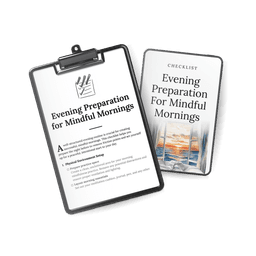
Give the evening a clear end, so bed is a step you take rather than something you keep avoiding. Fifteen to thirty minutes is enough: dim the lights, set out what you need for tomorrow, read a paper book or stretch. Preparing for the next morning also takes away a reason to stay up worrying about it. Our free Evening Preparation for Mindful Mornings checklist walks through it, and the full Evening Preparation Protocol covers sleep setup, screens and what to do when the routine slips.
6. Move bedtime gradually and review weekly
If you usually sleep at 1 a.m., aiming for 11 tomorrow will probably fail. Move it 15 minutes earlier every few days. Once a week, look at your notes: which nights worked, which did not and why. Adjust the plan, not your opinion of yourself.
What helped in the few trials there are
Treatment research is small but growing. Apart from the two student trials above, a randomized trial in 60 young adults in South Korea found that a behavioral program reduced bedtime procrastination scores by about 36% compared with a wait list, and improved sleep diaries too. A 2025 pilot trial in 55 young workers found that all three groups cut device use before sleep and slept longer, including the comparison group, so it could not show which approach worked best.
Other studies also hint at a role for mindfulness: in 220 young adults, mindfulness was linked to less boredom and less bedtime procrastination. That is a correlation, not a test of a mindfulness program.
Is it procrastination or insomnia?
They can look alike from the outside. In interviews with 17 people who often stay up late, researchers found three kinds of delay: deliberate, mindless and strategic. The strategic group stayed up because they expected to lie awake anyway, which the authors say may point to undiagnosed insomnia.
Signs it may be more than procrastination:
- You fall asleep long after you lie down, most nights, even without a screen.
- You wake in the night and can't get back to sleep.
- You put off bed because bed itself feels stressful.
- You snore loudly, gasp at night or are very sleepy during the day even after enough hours in bed.
If any of these fit, talk to a doctor. For chronic insomnia, the American College of Physicians recommends cognitive behavioral therapy for insomnia (CBT-I) as the first treatment, and other sleep problems need a proper check.
Parents, ADHD and long hours
Parents
Much of the public discussion comes from parents, especially mothers, who describe the hours after the kids are asleep as the only part of the day nobody needs them. A 2026 perspective paper notes that parental revenge bedtime procrastination has had almost no direct study so far. Practical options people mention include getting up before the kids instead of staying up after them, or swapping one or two evenings a week with a partner.
ADHD
One study of 553 university students found that ADHD symptoms were linked to more bedtime procrastination, though the link was small. People with ADHD often describe hyperfocus, trouble switching tasks and losing track of time. Our guide on time blindness covers tools that make time visible, such as alarms that tell you when to start winding down.
Long working hours
If your workday leaves no free evening at all, a sleep routine can only do so much. The real fix may be fewer hours, a protected end to the workday or help at home. For the stress side, 12 Stress Habits That Secretly Wreck Your Health helps you spot the daily habits that keep you wired at night.
A sample evening
| Time | What happens |
| 6:00 p.m. | Work ends. Notifications off for work apps. |
| 8:30 p.m. | Me-time block: a show, a game, a call with a friend. Fully yours. |
| 10:15 p.m. | Alarm: start wind-down. Set out tomorrow's clothes, tidy for five minutes. |
| 10:30 p.m. | Phone on the charger in the kitchen. Paper book or stretching. |
| 11:00 p.m. | Lights out, for a 6:30 a.m. alarm. |
The me-time is still there. It just ends with a plan instead of when the phone battery or your eyes give out.
Your first week
- Days 1 to 3: track your intended bedtime, real bedtime and phone-down time. Change nothing yet.
- Day 4: pick a target bedtime 15 minutes earlier than your average and write one if-then plan.
- Day 5: move the phone charger out of the bedroom.
- Day 6: add a 30-minute me-time block earlier in the evening.
- Day 7: review your notes and move the target another 15 minutes if the week went well.
If it keeps slipping, our guide on how to stop procrastinating covers the same habit in the daytime, where many of the same tools apply.
FAQ
Why do I stay up late when I'm tired?
Often because the late hours are your only free time, and going to bed feels like ending the one part of the day that is yours. Stress, a late body clock and phones in bed make it more likely.
Is revenge bedtime procrastination a disorder?
No. It is a pattern of behavior, not a medical diagnosis. If you cannot sleep even when you go to bed on time, talk to a doctor about insomnia.
How do I get me-time without losing sleep?
Move part of it earlier in the evening, give it a clear end time and trade some evenings with a partner or housemate if you share chores. Waking up earlier works for some people, but only if bedtime moves too.
Is it a sign of ADHD?
Not on its own. Many people without ADHD do it. One study found a small link with ADHD symptoms, so if you also struggle with focus and time in the daytime, it may be worth discussing with a professional.
Is one late night a problem?
An occasional late night is normal. The concern is a regular pattern that keeps you under 7 hours of sleep.
Why is it called "revenge"?
The name comes from a Chinese phrase that was discussed in English online in 2020. It describes taking back time at night from a day that felt controlled by work or other people.
How we put this guide together
This guide was written with AI assistance and edited by the AllMyGuides team. None of us is a doctor or sleep specialist. We based it on peer-reviewed studies found through Europe PMC and journal pages, the AASM and Sleep Research Society consensus, CDC data, a Cochrane review, and health pages from Cleveland Clinic and the Sleep Foundation. We opened the sources linked here, checked that they say what we report, and note where studies were small, correlational or limited to students. We also read public discussions about staying up late to choose which questions to answer. The sample evening is an illustration, not a tested program. Last reviewed November 2026. This is general information, not medical advice.