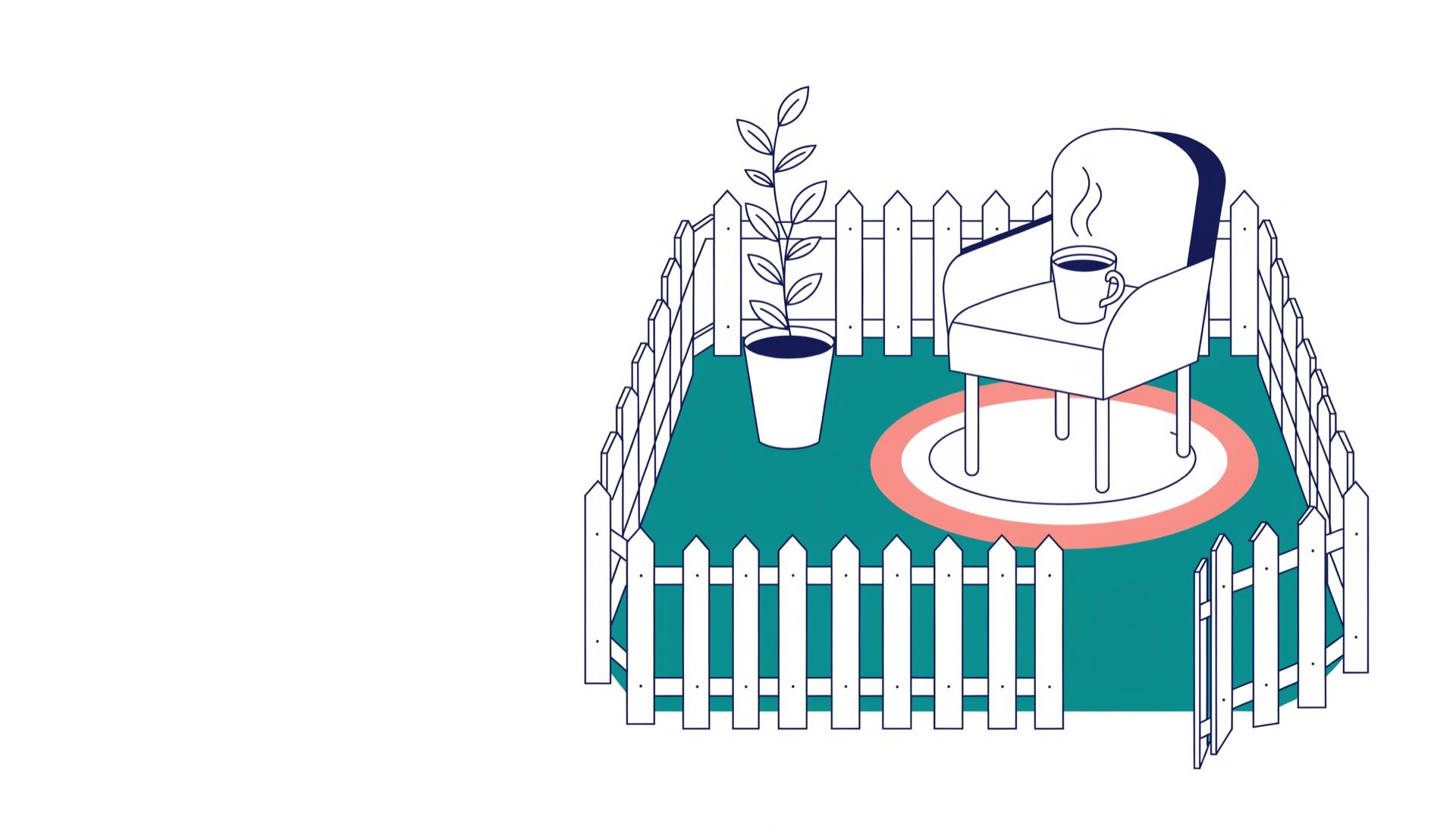
Setting boundaries means deciding what you will and will not accept from other people, and what you will do when a limit is crossed. A boundary is about your own actions, not a rule for someone else. To set one: notice where you feel drained or resentful, decide the limit, say it in one or two calm sentences, and then follow through, every time, even when you feel guilty.
This guide walks through that process step by step, with the types of boundaries, examples you can copy, scripts for partners, parents, friends and work, and what to do when someone pushes back.
Key takeaways
- A boundary describes what you will do ("If you raise your voice, I'll end the call"), not what the other person must do ("You can't yell at me").
- The follow-through matters more than the wording. A limit you never act on teaches people it is optional.
- Guilt after setting a boundary is not proof you did something wrong. Research suggests people overestimate how badly others react to a "no."
- Short, first-person sentences tend to land better than accusations that start with "you."
- A boundary protects you. If a "boundary" is used to restrict who someone sees, what they wear or where they go, it has turned into control.
What are boundaries?
Cleveland Clinic describes boundaries as the framework we set for ourselves for how we want to be treated by others and how we treat other people. UC Davis Health puts it more simply: "limits we identify for ourselves and apply through our actions or communication."
That last part is the key. A boundary is not a demand. You cannot control whether your mother comments on your weight. You can control whether you stay in the conversation when she does.
| Type | What it sounds like | Why it is (or isn't) a boundary |
| Request | "Could you text before you come over?" | An invitation. The other person can say no. |
| Boundary | "If you drop by without texting, I won't open the door. Text first and I'll make time." | States what you will do. You don't need their agreement to keep it. |
| Ultimatum | "Stop dropping by or we're done." | Usually said in anger, with an outcome you may not mean. It aims to force a change. |
| Control | "You're not allowed to see your friends without me." | Restricts the other person's life. Not a boundary at all. |
The types of boundaries
There is no official list, but UC Davis Health names six types. We add a seventh, digital, because so many of the problems people describe now happen through a phone.
| Type | What it protects | Example |
| Emotional | Your feelings and mental health | "I'm happy to listen, but I can't be the only person you vent to about your breakup." |
| Physical | Your body and personal space | "I'm not a hugger. A wave is great." |
| Sexual | Your consent, needs and safety | "I want to stop. Let's talk about it tomorrow." |
| Workplace | Your work-life balance | "I check messages until 6 p.m. Anything urgent after that, please call." |
| Material | Your money and belongings | "I don't lend my car, but I can drive you to the shop on Saturday." |
| Time | Your schedule and energy | "I can stay for an hour, then I need to head home." |
| Digital (ours) | Your attention and privacy | "No phones at dinner. And please don't read my messages." |
Emotional boundaries are often the hardest to explain. They are about not taking responsibility for another adult's feelings, not sharing more than you want, and not letting someone else's mood decide yours.
Why setting boundaries is so hard
Some people are wired, by temperament or history, to put relationships first. Researchers call one version of this unmitigated communion: a focus on others to the exclusion of the self, which Fritz and Helgeson linked to psychological distress across four studies. If that sounds like you, our guide on how to stop being a people pleaser covers where the habit comes from.
The fear is often bigger than the reality. Across several experiments, Givi and Kirk found that people who turn down an invitation overestimate the negative ramifications in the eyes of the person who invited them. Most scenarios were imagined or low stakes, so this doesn't promise that your sister will be fine with you skipping her wedding. It does suggest the dinner party host will survive.
Saying yes when you mean no also has a cost. In a study of dating couples, hiding your feelings while making a sacrifice was linked to lower well-being that day and lower relationship satisfaction three months later.
How to set boundaries in 6 steps
1. Notice the signal
Many therapists treat resentment as the clue: if you keep feeling used, drained or quietly angry around a person or a task, a limit is probably missing. We could not find a study that tests this directly, so take it as practical advice, not science. For example, if you dread Sunday calls with your dad because they always turn into a lecture, that dread is information.
2. Decide what you will do
Write the boundary down before you say it. Use this formula: "If [this happens], I will [my action]." For example: "If my brother asks to borrow money again, I will say no and offer to help him make a budget." Keep the action something you can actually do on your own. Cleveland Clinic also advises being specific and naming the consequence.
3. Say it short and calm
One or two sentences. Start with "I," not "you." In a study of high school students, accusatory "you" statements were rated as more aversive than statements about the speaker's own feelings. A later experiment found that I-language and sharing your perspective reduced perceived hostility. Both used imagined scenarios, and real arguments are messier, but the direction is consistent.
Pick a calm moment, not the middle of a fight. You don't owe a long explanation. A short reason is fine if you want to give one.
4. Follow through
This is where many boundaries fail. If you said you would leave when the yelling starts, leave. Calmly, without a speech. The first few times are often the hardest, and they are what make the boundary real.
5. Expect pushback, and repeat yourself
People who benefited from the old arrangement often test the new one. They may argue, sulk, or ask "why" five times. You don't need a new argument each time. Repeat the same sentence: "I understand you're upset. My answer is still no." This is sometimes called the broken record technique.
6. Review after a few weeks
Some boundaries turn out too loose, others too rigid. A good boundary protects you without cutting off people you care about. Adjust it, and tell the other person if it changes.
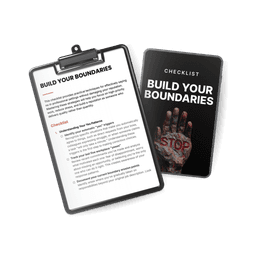
If you want this as a checklist you can fill in, our free Build Your Boundaries walks through deciding, wording and keeping a limit.
Boundary examples and scripts
Experiments by Schlund, Sommers and Bohns (N = 535) found that giving people the words to say no made them feel freer when they did say yes. In those studies the person asking supplied the words, but the lesson carries over: having a script ready helps. Here are some to adapt.
How to set boundaries in a relationship
- "I need an hour to myself after work before we talk about plans. Then I'm all yours."
- "When the argument turns to name-calling, I'm going to take a break and come back in 30 minutes."
- "I'm not comfortable with you going through my phone. If you're worried about something, ask me."
Phones come up a lot. In a 2019 Pew Research Center survey, 51% of partnered Americans said their partner is at least sometimes distracted by their cellphone, and 34% admitted looking through a partner's phone without them knowing.
How to set boundaries with parents and family
- "I'm not going to discuss my weight. If it comes up, I'll change the subject, and if it continues, I'll head home."
- "We'll be at your place from 2 to 5 on Christmas Day. We're spending the evening at home."
- "I love you, and I make my own decisions about my career. I'm not asking for advice on it."
With in-laws, it often works best if the partner who is their child has the conversation. If your spouse won't back you up, that is a conversation between the two of you first.
Family boundaries sometimes end in distance. In a national survey of more than 1,300 US adults by Cornell's Karl Pillemer, 27% said they had cut off contact with a family member. Distance isn't always permanent: in one national dataset, 81% of estrangements from mothers and 69% from fathers ended at some point. Many people choose a middle path, often called low contact: shorter visits, fewer topics, clear exits.
How to set boundaries with friends
- "I can't make it this time, but I'd love to see you next week."
- "I'm not able to lend money. I hope you find a way through this."
- "I want to hear about your day, but I can't talk every night anymore. How about Sundays?"
How to set boundaries at work
Work boundaries come with real job risk, so they are often more about negotiation than declarations. The research gives you a reason to try. Becker and colleagues found that the expectation of answering email after hours was linked to higher anxiety, which in turn was tied to worse health for employees and their partners. A meta-analysis of 38,124 employees linked detaching from work in your free time with less exhaustion and better sleep.
- "I can take this on. Which of my current projects should move to make room?"
- "I'm offline after 6. If something is truly urgent, call me."
- "I'd like to block Tuesday and Thursday mornings for focused work. Can we keep meetings to the afternoon?"
People differ in how much they want to separate work and home. A study of 325 employees found that the fit between your preference and your workplace mattered for stress and satisfaction. Some countries now write this into law: France has had a legal right to disconnect since 2017, which employers must negotiate or set out in a charter. For more on the workplace side, see our guide on how to manage stress at work and our guide Boundaries that Work at Work, which has templates for coworkers and clients.
Digital boundaries
- "I don't answer group chats during the workday. I'll catch up in the evening."
- "Please ask before posting photos of the kids."
- "Phones go in the basket during dinner, mine included."
Our Digital Boundary Setup System covers device settings and how to explain new rules to family and teams. If the phone is the problem for you rather than for others, start with how to break phone addiction.
When someone ignores or crosses your boundary
- Name it once. "I asked you not to bring this up. I'm going to step outside."
- Act on the consequence you set. No new threats, no bigger ones. Just the one you said.
- Don't negotiate in the moment. "We can talk about it tomorrow" is enough.
- Raise the stakes only if it keeps happening. For example, shorter visits, or visiting only when someone else is there.
Expect a period where things feel worse. The other person may escalate before they adjust. That is not a sign the boundary is wrong.
Boundary or control? How to tell the difference
"Boundaries" is sometimes used as cover for controlling a partner. The National Domestic Violence Hotline says a healthy boundary protects and respects a person, and does not seek to control or harm another person.
| Boundary | Control |
| "I won't stay at parties where I feel unsafe." | "You can't go to parties without me." |
| "I'm not OK with being yelled at. I'll leave the room." | "If you talk to your ex, I'll leave you." |
| "I need my own money for personal spending." | "Give me your bank password." |
UK Home Office guidance describes coercive control as a pattern of behaviour over time used to exert power over another person. If you recognize the right-hand column in your relationship, setting a boundary may not be safe on your own. In the US, the National Domestic Violence Hotline is at 1-800-799-7233 (or text START to 88788). If you are in crisis, call or text 988.
How to set boundaries without feeling guilty
You probably won't skip the guilt at first. The goal is to stop letting it make the decision. A few things help:
- Separate the feeling from the facts. Guilt says you hurt someone. Ask whether you actually did, or whether they are simply disappointed.
- Don't over-explain. Long justifications invite debate.
- Wait before you apologize. Give the urge a day. If you still think you were unkind, apologize for the tone, not the boundary.
- Calm your body first. If your heart races afterward, the techniques in our high-functioning anxiety guide can help, and replaying the conversation for hours is covered in how to stop overthinking.
If boundaries feel impossible across many relationships, assertiveness can be learned. In a randomized trial of 210 adults in Sweden, an eight-week online CBT program for assertiveness improved assertiveness and reduced social anxiety compared with a wait list. A therapist can help too.
Myths about boundaries
| Myth | What's closer to true |
| "Boundaries are rules other people have to follow." | They are about your own actions. Others can still choose what they do. |
| "'No' is a complete sentence, so always say just 'no.'" | You never owe a reason, but with people you care about, a short reason or an alternative often keeps things warm. |
| "Saying 'I don't' works better than 'I can't.'" | Studies on self-talk found "I don't" helped people resist temptations like snacks, and a follow-up found it sounded more convincing to others. Neither tested real conversations, so treat it as a style choice. |
| "If they get upset, the boundary was wrong." | Upset is a normal reaction to change. Whether the boundary is fair is a separate question. |
| "Healthy boundaries mean cutting people off." | Most boundaries are small and keep relationships going. Cutting contact is one option, rarely the first. |
Your first week
- Day 1: List three situations that leave you drained or resentful.
- Day 2: Pick the lowest-stakes one. Write the boundary with "If…, I will…."
- Day 3: Say it out loud alone, until it sounds normal.
- Day 4-5: Say it to the person, in a calm moment.
- Day 6: When it gets tested, act on it.
- Day 7: Note what happened and how you felt. Pick the next situation.
For a printable version with personal and work prompts, see our Personal Boundary Builder.
Frequently asked questions
What are healthy boundaries?
Healthy boundaries are clear, consistent and about your own behavior. They protect your time, body, feelings and belongings without trying to control anyone else. They also flex: you might be more available for a friend in crisis than on an ordinary week.
What are emotional boundaries?
Emotional boundaries separate your feelings from other people's. Examples: not taking the blame for an adult's bad mood, choosing how much personal information you share, and ending conversations that turn into criticism.
What if my partner gets angry when I set boundaries?
Some anger at first is common, especially if the old pattern suited them. Stay calm and repeat yourself. If the anger turns into threats, intimidation or punishment, that is a safety issue: contact the National Domestic Violence Hotline.
Should I go low contact or no contact with my parents?
That is a personal decision, and it helps to talk it through with a therapist. Many people start with low contact (shorter, structured visits and off-limits topics) and adjust from there.
How do I set boundaries with someone who doesn't respect them?
Stop explaining and start acting. Use the consequence you named, every time. If they keep crossing it, reduce how much time or access they have.
Is it selfish to set boundaries?
No. Saying yes to everything tends to build resentment, which hurts relationships too. A clear no often makes your yes more honest.
How we put this guide together
This guide was written with AI assistance and edited by the AllMyGuides team. None of us is a doctor or therapist. We based it on health-system pages (Cleveland Clinic, UC Davis Health), the National Domestic Violence Hotline, UK government guidance, and peer-reviewed studies found through Europe PMC and journal pages. We opened the sources linked here and checked that it says what we report, and we note where studies were small, imagined or correlational. We also read public discussions about setting boundaries to choose which questions to answer. The digital category is our own addition. Last reviewed November 2026. This is general information, not medical or legal advice.