
Cognitive distortions are habitual thinking patterns that bend what happened into something worse than the facts support: one mistake becomes "I always fail," a short reply becomes "she's angry with me." The APA Dictionary of Psychology calls them "faulty or inaccurate thinking, perception, or belief" and adds that they are a normal process that can occur in everyone to some degree. You cannot delete them. You can learn to spot the common ones, slow them down, and decide how much weight to give them.
Key takeaways
- Cognitive distortions are biased shortcuts in thinking, not a diagnosis. Everyone has them; they matter when they are frequent, sticky and painful.
- Higher levels of distorted thinking are linked with depression and anxiety, but most of those studies are correlational, so they show a link, not a cause.
- Naming the trap is step one, not the fix. The useful part is checking the evidence, finding a more balanced thought and testing it in real life.
- Arguing with every thought is not the only route. Stepping back from a thought (defusion) has research behind it too.
- If the thoughts come with lasting low mood, panic or thoughts of self-harm, talk to a professional. In the US you can call or text 988.
What cognitive distortions are (and where the idea comes from)
The term goes back to psychiatrist Aaron Beck, whose 1963 paper was titled "Thinking and Depression: I. Idiosyncratic Content and Cognitive Distortions". According to the Beck Institute, he came to call his patients' spontaneous negative thoughts "automatic thoughts," and his Cognitive Therapy was later termed cognitive behavior therapy (CBT).
Psychologist Albert Ellis reached a similar idea from another direction. His Rational Emotive Behavior Therapy, developed in 1955 according to the Albert Ellis Institute, rests on the idea that "it is largely our thinking about events that leads to emotional and behavioral upset." Psychiatrist David Burns later popularized a list of ten thinking errors in his 1980 book Feeling Good. Lists like his were later used to build a 15-item questionnaire on distorted thinking.
There is no single official list: authors group and name the traps differently, and the categories overlap. The 12 below cover the traps most lists share.
The 12 cognitive distortions, with examples
For each one you get what it sounds like and a question that loosens it.
1. All-or-nothing thinking
Also called black and white thinking. Things are perfect or a disaster, with nothing in between. "I missed one deadline, so the whole project is a failure."
Ask: What would a 60 percent version of this look like? What went partly right?
2. Overgeneralization
One event becomes a rule, often with "always," "never" or "everyone." "I got rejected again. Nobody ever wants to hire me."
Ask: How many times has this actually happened, and how many times has it not?
3. Mental filter
You zoom in on one negative detail and lose the rest of the picture. Nine good comments on a presentation and one critical one, and only the critical one stays with you.
Ask: If I wrote down everything that happened, what would the full list say?
4. Discounting the positive
Good things happen, but they "don't count." "They only said it went well to be nice."
Ask: Would I dismiss this evidence if it were about a friend?
5. Mind reading
You decide what someone thinks without checking. "He didn't say hi. He thinks I'm incompetent." Social psychology suggests we routinely overestimate how much others notice us: in the spotlight effect studies, people overestimated how much their actions and appearance were noted by others, and in the illusion of transparency studies, people believed their inner states "leak out" more than they really do.
Ask: What are three other reasons for what they did? Can I simply ask?
6. Fortune telling
You predict a bad outcome and treat it as settled. "The interview will go badly, so why prepare?"
Ask: What has happened the last few times I predicted this?
7. Catastrophizing
The mind jumps to the worst case and treats it as likely and unbearable. "A headache. It could be something serious. What if I can't work?" Catastrophizing is one of the better studied traps because of its role in pain. A critical review found that pain catastrophizing "has been associated with a number of important pain-related outcomes," and a meta-analysis of 29 studies on pain after surgery found that catastrophizing may predict lasting pain better than general anxiety, though only about half the studies found a clear link.
Ask: What is the worst case, the best case and the most likely case? If the worst happened, what would I do first?
8. Emotional reasoning
A feeling is taken as proof. "I feel like a fraud, so I must be one."
Ask: If the feeling were not there, what would the facts say?
9. Should statements
Rigid rules for yourself or others: "should," "must," "ought to." "I should be able to handle this without help."
Ask: Whose rule is this? What happens if I swap "should" for "I'd prefer"?
10. Labeling
Overgeneralization in its most compressed form: one action becomes an identity. "I forgot her birthday. I'm a terrible person."
Ask: What did I do, as opposed to what am I?
11. Personalization
You take responsibility for things outside your control. "The team is stressed. It must be because of me."
Ask: What other factors played a part? What share of this is actually mine?
12. Blaming
The mirror image of personalization: the problem is all someone else's fault. "My manager ruined my week."
Ask: Even if they played a big part, is there one thing in my control here?
Quick reference table
| Trap | Sounds like | Balancing question |
| All-or-nothing | "Total failure" | What is the in-between? |
| Overgeneralization | "Always," "never" | How often, really? |
| Mental filter | Only the bad part | What is the full list? |
| Discounting the positive | "That doesn't count" | Would it count for a friend? |
| Mind reading | "They think I'm..." | What are other explanations? |
| Fortune telling | "It will go badly" | What happened last time? |
| Catastrophizing | "What if the worst..." | Worst, best, most likely? |
| Emotional reasoning | "I feel it, so it's true" | What do the facts say? |
| Should statements | "I must," "they should" | Rule or preference? |
| Labeling | "I'm an idiot" | What did I do, not who am I? |
| Personalization | "It's my fault" | What is my real share? |
| Blaming | "It's all their fault" | What is in my control? |
Why they matter: what the research links them to
Distorted thinking on its own is ordinary. The concern is when it becomes the default lens. In a 2021 study in Nature Human Behaviour, researchers analyzed the language of Twitter users who reported a depression diagnosis and found higher levels of distorted thinking than in a random sample, a difference that could not be explained by topic, sentiment or first-person pronouns. A 2025 follow-up reported that language markers of distorted thinking can be observed in anxiety disorders and increase with anxiety severity.
Smaller studies point the same way. A study of 208 first-year university students linked most types of distortions with depressed mood, partly through less use of self-boosting humor. A chart review of 30 adults with ADHD found a positive correlation between self-reported distortions and ADHD symptoms, with perfectionism the most common. At work, a 2026 systematic review of 41 papers linked dysfunctional cognition to well-being, stress, burnout, performance and decision quality.
These studies are mostly correlational (low mood may feed distorted thinking as much as the reverse), and the ADHD study is very small. Treat them as reasons to pay attention, not as proof that fixing thoughts fixes everything.
How to challenge cognitive distortions in 5 steps
This is the core loop of CBT-style self-help. Do it on paper or in a notes app: writing slows the thought down enough to look at it.
Step 1: Catch the moment
Your cue is a shift in feeling: a drop in mood, a jolt of anxiety, sudden irritation. Write down the situation in one line, the way a camera would record it. "Tuesday, 10:40, manager replied 'ok' to my report."
Step 2: Write the exact thought
Not "I felt bad," but the sentence in your head. "She hated it. I'm going to get a bad review." Rate how much you believe it, from 0 to 100.
Step 3: Name the trap, then move on
Here it is mind reading plus fortune telling. Do not get stuck on the exact category: the label is only a handle.
Step 4: Check the evidence and write a balanced thought
List what supports the thought and what does not. Then write a sentence that fits all of the evidence, not a cheerful one. "She often replies briefly when she's busy. She hasn't raised problems with my work before. If something is wrong, I can ask on Thursday." Re-rate your belief in the original thought.
Step 5: Test it in real life
Behavior can give a thought new evidence. Ask the question, send the draft, go to the event. Note what actually happened.
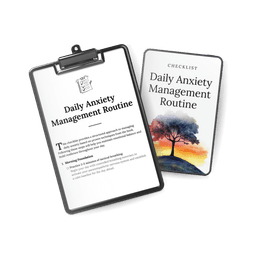
Our free Daily Anxiety Management Routine gives you morning, midday and evening check-ins, which are natural moments to run this loop. For a structured version focused on work stress, our Think Clearly with ABCD Method guide walks you through linking triggers, thoughts and reactions step by step.
"I know it's a distortion, but I still feel it"
- Feelings often lag behind reasoning. A balanced thought rarely flips a feeling in one go. A belief rating that moves from 90 to 60 is progress.
- Some thoughts are true but unhelpful. "I might lose my job in the layoffs" may be accurate. The distortion is often the leap that follows ("and then my life is over") or the fact that you replay it all day. In that case, ask "is this thought useful right now?" and make a plan for the part you can act on.
- Balanced is not positive. You are not trying to convince yourself that everything is fine.
- Emotion can arrive before thought. If you have ADHD or rejection sensitivity, the feeling may hit before there is anything to examine. Calm the body first, then look at the thought. Our guide to rejection sensitive dysphoria covers this in more depth.
Another option: step back instead of arguing
Challenging thoughts is not the only tool. Acceptance and commitment therapy (ACT) uses defusion: noticing a thought as a thought ("I'm having the thought that I'm a failure") without debating it. A study comparing brief restructuring and defusion found that defusion lowered how believable the target thought felt and increased people's comfort and willingness to have it. A meta-analysis of 39 trials found ACT clearly better than a waitlist and found no significant difference from CBT, which does not prove they are equal but shows both are serious options.
The related idea of decentering describes three parts: noticing your thoughts, not identifying with them, and reacting less to their content. A mix often works: challenge clearly inaccurate thoughts, step back from uncertain ones. If thoughts loop for hours, our guide on how to stop overthinking has more ways to break the cycle.
What the evidence says (honestly)
CBT, the therapy built around these ideas, is among the most studied talking therapies. A 2023 meta-analysis of 409 trials with 52,702 patients found moderate to large effects of CBT for depression compared with control conditions. A review of 106 meta-analyses found the strongest support for anxiety disorders, while describing the depression evidence as mixed.
What is less clear is whether challenging thoughts is the ingredient that does the work. In a trial with 150 outpatients with depression, the behavioral part of the treatment alone did as well as full cognitive therapy, and even changed negative thinking as much. A 2007 review found little evidence that specific cognitive techniques add to the effect of therapy. On the other side, a 2023 meta-analysis found that clients who showed more cognitive restructuring in sessions tended to have better outcomes, but it rests on only four studies.
Disclosing your thoughts and feelings, often by writing, has a small but positive effect across 146 randomized studies. So the fairest summary is: working with your thoughts helps many people, especially as part of a broader approach that also changes what you do, and we could not find strong trials testing a self-help thought record on its own.
Are cognitive distortions always wrong?
Not always. Classic experiments from the late 1970s suggested that depressed students judged some situations surprisingly accurately, more so than expected, an idea known as depressive realism. A later meta-analysis of 75 studies found the effect was small and more likely to show up in studies without an objective standard of reality. The practical point: a thought being negative does not make it distorted. Check it against the facts, not against your mood.
Cognitive distortions at work, in relationships and in anxiety
At work
Feedback is a hotspot for the mental filter, mind reading and labeling. Before reacting, write the feedback down word for word and separate what was said from what you concluded. Our guide on how to manage stress at work covers the workload side, and 12 Stress Habits That Secretly Wreck Your Health looks at the habits that keep stress running in the background.
In relationships
Mind reading and personalization often show up here, and the other person can be asked: "When you went quiet at dinner, I started telling myself you were upset with me. Was something going on?" One caution: these labels are tools for your own thoughts. Using them to dismiss a partner's concern ("that's just catastrophizing") turns a self-help idea into a way to win arguments.
With anxiety
When the risk behind a worry is real, arguing about probability may not help much; a short coping plan ("if it happens, my first step is...") can do more. If anxiety stays high even when life looks fine from the outside, see our guide to high functioning anxiety. Our The Calm Beyond Anxiety guide brings these tools together into a longer program.
Your first week with this
- Days 1 and 2: Just notice. Each time your mood drops, write the situation and the exact thought. No challenging yet.
- Days 3 and 4: Look over your notes and find your two or three most common traps from the list above.
- Days 5 and 6: Run the full five steps on one thought per day. Rate your belief before and after.
- Day 7: Pick one prediction you wrote down and test it: ask the question, send the message, attend the thing. Write what happened.
A little practice most days is usually easier to keep up than a single long session.
When to get professional help
Self-help is best suited to everyday thinking traps. If negative thoughts come with low mood most days for two weeks or more, panic attacks, avoiding things you need to do, or thoughts of harming yourself, talk to a doctor or a licensed therapist. The NIMH lists CBT among the evidence-based therapies for depression, and the NHS describes it as a talking therapy used for depression and anxiety, among other conditions. In the US, the 988 Suicide and Crisis Lifeline is available 24/7 by call, text or chat.
Frequently asked questions
How many cognitive distortions are there?
There is no fixed number. David Burns listed 10 in 1980, and other lists range from a handful to 15 or more. The 12 in this guide cover the traps that appear on most lists.
What is the most common cognitive distortion?
It varies by person and by problem, and we could not find a reliable ranking for the general population. Our best advice is to track your own thoughts for a week and see which two or three traps come up most.
Are cognitive distortions a mental illness?
No. The APA describes them as a normal psychological process. They become a concern when they drive depression, anxiety or avoidance.
Is there a cognitive distortions worksheet I can use?
The five steps above work as a worksheet: situation, thought with a belief rating, trap, evidence and balanced thought, real-life test. Copy them into a notebook or a notes app and fill one in whenever your mood shifts.
How we put this guide together
This guide was written with AI assistance and edited by the AllMyGuides team. None of us is a doctor or therapist. We based it on peer-reviewed studies, meta-analyses and pages from the APA, NIMH and NHS, and we opened every linked source to check that it says what we report. Where the evidence is small, correlational or disputed, we say so. The list of 12 distortions is our own synthesis of the lists by Beck, Burns and later authors. Last reviewed in November 2026. This article is for general information and is not medical advice; if you are struggling, please talk to a qualified professional.