Preparing for an interview means working out what the employer will judge you on, gathering proof that you can do it, and practicing saying that proof out loud until it comes easily. In practice that is five jobs: read the job description like a scoring sheet, research the company, build a small bank of stories, rehearse out loud, and plan the logistics so nothing on the day steals your attention. A week is enough for most interviews, and two focused days can still cover the essentials.
This guide turns those five jobs into a 7-day plan, with a short version for when the interview is tomorrow. It also covers video, recorded and AI interviews, how to handle nerves, what to bring, and four popular pieces of interview advice that the research does not back up.
Key takeaways
- Prepare against the job description. Research on hiring ranks structured, job-related interviews as the best predictor of job performance, so preparing against the skills in the job post pays off.
- Build 6 to 8 short stories about things you actually did, and practice telling them out loud. In studies of interview coaching, people who prepared and practiced got higher interview scores.
- Prepare talking points, not scripts. A memorized monologue breaks at the first follow-up question.
- Nerves cost a little, not everything. Speaking slowly, staying warm and treating the adrenaline as energy are what research suggests helps.
- The opening minutes matter mostly because of your first answers. The "they decide in 7 seconds" claim does not come from hiring research.
Why the job description is your study guide
Many candidates prepare by reading lists of "the 50 most common interview questions." It feels productive, but it misses how a good interview works. In a structured interview, the employer decides in advance which skills matter for the role, asks every candidate the same questions about them, and scores the answers against a rubric.
That format exists for a reason. A 2022 re-analysis of decades of hiring research in the Journal of Applied Psychology found structured interviews to be the top-ranked selection method for predicting job performance. Its 2023 follow-up put their average validity at .42, higher than general mental ability tests at .31. The research does not tell you how many employers follow it, but it points them toward structured, job-related questions. That makes the job description your best guide to what you will be asked.
So the first move is simple. Print the job posting, highlight every skill, task and quality it mentions, and group them into 5 to 7 themes, for example "managing deadlines," "dealing with difficult customers," "working with data." Those themes are your syllabus.
A 7-day plan to prepare for an interview
Each day takes 30 to 60 minutes. If your interview is sooner, jump to the two-day version below.
Day 1: Decode the role
Turn the job description into your 5 to 7 themes. Next to each, write one sentence on why it probably matters in this job. Then reread your own resume with the same eyes: an interviewer may ask about any line on it, so be ready to explain each one in two or three sentences.
Day 2: Research the company
You are looking for three things: what the company does and for whom, what is changing for it right now, and how this role fits in. The Washington University career center suggests looking at the mission, leadership and recent news. Add the company's own website and job posts, a recent annual report or press release if there is one, and the LinkedIn profiles of the people interviewing you, if you know their names. Write down two or three facts you could naturally mention, not twenty.
Day 3: Build your story bank
Behavioral questions ("Tell me about a time when...") are a staple of structured interviews. Answer them with stories, using the STAR shape: the Situation, the Task you had, the Action you took and the Result. WashU's career center puts the key rule well: "Focus on what you did, not just what the group did."
Write 6 to 8 stories, one or two per theme. Include at least one about a mistake or a conflict, because those questions come up often. Add a number to the result when you honestly can ("cut response time from two days to four hours"). One story can often serve several questions, so you need fewer than you think. If you want a guided process for collecting and organizing your stories, our guide Professional Story Library Creator walks through it step by step.
Day 4: Prepare "Tell me about yourself"
Many interviews open with this question, and it is one candidates often freeze on. Keep it to about a minute with a simple shape: where you are now, what you did before that matters for this role, and why this job is the next step. End on the role, not on your life story. Practice it until you can say it in different words each time, which is how you know you own it rather than recite it. Our guide on how to answer "Tell me about yourself" has the full formula and five sample answers.
Day 5: Practice out loud
This is the step people skip, and the one with the best evidence behind it. In a study of 213 police and fire promotion candidates, those who attended an interview coaching session scored higher on the interview, even after accounting for job knowledge and motivation. A later experiment found that more complete coaching, including skill practice, led to higher interview ratings. We could not find a trial of mock interviews in the general job market, so treat this as a strong hint rather than proof.
The practical version: answer your likely questions out loud, record yourself on your phone, and watch it back once. Better still, ask a friend or your school's career service for a mock interview. Watching interview videos is not the same as practicing, because the hard part is finding words under pressure.
Keep your notes as bullet points, not full answers. A memorized script sounds flat, and the first unexpected follow-up throws you off it.
Day 6: Prepare your questions and logistics
WashU's career center suggests preparing 5 to 10 questions in advance, since some will be answered during the conversation. Good ones ask about the work itself: what a typical week looks like, what success in the first six months would mean, what the biggest challenge in the role is right now. We found no solid research showing that asking questions changes the outcome, but it is how you learn whether you want the job. For 30 ideas sorted by topic and by interviewer, see our list of questions to ask in an interview.
Then the logistics: route and travel time, or for a video call, the link, camera, sound and lighting tested on the device you will use. Lay out your clothes and pack your bag (see the list below).
Day 7: Light review and rest
Reread your themes, your stories and your questions once. Do not cram. Get a full night's sleep: a meta-analysis of sleep deprivation studies found that a night without sleep hurts performance on cognitive tasks, and simple attention suffers most. If your mind races the night before, our guide on how to stop overthinking has a short routine for it.
The two-day version
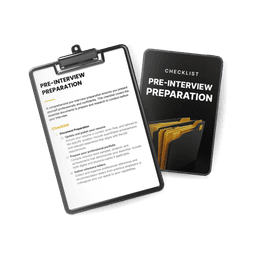
Short on time? Day one: decode the role, do 20 minutes of company research and write 4 stories. Day two: prepare "Tell me about yourself," say your stories out loud twice, write 3 questions and check the logistics. Our free Pre-Interview Preparation checklist puts the documents, research, role preparation and logistics on one page, so you can tick them off.
What to bring to an interview
| In person | Video or phone |
| Several printed copies of your resume | Your resume open in a window, or printed next to you |
| A notebook and pen, with your questions written in it | Notes with your themes and questions, off camera |
| A list of references, if they might ask | A charged laptop or phone, charger plugged in |
| Photo ID and any documents they requested | The meeting link and a phone number in case it fails |
| Interviewer names and the address, saved on your phone | Water, and a quiet room with the door closed |
Plan to arrive 10 to 15 minutes early, as WashU recommends. For a video call, join a few minutes early to check that everything works.
Video, recorded and AI interviews
The format changes the experience, and sometimes the score. In one experiment with 114 participants, people interviewed by videoconference got lower performance ratings than those interviewed face to face, and the gap was linked to weaker social presence and eye contact. Yet another study found that people in one-way recorded interviews, while finding them "creepier and less personal," actually got better ratings than people in videoconferences. The honest summary: format matters, but not always in the same direction.
- Video calls: put the camera at eye level and look into it when you make your main points. Light from the front, not behind you. Keep your notes beside the camera.
- One-way recorded interviews: you answer prompts on a timer with no one listening. Practice by recording yourself answering a question in two minutes, because the timer is what throws people off. Use any practice question the platform offers.
- AI interviews: some employers now use software in early screening. In a 2024 SHRM survey of HR professionals, recruiting was the most common use of AI among organizations already using it in HR. Prepare exactly as you would for a person: clear, specific stories that match the job's themes. Many people are wary of it. In a 2023 Pew survey, 66% of US adults said they would not want to apply for a job with an employer that uses AI to help make hiring decisions.
One more point: using AI to prepare is fine and useful, for example to generate likely questions from the job description. Reading answers from a chatbot during a live interview is a different matter. The pauses and the flat delivery are easy to notice, and it defeats the purpose of the conversation.
How to calm nerves before an interview
Feeling nervous is normal, and it is not a verdict. A meta-analysis of interview anxiety research found a correlation of about −.19 between anxiety and interview performance, which the authors call a medium effect for this field. It matters, but anxious candidates still get hired every day.
What seems to hurt is not the anxiety itself but how it shows. In a study of about 120 students in mock interviews, slow speech was the only cue interviewers correctly linked to anxiety, and the candidates who were rated lower came across as less warm and less assertive. That gives you something concrete to work on:
- Prepare your openings. Know your first sentence for "Tell me about yourself" and for each story, so you start strong instead of searching for words.
- Stay warm. Smile when you greet people, thank them for their time, show interest in their answers. Warmth is easy to forget when you are nervous.
- Call it excitement. In experiments with public speaking and other performance tasks, people who told themselves "I am excited" felt more excited and performed better than people who tried to calm down. The racing heart is the same; the label changes how you use it.
- If you blank, say so. "Let me take a second to think about the best example" is a normal sentence in an interview. Look at your notes and continue.
Our Pre-Interview Confidence Protocol covers the mental and physical preparation for the last 24 hours, including what to do if something goes wrong on the day. If interview anxiety is severe and affects other parts of your life, it is worth talking to a mental health professional.
Interview advice that doesn't hold up
| Popular claim | What the research says |
| "Interviewers decide in the first 7 seconds." | The opening minutes do matter. In one study, better first impressions were linked to more internship offers, and what carried over was how competent candidates seemed early on. A follow-up found that much of that effect overlaps with job-related content and is strongest for the earliest answers. A study of 691 applicants concluded that the belief in quick interviewer decisions may be overstated. We found no hiring study behind the seconds-level figures. |
| "Do a power pose to raise your confidence hormones." | Later studies did not replicate the hormone effect. A 2022 meta-analysis of about 130 experiments found upright poses can make people feel more confident, but the effects on hormones were not supported. Standing tall is fine; just don't expect chemistry. |
| "Memorize perfect answers." | Interviews are conversations with follow-up questions. Prepared stories and talking points adapt; scripts break. |
| "Everyone exaggerates, so you should too." | Candidates do embellish: one set of studies found that over 90% of undergraduate candidates faked to some degree. But later research found honest and deceptive self-presentation are different things with different effects on interview outcomes. Show your real results well; don't invent new ones. |
The morning of the interview
- Eat something and give yourself more time than you think you need.
- Read your themes, your first sentences and your questions once. No new material.
- Say "Tell me about yourself" out loud one last time.
- Arrive or log in early, then put your phone on silent.
- Walk in planning to have a conversation, not to pass an exam.
If you already have a morning routine that works for you, keep it. An interview day is not the day to try something new.
After the interview
Send a short thank-you email the same day. Mention one specific thing from the conversation and repeat, in one sentence, why you fit the role. Then write down the questions you were asked and how you answered. That note is the best preparation material you will ever have for the next round.
Long processes and silence after the final round are a common frustration. If you were given a timeline and it passes, one polite follow-up is reasonable. Keep applying in the meantime: one interview is never a plan.
For the full process, from strategy and storytelling to body language and salary negotiation, our book Interview Success Blueprint goes deeper than a single article can.
Frequently asked questions
How long should I prepare for an interview?
For most interviews, 30 to 60 minutes a day over a week is plenty. If you only have a day or two, focus on the job description, 4 good stories, "Tell me about yourself" and the logistics.
How do I stop my mind from going blank in an interview?
Practice out loud beforehand, so the words already exist. Keep short bullet notes in front of you. If you blank anyway, say you need a moment to choose an example, pause, and look at your notes. Interviewers see this all the time.
Should I memorize my interview answers?
Memorize the first sentence and the key facts of each story, not the whole answer. That way you sound natural and can adapt when the question is worded differently or a follow-up comes.
How many stories do I need?
Six to eight well-chosen stories cover most behavioral interviews, because one story can answer several questions. Make sure they cover the main themes of the job description, plus a mistake and a disagreement.
What questions should I ask at the end of an interview?
Ask about the work and the team: what a typical week looks like, what success in the first months would mean, what the biggest challenge in the role is. Avoid questions the website already answers. Have 5 to 10 ready, because some will come up during the conversation.
How do I prepare for a one-way video interview?
Practice answering questions on a timer while recording yourself, since the countdown is the hard part. Test your setup, look at the camera, and use your story bank exactly as you would with a person.
Is it OK to use ChatGPT to prepare for an interview?
Yes, for preparation: generating likely questions, checking your stories for clarity, or doing a practice run. Don't use it to write answers you read out during the interview. The stories need to be yours, in your words.
How we put this guide together
This guide was written with AI assistance and edited by the AllMyGuides team. None of us is a recruiter or psychologist. We built it from peer-reviewed research on employment interviews, surveys from Pew and SHRM, and the advice of university career centers. We opened each linked source to check that it says what we report, and we noted where the evidence is thin, comes from lab tasks or did not replicate. We also read recent discussions among job seekers to understand where people get stuck. Reviewed in November 2026. This article is general information, not professional career, legal or medical advice.