
A habit is an action you do automatically when you meet a familiar cue, such as brushing your teeth after breakfast, without having to decide each time. So how long does it take to form a habit? There is no magic number. In the best-known study, it took a median of about 66 days for a new daily behavior to become close to automatic, but individual times ranged from 18 to 254 days. A recent review of 20 studies found medians of about two months in the studies that measured timing, with some people taking much longer. The good news: you can make that time easier to get through, and a missed day doesn't reset the clock.
Key takeaways
- It's not 21 days. That number comes from a 1960 book about adjusting to plastic surgery, not from habit research.
- Expect about two months, give or take a lot. Medians in the research sit around 59 to 66 days, and individual times vary from a few days to most of a year.
- Same cue, same place, every day. Habits form through repetition in a consistent context. Tying the new action to something you already do helps.
- Missing one day is fine. In the main study, missing one opportunity did not materially affect the process. What matters is getting back on track.
- Enjoyment helps it stick. Habits you chose yourself and find rewarding tend to grow stronger.
Where "21 days" came from
The 21-day idea traces back to Maxwell Maltz, a plastic surgeon. In his 1960 book Psycho-Cybernetics he wrote that it usually requires "a minimum of about 21 days" to see a change in a person's mental image, for example a patient getting used to a new face after surgery. Over the years, retellings dropped the "minimum" and turned it into "21 days to form a habit".
Habit researchers have pushed back on this. A 2012 article in the British Journal of General Practice says the 21-day myth appears to have originated from anecdotal evidence of plastic surgery patients. Researchers at UCL wrote that while 21 days might apply to adjusting after plastic surgery, it is unfounded as a basis for habit formation. If you gave up because something didn't feel automatic after three weeks, you didn't fail. You were measuring against the wrong number.
What the research actually found
The study most people quote is by Phillippa Lally and colleagues at University College London. In it, 96 volunteers chose an eating, drinking or activity behavior to carry out daily in the same context, for example something done after breakfast. Every day they rated how automatic the behavior felt, for 12 weeks.
The time it took to reach 95% of their own maximum automaticity ranged from 18 to 254 days. A 2024 review reports the median as about 66 days, and the BJGP article describes it as an average of about 66 days. According to the BJGP summary, simple actions like drinking water became automatic faster than more elaborate routines like doing 50 sit-ups. Lally herself has said that what the study really showed is that how long habit formation takes is highly variable.
A 2024 systematic review of 20 studies with 2,601 participants reached a similar picture. The four studies that measured timing found medians of 59 to 66 days and averages of 106 to 154 days, suggesting some people take much longer, with individual times from 4 to 335 days. The authors note that most of the studies had a high risk of bias, so the numbers are estimates, not rules.
| Source | What it found | Keep in mind |
| Lally et al. (UCL) | Median about 66 days; range 18 to 254 days | 96 volunteers, 12 weeks, longer times are model estimates |
| Singh et al. 2024 review | Medians 59 to 66 days; averages 106 to 154 days; range 4 to 335 days | 20 studies, many with a high risk of bias |
| Kaushal and Rhodes 2015 | New gym members needed at least four workouts a week for about six weeks | One observational study of exercise |
| "21 days" | Not a research finding | Comes from a 1960 book about self-image after surgery |
The practical takeaway: plan for roughly two to three months of conscious effort, and expect it to get easier along the way, not suddenly on a specific day.
Why some habits take longer than others
- How complex it is. "Drink a glass of water after breakfast" has one step. "Go to the gym" has many: pack the bag, travel, change, train. More steps, more chances to stop.
- How consistent the cue is. A habit grows when the same cue leads to the same action. "Some time in the evening" isn't a cue; "after I put the kettle on" is.
- How often you repeat it. In a study of 111 new gym members, exercising at least four times a week for six weeks was the minimum needed to establish an exercise habit. Repeating it often, ideally daily, helps; the 2024 review lists frequency among the factors linked to habit strength.
- Whether you enjoy it. In a survey of 192 young adults, past behavior predicted habit strength more strongly in people who were motivated by their own reasons, not by pressure. The 2024 review also points to enjoyment and self-chosen habits as factors linked to stronger habits.
How to build a habit that lasts: 7 steps
1. Choose one habit
Starting five new habits on the same Monday makes it much harder to keep any of them. Pick one, ideally one you actually want, not one you think you should want. When it feels automatic, add the next. Not sure where to start? Our list of good habits includes a two-minute version of each.
2. Anchor it to something you already do
Write the habit as "After I [existing routine], I will [new habit]". For example: "After I pour my morning coffee, I will write my three priorities for the day." This is often called habit stacking. In a small study on flossing, people who flossed after brushing their teeth, rather than before, tended to form stronger flossing habits. The existing routine works as a ready-made cue. Mornings are a natural place for this; our guide to a morning routine shows how to build one around a few anchors.
If you'd like ready-to-use examples, 12 Proven Habit Stacking Formulas for Unstoppable Execution collects formulas you can copy and adapt.
3. Make it tiny
Shrink the habit until it feels almost too easy: one push-up, one page, two minutes of tidying. The goal of the first weeks is to repeat the cue-and-action link every day, not to get results. You can make it bigger once the link holds. On bad days, do the tiny version; on good days, do more if you want.
4. Keep the same time and place
The BJGP article advises choosing a time and place you encounter every day of the week. Context is powerful: in a cinema experiment, people with a strong popcorn habit ate as much stale popcorn as fresh when they were in the cinema, because the setting triggered the behavior almost regardless of how much they liked the food. That same power can work for you when the cue is consistent.
5. Use real-life cues, not just phone reminders
Reminders help you remember, but they can become the cue themselves. In a study of habit apps, relying on reminders supported repetition but hindered habit development, while cues tied to existing events led to more automaticity. Use an alarm for the first days if you need it, but make the real cue an event in your day: waking up, lunch, closing your laptop.
6. Make it pleasant
Pair the habit with something you like, such as a podcast only during your walk or a favorite mug for your writing session. Make it easy to start (shoes by the door, book on the pillow), and notice the small win when you finish. A habit that feels good has a better chance of surviving the two months it may take.
7. Track it, and never miss twice
A simple tick on a calendar or in an app makes repetition visible. But a broken streak is where many people quit, and the research is reassuring: in Lally's study, missing one opportunity did not materially affect the habit formation process. A practical rule many people use is "never miss twice": a missed day is normal, two in a row is the point to act. When you miss, restart at the next normal opportunity with the tiny version, without trying to make up for it.
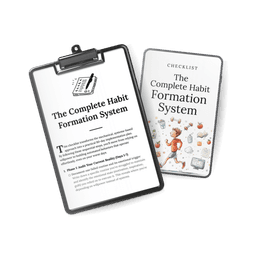
Our free Complete Habit Formation System checklist puts these steps on one page. If you want the full method, Habits Without Willpower explains the cue, routine and reward loop, environment design and the "never miss twice" approach, and Build Your First Habit Molecule shows how to link small connected actions into one routine.
What to expect month by month
| When | What it usually feels like | What to do |
| Weeks 1 to 2 | Motivation is high, but you have to remember and decide every day | Keep it tiny, keep the same cue, track every repetition |
| Weeks 3 to 6 | Novelty fades; many people find this the hardest stretch | Expect the dip, use the tiny version on bad days, never miss twice |
| Weeks 7 to 10 | It starts to happen without much thought on most days | Grow the habit a little if you want, keep the cue unchanged |
| Month 3 and later | It feels strange to skip it | Add the next habit, anchored to this one |
These stages are a rough guide, not a schedule: your habit may move faster or slower depending on how simple it is and how consistent your days are. For a structured month, Build Unbreakable Daily Routines in 30 Days walks you through environment design, stacking, shrinking habits and recovering from missed days, day by day.
If you keep putting off starting at all, our guide on how to stop procrastinating covers how to break big changes down and get going. And if routines are especially hard because of ADHD, our guide on how to be productive with ADHD covers systems built for that.
Frequently asked questions
How long does it take to form a habit?
Research suggests a median of about two months (59 to 66 days in different studies) for a daily behavior to become close to automatic, with big differences between people and habits: from a few days to most of a year.
Is it true that it takes 21 days to form a habit?
No. The 21-day figure comes from a 1960 book by a plastic surgeon about adjusting to changes in self-image. Habit studies have found that people typically need considerably longer.
Does missing a day ruin a habit?
No. In the best-known study, missing one opportunity did not materially affect habit formation. Get back to it at the next normal opportunity and avoid missing twice in a row.
How long does it take to break a bad habit?
We couldn't find a reliable number for breaking a habit; the studies above looked at building new ones. The same principles help: change the cue or the context, make the old behavior harder and replace it with a new action tied to the same cue.
What is habit stacking?
Linking a new habit to one you already have: "After I [current habit], I will [new habit]." The existing routine becomes the cue, which makes the new action easier to remember and repeat.
Should I use a habit tracker?
Tracking helps you see your repetitions, but don't let a broken streak make you quit. Use reminders at the start if you need them, and let a real event in your day become the cue.
How we put this guide together
This guide was written with AI assistance and edited by the AllMyGuides team. None of us is a psychologist or researcher. We started from the questions people ask about building habits and why they give up. Then we checked each claim against peer-reviewed studies, reviews and university sources. We opened every source linked above and confirmed that it says what we report (for some studies only the abstract or later summaries were publicly available, including the 66-day median). Most habit studies are small and many use volunteers or students, so we treat the numbers as estimates. Last checked: November 2026.