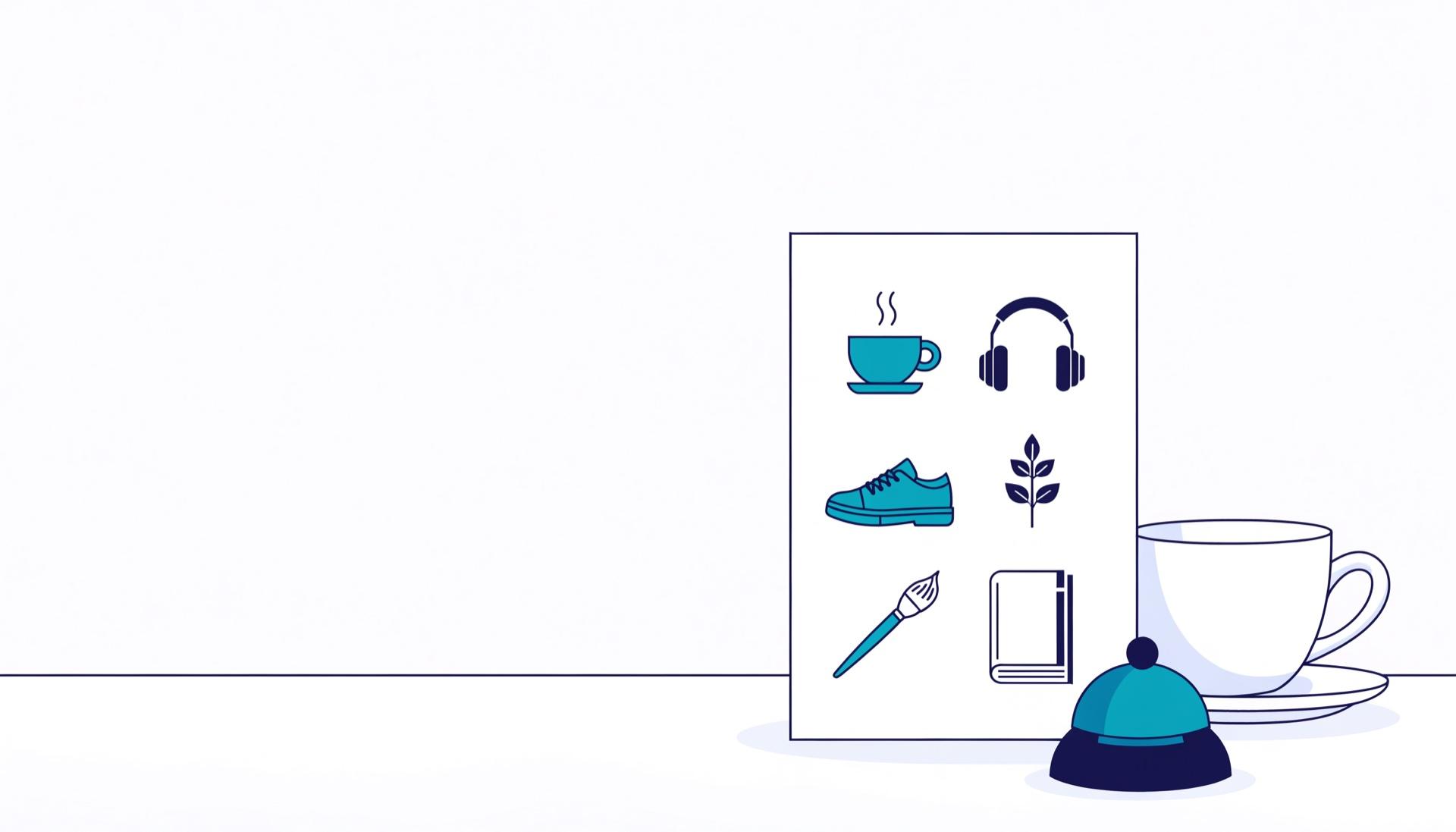
A dopamine menu is a personal list of activities that lift your mood or energy, organized like a restaurant menu so you can pick one quickly when you feel bored, stuck or under-stimulated. Some people call it a "dopamenu." It became popular in the ADHD community as a healthier alternative to reaching for the phone. Despite the name, there is no evidence it measurably "boosts dopamine." It works the way a well-known therapy technique called behavioral activation works: you decide in advance what helps, then make it easy to do.
This guide explains where the idea comes from and what dopamine actually does. Then it walks through the five sections of a menu with examples for work and home, how to build yours in 20 minutes, why "desserts" can take over, and when a menu isn't enough.
Key takeaways
- A dopamine menu is a list of go-to activities sorted into quick starters, longer mains, sides you pair with boring tasks, desserts to keep small, and occasional specials.
- A Mayo Clinic physician calls it a rebranding of behavioral activation, a technique with good research support for depression, though many of the studies are low quality.
- Dopamine is more about wanting and motivation than pleasure. The menu helps because it removes the decision in the moment, not because it changes brain chemistry in a proven way.
- Put the menu where you will see it and choose items in advance. A menu you never look at does nothing.
- Keep scrolling and TV in the dessert section. If nothing on your menu feels good anymore, talk to a doctor or therapist.
Where the dopamine menu comes from
The idea was popularized in a 2020 YouTube video by Jessica McCabe of the How to ADHD channel. ADHD coach Eric Tivers, CNN reports, co-coined the term "dopamenu." The thinking behind it is simple: when your brain craves stimulation, you will grab the easiest thing available, usually your phone. If you have a short list of better options ready, you are more likely to choose one of them.
Mayo Clinic family physician Dr. Robert Wilfahrt puts it plainly: "A dopamine menu is a rebranding of what psychologists or healthcare professionals previously called behavioral activation." He adds that while it is usually aimed at people with ADHD, anyone can benefit.
What dopamine actually does
Dopamine is often called the "pleasure chemical," but that is not quite right. Influential research found that dopamine systems are necessary for "wanting" rewards, but not for "liking" them. A later review of the brain's pleasure systems concluded that the main dopamine pathway "may not generate pleasure after all." Dopamine is closer to a motivation signal. It helps you notice what is worth going after and signals when a reward turns out better or worse than expected.
There is a real link with ADHD. A brain imaging study of 53 unmedicated adults with ADHD found lower levels of certain dopamine markers in the brain's reward pathway than in controls, associated with symptoms of inattention. A review of reward research concluded that ADHD is associated with altered sensitivity to rewards, "despite a number of inconsistent findings." These are associations, not proof that ADHD is simply "low dopamine."
So the honest version: there is no evidence that a dopamine menu tops up a chemical. It helps you act on what you want to do instead of what is easiest, which is exactly what people with reward and motivation difficulties struggle with.
Does a dopamine menu work?
Nobody has run a trial of dopamine menus as such. But the technique they repackage has been studied a lot. Behavioral activation means planning and doing activities that give you a sense of enjoyment or achievement, especially when your mood says "do nothing." A meta-analysis of 26 randomized trials found it clearly better than control conditions for depression, though most trials were of low quality with short follow-up. An earlier meta-analysis found that activity scheduling worked about as well as other psychological treatments.
Two caveats. That research is about depression treatment, usually guided by a therapist, not about ADHD focus or a list on the fridge. And it works by actually planning and doing the activities, not just by having a list. Keep that in mind as you build yours.
The five sections of a dopamine menu
| Section | What it is | Examples |
| Starters | Quick boosts of 1 to 10 minutes that are easy to stop | Make tea, stretch for a minute, step outside, play one favorite song, send a voice note to a friend, water a plant |
| Mains | Longer, more absorbing activities that may need a slot in your calendar | A workout, cooking a real meal, an instrument, a hobby project, a long walk with a podcast |
| Sides | Things you add to a boring task to make it bearable | Music or ambient sound, a fidget toy, chewing gum, a candle, working next to someone (body doubling), a timed challenge |
| Desserts | Easy, tempting, and easy to overdo | Social media, short videos, TV episodes, online shopping, games |
| Specials | Occasional bigger treats to look forward to | A concert, a day trip, a massage, a full day with friends |
The categories are a tool, not rules. The point of sorting is to have something quick, something deep and something to pair with dull work, and to keep the easy-to-overdo items in their own box.
How to make a dopamine menu in 20 minutes
1. Brainstorm without judging
List everything that has ever made you feel more awake, calmer or more like yourself. Include tiny things. Think about your body (movement, temperature, food), your senses (music, smells, textures), people, making things and being outside.
2. Sort into the five sections
Ask two questions of each item: how long does it take, and how hard is it to stop? Short and easy to stop goes in Starters. Long and absorbing goes in Mains. Hard to stop goes in Desserts, whatever its length.
3. Keep it short
Five or six items per section is plenty. A long menu creates the very decision you are trying to avoid.
4. Write a few if-then rules
Turn the menu into decisions made in advance. For example: "If I've been stuck on this report for 20 minutes, then I take a starter." "If I'm about to open social media during work, then I pick a side instead." Plans in this if-then form are well studied: a meta-analysis of 94 tests found they had a medium-to-large effect on reaching goals, partly by helping people get started and resist distractions.
5. Put it where you'll see it
On the fridge, next to your desk, as your phone lock screen. Make starters easy to reach: tea by the kettle, headphones on the desk, shoes by the door. If you would like ready-made prompts for planning, reflecting and getting started, our Productivity with ADHD Prompts pack includes them.
Dopamine menu ideas
At work or while studying
- Starters: refill your water, walk to a window, two minutes of stretching, one song with headphones, a quick message to a friend.
- Sides: instrumental music, a timer race ("how much can I finish in 15 minutes?"), a standing desk, a coworking session online.
- Mains: a lunchtime walk, a short workout, a real lunch away from the screen.
At home
- Starters: a shower, five minutes of tidying with music, playing with a pet, stepping outside barefoot.
- Sides: a podcast while doing dishes, a face mask while folding laundry, calling a friend while cooking.
- Mains: cooking something new, a bike ride, a creative project, a phone-free bath with a book.
On low-energy days
Have a mini-menu of things that take almost no effort: open a window, drink a glass of water, lie on the floor and listen to one song, text one person. On those days, one starter counts as a win.
The dessert problem
A common way a dopamine menu fails is that desserts eat the day. Scrolling is the perfect dessert: zero effort, endless and hard to stop. That is why it gets its own section with a portion size, not a ban.
There is some evidence that portions matter. In a randomized study of 143 US undergraduates, those who limited Facebook, Instagram and Snapchat to 10 minutes each a day (about 30 minutes in total) for three weeks reported significant drops in loneliness and depression compared with those who used it as usual. That is one study in students, but it fits what many people notice: a little is fine, a lot leaves you flatter than before.
Practical fixes: set a timer before you open a dessert, keep dessert apps off your home screen, and save them for after a starter or a main, not instead of one. If your phone is the main problem, our guide on how to break phone addiction goes further.
Why movement and short breaks earn a place on the menu
Two kinds of items have especially good research behind them. Movement: an umbrella review of over 1,000 trials found that physical activity had medium-sized effects on symptoms of depression in adults, with higher intensity linked to bigger improvements. Short breaks: a meta-analysis of micro-breaks found small but statistically significant boosts in vigor and reductions in fatigue, though no clear overall effect on performance. So use starters to feel better and come back to the task, not as a productivity hack.
Why your dopamine menu stopped working
- Novelty wore off. Things that felt fresh in January can feel stale by March. Swap a few items every month or two.
- You stopped seeing it. Move it, redesign it or make it your lock screen again.
- Starters turned into mains. "Just one video" became an hour. Move that item to Desserts and add a timer.
- The menu became a to-do list. It should feel like options, not obligations. Remove anything you dread.
Dopamine menu vs dopamine detox
They sound related but are opposites. A dopamine detox tries to remove stimulation for a period to "reset" your brain, a claim that hasn't been tested in good studies. A dopamine menu adds planned activities to replace the easiest, least satisfying ones. Neither changes your dopamine levels in any proven way; the menu is simply the more practical habit.
Where it fits with ADHD
A dopamine menu is one small tool, not a treatment. It pairs well with other strategies for the same brain. For example, you can make time visible if you struggle with time blindness, and a simple daily system for planning and starting tasks, which our guide on how to be productive with ADHD lays out. Our Productivity with ADHD Bundle brings the guide, workbook, prompts and toolstack together. Our Productivity with ADHD Guide covers time, habits, space and energy step by step, and our free Productivity with ADHD checklist is an easy first step.
When a dopamine menu isn't enough
Sometimes nothing on your menu sounds good. You may have lost interest in things you used to enjoy, or getting through the day takes all your energy. That may be a sign of depression rather than boredom. Talk to a doctor or therapist. Behavioral activation itself is best done with professional support when mood is low. If you are in crisis or thinking about harming yourself, call or text 988 in the US to reach the Suicide and Crisis Lifeline.
Frequently asked questions
What is a dopamine menu?
A personal list of mood- and energy-lifting activities, sorted like a restaurant menu (starters, mains, sides, desserts, specials) so you can choose quickly instead of defaulting to your phone.
Who came up with the dopamine menu?
It was popularized in a 2020 video by Jessica McCabe of How to ADHD, and ADHD coach Eric Tivers co-coined the name "dopamenu." The underlying idea, planning rewarding activities in advance, comes from behavioral activation therapy.
Does a dopamine menu really increase dopamine?
There is no evidence that it measurably changes dopamine levels. It helps by making better choices easy and pre-decided, which is how behavioral activation works.
Is a dopamine menu only for ADHD?
No. It is popular in the ADHD community, but anyone who drifts to their phone when bored or tired can use one.
Can social media be on my dopamine menu?
Yes, in the dessert section, with a portion size. Set a timer before you open it and don't let it replace starters and mains.
How many items should a dopamine menu have?
Around five or six per section. Fewer is fine. A long menu brings back the decision you were trying to avoid.
How often should I update it?
Whenever items stop working, and at least every couple of months. Some people keep separate menus for work and home, or for summer and winter.
How we put this guide together
This guide was written with AI assistance and edited by the AllMyGuides team. None of us is a doctor or therapist. We built it from research on dopamine and reward, meta-analyses of behavioral activation, implementation intentions, micro-breaks and physical activity, a randomized study on social media use, and expert comment from Mayo Clinic. We opened each linked source to check that it says what we report, and we were clear where the evidence is about related techniques rather than dopamine menus themselves. We also read what people with ADHD share about building and using their menus. Reviewed in November 2026. This article is general information, not medical advice.